


 Shkruar nga Pamfleti
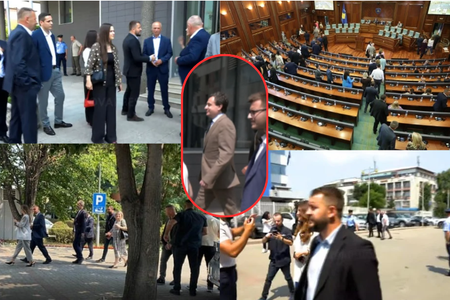
Without doing any work, the elected members of the Kosovo Assembly and their assistants are costing the state budget hundreds of thousands of euros. Forty-three attempts to constitute the Assembly have already failed. For some new members of parliament, this situation is far from their expectations.
For Nezir Kraki, the blocking of the constitution of the Assembly is making his work and commitment as a legislator difficult.
He was first elected in the February 9 elections as an MP for the Guxo party - part of the coalition with the Vetëvendosje Movement and the Alternative, which won the majority of votes.
He says he received his mandate as a member of the Kosovo Assembly to contribute to political and parliamentary life as a legislator, “and not in vain.” Kraki and the other elected members of parliament - 120 in total - receive salaries as if the Assembly were functional.
Since April 15, when the constitutive session began, they have received two and a half salaries, although most of the 43 extensions have lasted only a few minutes, due to disagreements over the election of the speaker and the voting method.
So far, 103 MPs have received two and a half salaries, while 17 others, who have the mandate of MPs but continue to hold positions in the acting Government of Kosovo, have been paid by the executive.
The total cost for MPs' salaries, from April 15 to June 30, reached 478,692 euros.
In addition to their salaries, the state budget also covers the salaries of MPs' senior personal officials, otherwise known as assistants.
Radio Free Europe asked the Kosovo Assembly how many assistants are currently engaged and what their salaries are, but as of the end of last week, it has not received a response.
In June, media in Kosovo reported that elected MPs had hired 74 personal assistants so far.
One of them, MP Time Kadrijaj from the Alliance for the Future of Kosovo, tells Radio Free Europe that this commitment was made in accordance with the Rules of Procedure of the Assembly and the Law on the Rights and Responsibilities of MPs.
According to her, the assistants were appointed with the expectation that the Assembly would be constituted quickly and that they would immediately begin their parliamentary work.
"Did you expect, for example, that the constitution of the Assembly would take six months? No one expected it. Thinking that as the largest party, (the Self-Determination Movement) would constitute the Assembly very quickly, we have adhered to the Assembly's regulations. Now we cannot tell (the assistants) to go home that the Assembly has not been constituted. We cannot violate either the regulations or the law," says Kadrijaj.
Asked what her assistant's role is in this situation, Kadrijaj responds:
"During debates on television, I need, for example: statistics, data, materials on corruption cases... they help me. I tell them: I need this or that, and they help me."
Kadrijaj says she doesn't know how much her assistant's salary is.
However, according to the Regulation on Supplements to the Basic Salary for Deputies and on the Classification of Salary for Political Support Staff of the Assembly of the Republic of Kosovo, the deputy's assistant has a basic salary with a coefficient of 5.8 and benefits from an additional 30% of this salary.
This means that an assistant, for example, in June received a basic salary of 638 euros, while with the allowances provided for in the regulations, this amount has increased to around 900 euros.
MP Kraki says that he and his colleagues have a legal right to their salary, but emphasizes that it does not make him feel good until he performs his duties properly.
"It is an expenditure of both physical energy on our part, but also financially on the part of the Parliament, for nothing," he tells Radio Free Europe.
Without giving many details, Kraki says that he has made efforts to convince his colleagues to find a solution and overcome the blockade that is preventing the constitution of the Assembly, but without success.
Like Kraki, Kosovare Murseli was first elected as an MP in the February 9 elections, but she comes from the other camp - the Democratic Party of Kosovo, which is currently in opposition.
She tells Radio Free Europe that the inability to exercise the role of MP effectively has caused her a deep sense of disappointment.
It also indicates that for the period April 15 - June 30, she received two and a half salaries as an MP.
"Under normal conditions, the salary of an MP, I say this with the utmost sincerity, is a responsibility and not a privilege - for me personally. However, in these circumstances, when the Assembly has not been constituted and we are not being allowed to exercise the mandate given to us by the people, this salary is undeserved. I, personally, do not feel good," says Murseli.
Blendi Hasaj, executive director of the GAP Institute for Advanced Research in Pristina, says that MPs' salaries cannot be legally contested.
However, he estimates that their cost is high and morally unjustifiable, as the deputies have not made serious efforts to overcome the blockade in the constitution of the Assembly.
"... especially when some of them have not hesitated to hire assistants, who do not perform any function or help them at the moment, considering that the Assembly itself is blocked and is not proceeding with the reading or preparation for the treatment of any new draft law," Hasaj tells Radio Free Europe.
And, the cost of monthly expenses for the salaries of MPs and assistants is expected to be even higher from July.
This is because the Government of Kosovo, in November last year, decided that salaries in the public sector would increase by 55 euros from January 2025 and by another 55 euros from July.
"Although they are not performing any work - I can't say function - in the Assembly, they now also receive a salary increase. The salary increase in the economy should reflect the increase in productivity, but in this case it is not related...", says Hasaj.
Citizens also contribute to the state budget, from which MPs and their assistants are paid, by paying taxes.
In several surveys conducted by Radio Free Europe, citizens have said that they want solutions through political dialogue.
On July 7, the 43rd unsuccessful attempt by elected deputies to constitute the Assembly was recorded.
As in the past, opposition parties - including PDK, LDK, AAK, Nisma and Srpska Lista - refused to propose members for the commission that would organize the secret ballot for the speaker of parliament, considering this process incompatible with the Constitution.
In an open vote, they repeatedly opposed the appointment of Albulena Haxhiu from the Vetëvendosje Movement to this position.
Vetëvendosje, which won the majority of votes in February's parliamentary elections, insists that secret balloting is legitimate and wants to move forward.
Otherwise, as of June 26, a decision of the Constitutional Court obliges MPs to constitute the Assembly within 30 days, but, so far, there does not seem to be political will to implement it./ REL


Lini një Përgjigje