


 Shkruar nga Pamfleti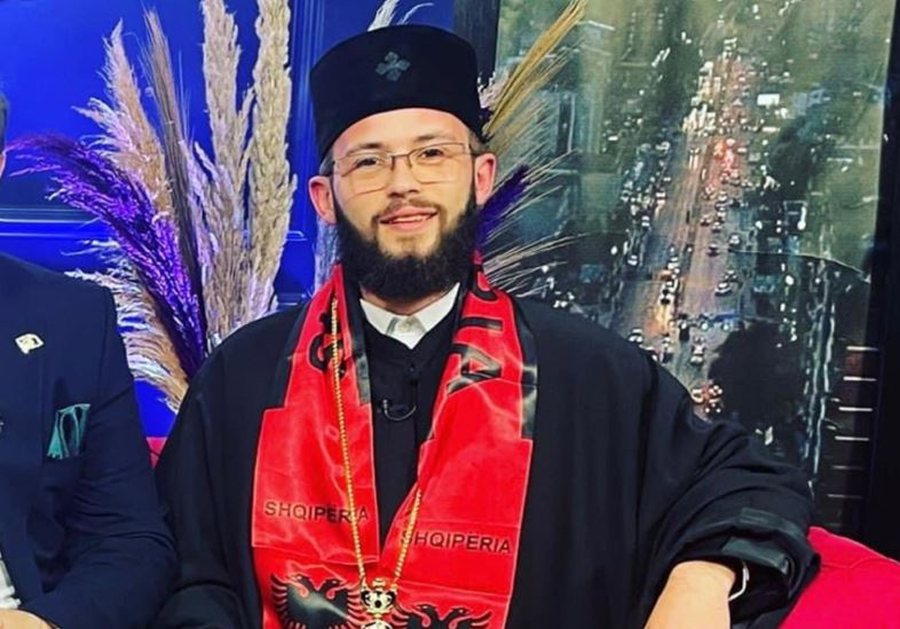
Niko Blazhde, known to the public as Nikolla Xhufka, and his associate, Lejdi Zagalli, will appear again before the Basic Court in Pristina to face charges of inciting discord. Xhufka, who presents himself as the Archbishop of Kosovo, in 2023 entered the Orthodox Church in Rakinica, Podujevo, declaring it an Albanian Orthodox church. The prosecution recognizes this object as property of the Serbian Orthodox Church
The Pristina High Court previously ruled that there is no evidence that they forcibly entered the church building in the Municipality of Podujeva, but the Appeals Court found that the evidence should be administered at trial.
" Therefore, only after administering this evidence can it be assessed whether the defendants, with their actions described in the indictment, had the intention of committing a criminal offense and whether their actions were directed against a social group on a national and ethnic basis, which could potentially have led to the disruption of public order ," the Appeals Court ruling states.
The panel of judges headed by Mentor Bajraktari found that there is a well-founded suspicion and that the actions of the accused cannot be defended in the name of freedom of expression.
" Finally, this criminal offense, which falls within the scope of hate crimes, is defined as a criminal act motivated by prejudice or prejudice against specific groups of people that in itself includes two elements: a behavior that qualifies as a criminal offense (Article 141 of the Criminal Code) and a prejudice motivation. Consequently, this offense is understood to occur when an author has intentionally targeted an individual or property associated with - or even perceived to be a member of - a group that shares a protected characteristic, which may be sexual orientation, ethnic, religious, etc., and that in this specific case we consider these elements to be met ," the ruling reads.
The second instance also found that it is not necessary to disrupt public order for incitement to be committed.
" From the analysis of the legal norm of Article 141 of the CPC, we can conclude that in order to commit the aforementioned criminal offense, it is not required that all elements of this criminal offense be fulfilled cumulatively, as the court concluded in this case. Clearly, the legal norm emphasizes that the aforementioned criminal offense is consumed in all cases when 'anyone who publicly incites or spreads hatred... between national, racial, ethnic, religious groups, in a manner that disrupts public order. Therefore, it is not necessary for public order to be disrupted by the action of the perpetrator of this criminal offense. Moreover, in such cases, it must be borne in mind that from such actions of the perpetrators of this criminal offense we do not have consequences, because in cases where we have disruption of public order with the aim of inciting hatred, then the consequences are unprecedented , "the decision of the Court of Appeal states.
The Special Prosecution alleges that in November 2023, through a video posted on Facebook, Xhufka incited hatred and division between religious, national and ethnic groups living in Kosovo. In that video, according to the indictment, he told Serbian Patriarch Porfirije: “ Do not dare to approach Albanian Orthodoxy and the 'Fan Noli' Orthodox Church in Rakinica, Podujeva, because hellfire awaits you. You are a violent church and an illegal church, you are a church cursed by the true Albanian National Orthodox Church ”/ Koha.net





Lini një Përgjigje