


 Shkruar nga Pamfleti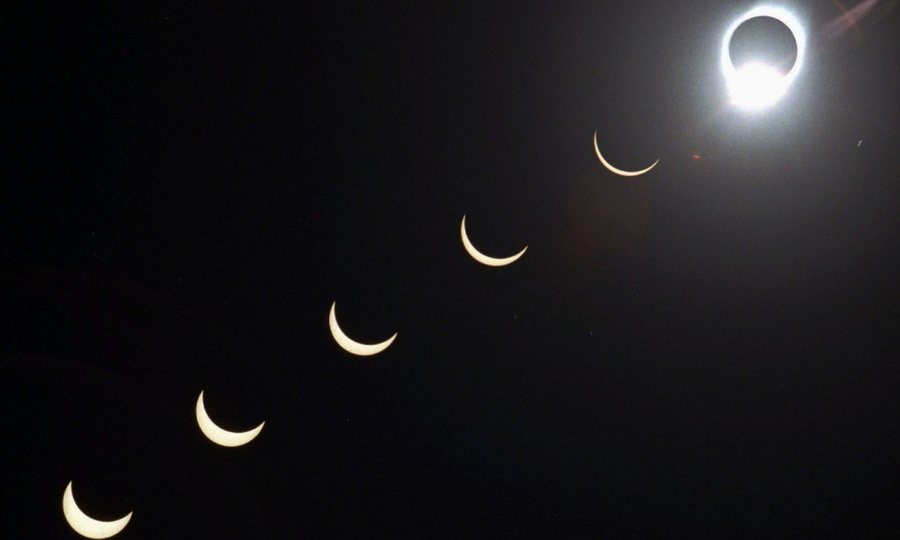
A new solar eclipse has already been marked on astronomers' calendars.
Although it is two years away from its realization, the event has already mobilized the creation of travel plans and has aroused great interest. It is an extraordinary event, the formation of which will not be repeated for many generations, which explains the anticipation and attention it arouses on a global scale.
NASA has confirmed that a total solar eclipse of unusual duration will occur on August 2, 2027. The totality phase will last for more than six minutes, a duration that makes it the longest eclipse of the 21st century and one of the longest astronomical events recorded in modern times.
Astronomical calculations show that this phenomenon is rare. The space agency explained that the predicted duration will not be repeated for several decades and that it was only surpassed by the total eclipse that occurred in 1991.
The uniqueness of the 2027 eclipse is explained by the coincidence of important astronomical factors:
-The Earth will be near its farthest point from the Sun (aphelion), which will make the solar disk appear slightly smaller.
-The Moon will be near its point of greatest proximity to Earth, increasing its apparent size.
-The path of the lunar shadow will pass through areas near the equator, increasing the time of total darkness.
The eclipse will be visible across large areas of the planet. The Moon's shadow will begin its path over the Atlantic Ocean and progress towards Europe, North Africa, the Middle East and Asia.
Countries and regions within the total eclipse zone include Spain, Morocco, Algeria, Tunisia, Libya, Egypt, Sudan, Saudi Arabia, Yemen and Somalia. In total, the shadow will travel more than 15,000 kilometers above the Earth's surface.
One of the most important points for observing the historic event will be Luxor in Egypt, where one of the longest total eclipses and favorable weather conditions for observing it are expected.








Lini një Përgjigje