


 Shkruar nga Pamfleti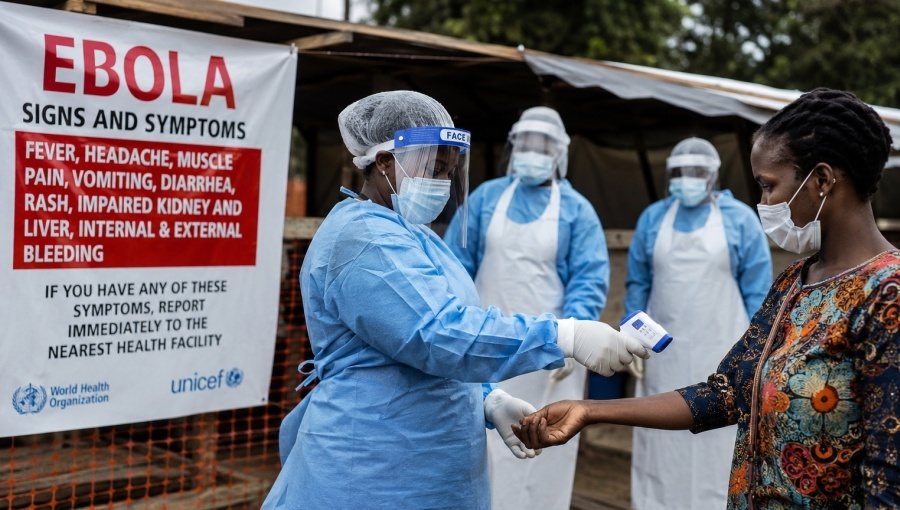
Ebola outbreak threatens African economies and preparations for the 2026 World Cup. WHO warns of rapid spread in DR Congo and Uganda, as sports and health authorities step up measures ahead of international tournaments…
Health authorities in central and eastern Africa are struggling to contain a widening outbreak of the Ebola virus, centered in the Democratic Republic of Congo (DR Congo) and Uganda. The World Health Organization (WHO) warned that insecurity, weak health systems and the lack of an approved vaccine for the current strain are making it difficult to control the situation.
The outbreak is linked to the rare Bundibugyo variant of the Ebola virus, for which there is currently no approved vaccine or specific treatment. The WHO declared the situation a “Public Health Emergency of International Concern” on May 17, the highest level of global alert.
According to the WHO and the US Centers for Disease Control and Prevention (CDC), the first cases were confirmed in Ituri province in northeastern DR Congo, near the borders with Uganda and South Sudan. Uganda subsequently reported imported cases linked to cross-border transmission.
WHO Director-General Tedros Adhanom Ghebreyesus said he was concerned about the “speed and scale” of the spread as the number of cases continued to rise. Health agencies are reporting hundreds of suspected cases and more than 100 possible deaths in affected areas, although the numbers remain volatile due to expanded testing and epidemiological surveillance.
African football and the World Cup under pressure
The outbreak could also affect the African sporting calendar, including qualifying matches for the 2026 World Cup. In previous outbreaks, Confederation of African Football (CAF) tournaments and FIFA qualifiers were postponed, moved or held without fans.
DR Congo has cancelled a planned training camp in Kinshasa and moved preparations to Belgium. FIFA said it was monitoring the situation in coordination with the Congolese football federation.
US authorities have imposed strict protocols on the Congolese delegation ahead of the World Cup, which kicks off on June 11 in the US, Canada and Mexico. Andrew Giuliani, executive director of the White House World Cup Task Force, told ESPN that the delegation must observe a controlled isolation period of 21 days to maintain their right to travel to the US.
Health authorities in the World Cup host cities are also preparing additional monitoring measures. Toronto's chief health officer, Michelle Murti, said that expanded epidemiological checks will be carried out during the tournament.
Public health experts say the current situation brings back memories of the devastating 2014-2016 epidemic in West Africa, which killed more than 11,000 people. However, the WHO and Africa CDC emphasize that the current outbreak does not meet the criteria for a global pandemic and that the international risk remains low for now.
Conflict and mistrust hinder control
The outbreak is unfolding in difficult conditions in eastern DR Congo, where armed conflict, population displacement and attacks on health facilities are hampering the authorities' response. The Associated Press reported that angry residents attacked a hospital treating Ebola patients, while several treatment centers have been attacked in recent days amid growing distrust of health institutions.
The WHO warned that the more the virus spreads, the harder it will be to control. The Africa CDC called for stronger regional coordination and stricter border monitoring.
Health officials said vaccine candidates are still in development and may not be ready for use for six to nine months. Meanwhile, neighboring countries have increased health checks at borders and airports, while the U.S. CDC has imposed additional monitoring measures for travelers from affected areas.
Economic risks for the region
Economists warn that the further spread of the virus could have serious economic consequences for the region. Previous Ebola outbreaks in West and Central Africa have hit trade, tourism, mining and cross-border transport. The World Bank estimated that the 2014–2016 outbreak cost Guinea, Liberia and Sierra Leone more than $2.8 billion in economic losses.
Tour operators and airlines in East and Central Africa are carefully monitoring developments, amid fears that international travelers may avoid the region if the crisis escalates.








Lini një Përgjigje