


 Shkruar nga Pamfleti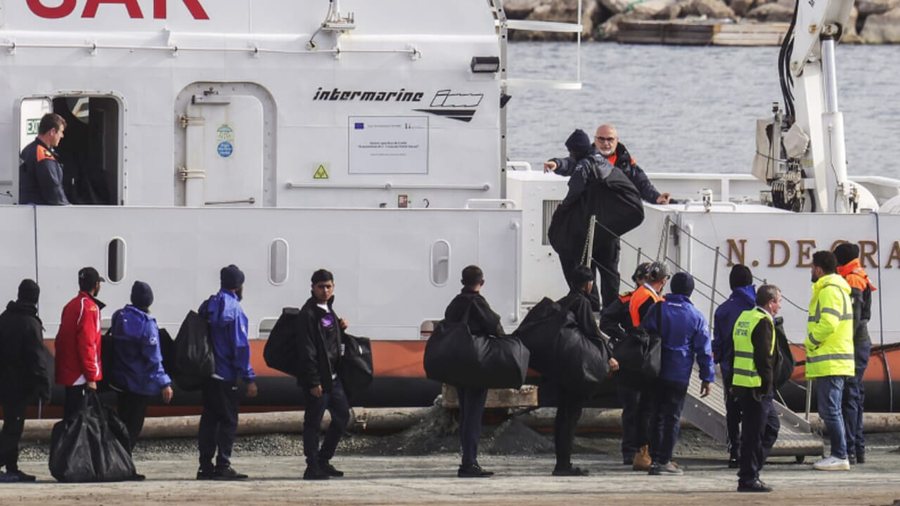
The European Commission wants to change the rules, completely eliminating the requirement for a proven link between the deported migrant and the country to which he or she is being sent...
The European Union is determined to tighten asylum rules, making it easier for member states to send asylum seekers to third countries. This shifts the burden of waiting and reduces the possibility of appealing against a deportation order.
The Commission has presented its proposal to amend the rules on the implementation of the 'safe third country' concept, with the stated aim of speeding up asylum procedures and reducing pressure on national systems.
The concept of a safe third country allows Member States to consider an application for protection inadmissible when applicants can obtain it in another country considered safe for them.
For Italy, this is excellent news, because such a reform would open the doors to systems like the one that Prime Minister Giorgia Meloni would like to implement, which has opened reception centers in Albania that would house migrants rescued at sea.
Changes
When a country is declared safe, it means that asylum applications for migrants from that nation can be easily rejected, as there is no need for protection for its citizens. But a safe third country is also a country to which a migrant can be sent, even if he or she is not originally from there, after having entered European territory irregularly, thus delegating the task of managing a possible request for protection to its government. However, under current EU law, it is necessary to demonstrate a concrete link between the applicant and that country.
With the Commission's proposal, which will now have to be approved by the European Parliament and the Council, this requirement will no longer be mandatory: Member States will be able to apply the concept even in the absence of a link, provided that there are agreements or understandings with the State in question that guarantee the examination of the request and, if justified, the granting of protection.
Currently, Albania has an agreement with Italy, but on the other hand there is also interest from Germany. This is at least according to the German media, where Chancellor Merz during the meeting with Giorgia Meloni in Rome, also discussed the model applied in Albania with the opening of two reception centers for immigrants. Although Edi Rama, the Prime Minister of Albania, publicly rejected the request of the United Kingdom, making it clear to his British counterpart Starmer that Italy is a special case, it is not known what position he may take towards a request that may come from Germany, one of the leading countries of the EU. And he may also face a request from France, referring to the almost friendly relations that Rama has with President Macron.
Given that Edi Rama used the country's EU membership card by 2030 to secure a fourth term in office, it is not surprising that he is facing demands from at least two member states to open camps to accommodate deported migrants in exchange for support for achieving membership.
The Commission argues that the concept should now also be applied to countries through which migrants have simply passed, opening the door to North African countries such as Egypt, Algeria and Tunisia, but also to countries with which bilateral agreements have been signed, such as Albania or even potentially Rwanda, with which the United Kingdom, for example, had a pact to welcome its refugees.
Not only that, Member States will be able to choose to apply the concept of safe third country in the presence of a connection defined by national law, thus having almost a kind of complete freedom.
No appeal
In addition, the Commission proposes that appeals against decisions on the inadmissibility of an asylum application, based on the concept of a safe third country, no longer have the effect of automatically suspending a possible procedure for sending a migrant to that country, but instead require a final decision. However, the only ones excluded from this new definition will be unaccompanied minors, who will continue to have to be welcomed on European soil.
Safe place
A third country can only be considered safe if it meets a number of conditions, such as protection from deportation, the absence of a real risk of serious harm and threats to life and freedom on grounds of race, religion, nationality, membership of a particular social group or political opinion, and the possibility of seeking and receiving effective protection.
The Commission has currently drawn up a first EU list of safe countries, which includes Kosovo, Bangladesh, Colombia, Egypt, India, Morocco and Tunisia. However, member states have their own national lists and, for example, the Italian one has 19 countries: Albania, Algeria, Bangladesh, Bosnia and Herzegovina, Cape Verde, Ivory Coast, Egypt, Gambia, Georgia, Ghana, Kosovo, North Macedonia, Morocco, Montenegro, Peru, Senegal, Serbia, Sri Lanka and Tunisia.
Why is Italy happy?
The Commission's proposal demonstrates "the validity and effectiveness of the approach adopted by the Meloni government", said the Italian Minister for European Affairs, Tommaso Foti, according to whom "of particular importance is the provision according to which complaints against transfers to safe third countries will no longer lead to the automatic suspension of the procedure, thus avoiding abuses and delays".
For the European People's Party, the Commission's proposal "sends the right message."
Now “the establishment of common criteria for identifying safe third countries is the missing piece in the Common European Asylum System and a crucial step towards creating an efficient, manageable and fair system,” said EPP spokesperson for home affairs, Lena Dupont, in a statement. / Adapt Pamphlet /







Lini një Përgjigje