


 Shkruar nga Pamfleti
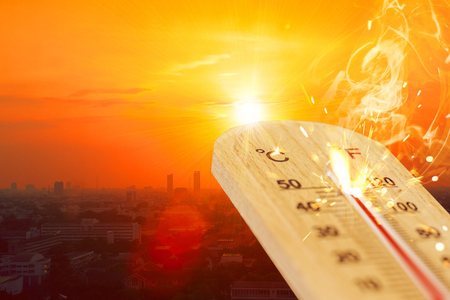
A massive African heat wave has swept across the European continent in recent days, being described by international meteorological agencies as a "heat dome".
According to IGJEUM forecasts reported by weather forecaster Anira Gjoni, the countries most affected by this extreme situation are Spain, Britain and especially France, which is facing the strongest blow and is setting historical temperature records for the month of June. The hot system is expected to gradually move towards Central Europe and Germany.
Fortunately, Albania is on the outskirts of this scorching wave. However, the country is recording thermal anomalies, with maximum temperatures reaching up to 36 degrees Celsius, about 3 to 6 degrees higher than the multi-year average for this period. Even the nights are being characterized as "tropical", with minimum values remaining at 21 degrees, similar to those usually recorded in July. Although light and isolated rainfall is expected in hilly and mountainous areas during the afternoons, they will not bring any cooling of the weather.
This unusual meteorological situation, which has also brought significant amounts of Saharan dust into the air, is the result of a dangerous combination. Climate change is intensifying these phenomena, while the natural phenomenon 'El Nino', which has begun its activity in the Pacific, is affecting the increase in average global temperatures.
While this summer is expected to be as hot as last year, experts at the Institute of Geosciences have raised the alarm for the near future. Based on long-term forecasts and the continued increase in El Nino activity, the year 2027 is expected to break every previous record, ranking as the hottest summer on record.
Anira Gjoni: Europe has been engulfed this week by a heat wave. International agencies have called it a heat dome and our region is fortunately located on the outskirts of this heat wave. It is similar to the one we faced in May and was the first so intense for this year as far as our continent is concerned. The most affected countries are Spain, France, Britain and then it will go towards Germany, so it will also enter Central Europe. As for our region, the maximum temperatures in our country are expected to go up to 36 degrees. Maximum, the maximum air temperatures, while the minimum or night temperatures, are expected to peak during the mornings. Today's morning, tomorrow and Thursday morning are expected to see temperatures reach up to 21 degrees. So, they are otherwise called July temperatures or tropical nights that we are used to experiencing mainly during the month of July.
While the maximums go up to 36. We don't have it, we don't get close to the value of 40. These are for Western Europe. France is the one that receives the greatest striking force of this heat wave, where temperatures also set records for the month in which we are. Meanwhile, for our country, temperatures go up to 36 degrees. Of course, this week's temperatures are higher than the multi-year averages, for our country too they are 3 to 6 degrees higher in different climatic zones as far as our country is concerned. But during the afternoons we will have the presence as well as during Monday, but today and tomorrow, Tuesday and Wednesday afternoon, bring isolated light precipitation, they will be very local, mainly in the hilly-mountainous areas of our country and will not bring a cooling of the weather, of the weather, therefore, the presence of these precipitations. On the contrary, temperatures will continue to remain high.
How does June end and how does July begin?
The month of June ends with this heat wave that has affected the continent. Heat waves of African origin, such as the one we are experiencing this week, are known for this period of the year, since in the summer season we are used to having the presence of heat waves that originate from northern Africa. They bring high temperatures, drought, as well as the presence of Saharan dust particles in the air. But this time it had a higher striking intensity. This is due to the combination of the consequences of climate change that bring about an increase in temperatures and the intensification of these phenomena, also combined with the El Nino effect, which has begun its activity on the Pacific coast and indirectly affects by increasing, giving added value to the air temperature, of the global average and thus affects every country.
This summer is expected to be hot, it will be similar to the year we left behind. It is expected that 2027 will have, will be a hotter year than this one, than 2026, as the effect of El Nino itself will increase its activity and it is therefore expected that... summer, but these are of course long-term forecasts and it is expected that 2027 will be the hottest year.







Lini një Përgjigje