


 Shkruar nga Pamfleti
There is a means to measure and evaluate the level of happiness and well-being of an individual, a group or a society as a whole.
This index aims to determine how happy a population is by taking into account various factors that can affect the feeling of happiness, such as income, health, education, work, social connections, security, freedom, etc.
While there are many variations of the happiness index, the Gross National Happiness Index first developed in Bhutan is often used.
To estimate the happiness index, surveys, polls or other sources of information are conducted to obtain the impression of individuals, in different age groups. This data is analyzed and evaluated to calculate the happiness index.
The happiness index is not a perfect tool, and critics argue that perceptions of happiness vary from culture to culture and from individual to individual.
However, the use of the happiness index can offer a more complete view of well-being and social progress, not only on economic factors.
According to recent reports, some of the countries that have a high happiness index are:
Finland: Finland has often been ranked as the happiest country in the world.
This country's policies for social welfare, good education, public health and environmental protection are some of the factors that have contributed to the high happiness index.
Iceland: Iceland is another country that often tops the happiness index. Good access to health, safety, education, beautiful nature, a calm climate make Iceland a favorite place and happier people.
Denmark: Denmark is a country with well-known traditions of social welfare and government support for its citizens. The health system, higher education, good infrastructure and high level of social trust are some of the factors that contribute to the high happiness index in Denmark.
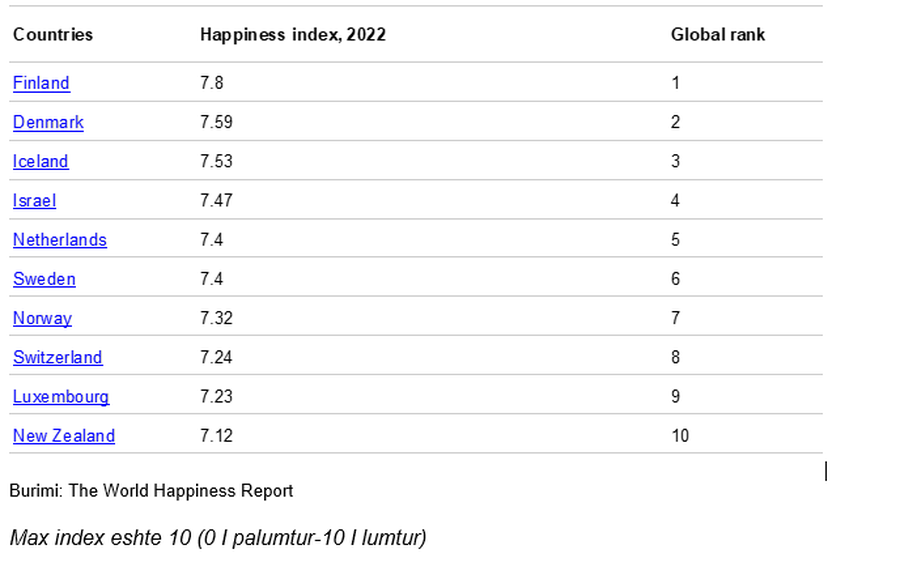
The top 10 countries with the highest happiness index are:
What about Albania?
Out of 134 countries for which the happiness index was measured, the average was 5.54 points.
Albania is ranked 81st in this list with 5.28, so it is below average and in the group or near countries such as: Tajikistan, Indonesia, Republic of Congo, Somalia, etc.
There is a lot to do in terms of income, education, health, services, etc.. We are close to countries with indicators: unhappy!








Lini një Përgjigje