


 Shkruar nga Pamfleti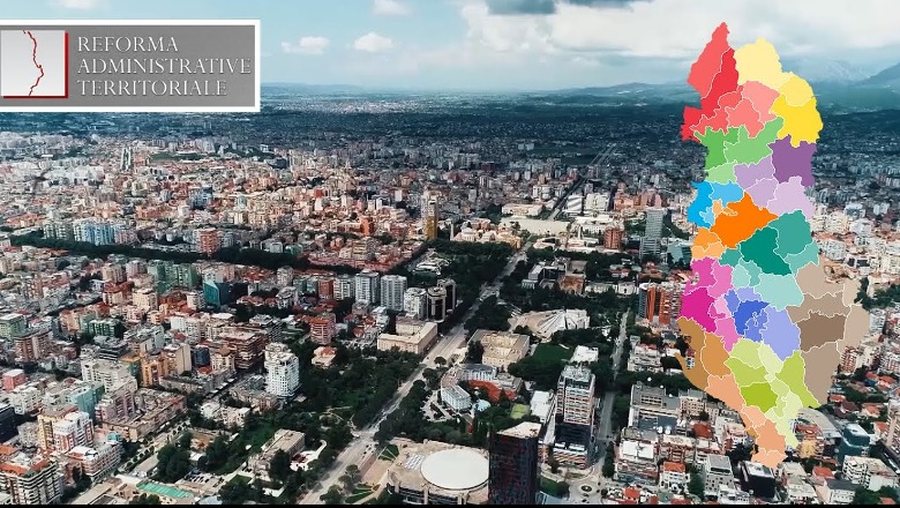
From 373 local government units, 65 municipalities and 308 communes, the number shrank to just 61 municipalities and 12 regions.
Villages and provinces, prefectures and sub-prefectures before World War II, districts, cities, localities during communism or administrative units, municipalities and regions in three and a half decades of transition... the administrative and territorial division of Albania has undergone continuous changes throughout its existence, both in terms of geographical extension and the functions of the structures.
The last one was at the end of July 2014. The newly elected Socialists undertook the Administrative-Territorial Reform which was approved with 88 votes in favor, 1 against and 1 abstention, without the presence of the Democratic Party. From 373 local government units, 65 municipalities and 308 communes, the number shrank to only 61 municipalities and 12 regions.
The administrative-territorial organization of the country is directly related to both the quality of governance and the electoral system. Until 2014, a citizen could go to the communes to receive administrative or social services, as well as to submit requests or complaints. But the uneven and unfair distribution, the lack of respect for participatory budgeting and bureaucracy often prevented the receipt of these services. Due to the law by which the former communes and municipalities operated, the latter offered similar services.
The reform brought services such as pre-university education, fire protection, social services, forest management, roads, irrigation and drainage, and multi-sports clubs under the administration of municipalities. Rural and agricultural services also became part of municipalities. The administrative-territorial division aimed, among other things, to increase the quality and efficiency of services and reduce costs.
With the aim of improving services to citizens, reducing the number of employees and consequently saving public funds, the government undertook the administrative-territorial reform in 2014, which significantly reduced the number of local units from 373 to 61 municipalities.
At the time, officials from the governing majority presented the reform as a historic step, promising hundreds of millions of euros in savings that would be used to modernize services and improve the quality of life for citizens. A decade later, the balance remains debatable. On the one hand, municipalities have a more consolidated structure and more powers, but on the other hand, economic and managerial challenges remain great.
The analysis shows that, although the number of employees has been reduced in some areas, wage costs have not decreased in the expected way, raising questions about the efficiency of the reform.
In many municipalities, accumulated debts have increased significantly, putting the financial sustainability of local units at risk. Water supply continues to be problematic, especially in rural municipalities, where a part of the population still does not have regular access to drinking water. Meanwhile, waste management is another open wound: lack of investment and weaknesses in organization have led to high costs and little efficiency, with many areas still facing serious environmental problems. In this context, the question arises: has the reform managed to meet the expectations of 2014, or has it remained a half-realized project?
Responding to A2 CNN's interest, the European Commission provided this response on the progress of the administrative-territorial reform in over a decade of implementation.
Local units continue to face a lack of sustainable financial resources and limited administrative capacities, which endangers their fiscal autonomy. As a result, the provision of quality public services at the local level remains limited. Another problem is the large salary gap between central and local administration employees, but also between large and small municipalities. Improving efficiency, transparency and accountability in human resource management is essential, as is the implementation of local integrity plans in all municipalities.
The European Commission
The path it has been on since 2015 hardly leads to the European Union.
Positively, municipal council committees on European integration have been established in 43 out of 61 municipalities, but coordinated efforts are needed to raise awareness of the role of local government in the EU integration process and to build administrative capacities that would enable municipalities to benefit from EU funds.
European Commission
Earlier, in 2022, at the request of the opposition, with claims that the reform carried out in 2014 unilaterally by the socialists and some small parties had not functioned properly in relation to the decentralization of services or the management of funds, a special bipartisan commission was established. The parliamentary group of the Democratic Party, which was then led by Enkelejd Alibeaj, demanded an administrative redistribution with 92 municipalities and the merger of 12 counties into 6 regions.
The proposal was rejected by the Socialists in Parliament. The latter are in favor of reducing the number of local government units. The review of the administrative-territorial reform was sealed by Prime Minister Edi Rama during the presentation of the new government cabinet. Arbjan Mazniku, who held the position of Minister of State for Local Government, will head the commission for the review of the reform.
This is in the hope that this time a solution will be found to curb the abandonment of the village, to increase the financial autonomy of the local government, and to give citizens what they have long been promised: an administration that works for them and not for itself.
In 2014, when the administrative-territorial reform was drafted, it was based on data from the 2011 census, when Albania had more inhabitants and villages were still alive.
But ten years later, the reality has changed. The 2023 census shows a smaller Albania, with thousands of families having abandoned the villages for the cities or emigrating, leaving behind empty streets and closed houses. In many areas, municipalities have been left without people to serve, but not without debts and challenges. This change raises a big question: does the map with 61 municipalities still make sense, or should local units be reorganized according to the new demographic reality?
More than a decade ago, administrative reform was drawn as a great promise, a new map that would bring development and modern services to every corner of the country. But today, this map is far from what was promised. The review of the reform is not just a technical process to regulate municipalities and competencies. It is a national challenge, to decide whether local government will become closer to citizens, or will remain a structure that exists only on paper./ a2





Lini një Përgjigje