


 Shkruar nga Pamfleti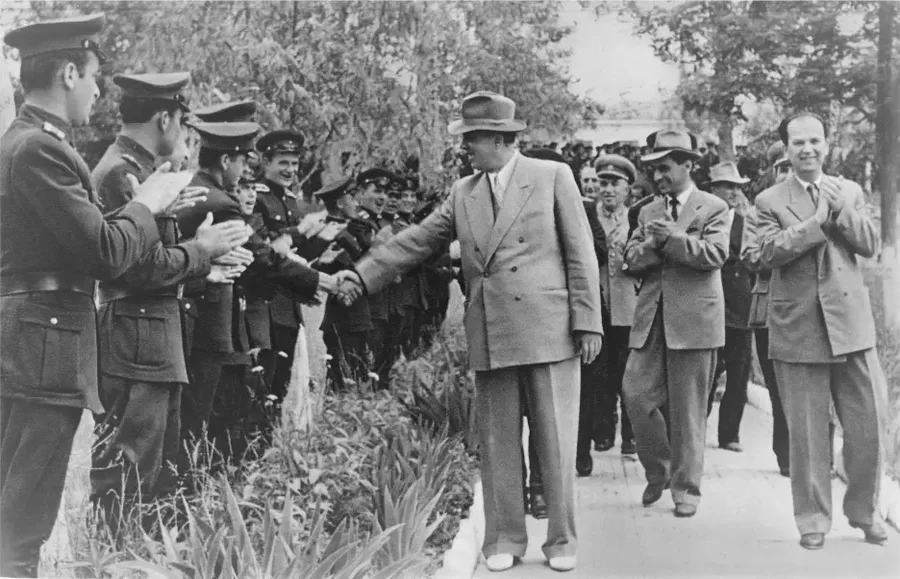
During the report of the Congress of the Communist Party of the Soviet Union on October 17, 1961, Khrushchev denounced the pro-Stalinist tendencies of the Albanian government, and demanded the removal of its current leaders, Enver Hoxha and Mehmet Shehu. Khrushchev even accused them of having misunderstood the term de-Stalinization. The clash of declarations between Moscow and Tirana also brought about the great and final rift and break with the Soviet Union.
From the mid-1960s, Soviet-Albanian relations deteriorated significantly, especially after October 1961. The Bucharest Conference in June 1960 predicted that it would be dominated by conflict between the Soviet and Chinese communist parties, with the Albanian party playing a significant role as the sole supporter of Beijing. Shortly thereafter, Albanian leaders thwarted a coup d'état, which they believed was supported by Moscow. As a result, Moscow and its followers began to reduce trade relations and aid to Albania.
According to Khrushchev, the Albanian Communist Party had twice rejected Soviet offers for talks in August 1960. Meanwhile, according to the Albanians, Khrushchev had said in October 1960 that he would treat Albania like Yugoslavia. During the Moscow conference of communist parties in November 1960, the Albanian delegation had again fully supported Beijing. Thus, Hoxha denounced Khrushchev in spectacular terms. According to Khrushchev, Hoxha and Shehu had rejected talks for the third time at this conference.
By the end of 1960, all Soviet loans and perhaps those of other Eastern countries to Albania had been canceled. Moscow began to demand from Albania to pay previous debts, as early as 1961, those debts that were expected to be repaid in 1970. By the end of 1960, the Chinese had purchased more than 100,000 tons of wheat for Albania. Throughout 1961, Albania began to make efforts to be considered part of the Chinese camp. Meanwhile, in January of that year, the Soviet Union (according to Tirana), had withdrawn a group of technicians, implying that it would withdraw them all later.
At the party congress in February 1961, Hoxha firmly reaffirmed his pro-Chinese position and publicly announced that he had uncovered an attempted coup (without directly accusing Moscow of supporting the coup). According to Albanians, Khrushchev had declared that the Soviet Union would stop all aid to Albania. In April 1961, the Chinese had agreed to provide Albania with economic aid in the amount of $125 million. This was the same amount that had been promised earlier, but had been canceled by the Soviet Union and the Eastern Bloc.
In May of that year, a mock trial of “spies and traitors” was held in Albania, which was, in fact, an anti-Soviet show of force. This was accompanied by the evacuation of the important submarine base in Vlora, the expulsion of Soviet and Albanian military attaches, the expulsion and withdrawal of several Soviet military advisors, the sending home of almost all Albanian students (civilian and military) from the Soviet Union and other Eastern countries, and a drastic decline in trade between the two countries.
In the following months, there were reports of a large influx of Chinese military and economic advisors to Albania, as well as the continued import of large quantities of Chinese grain from Albania, despite the difficult food situation in China. Above all, this indicated that China was emerging as the sole source of foreign aid for Albania.
The cult of personality
During the report to the Congress of the Communist Party of the Soviet Union on October 17, 1961, Khrushchev answered the rhetorical question whether it had been necessary to attack Stalin and Stalinism “so openly”. “It was absolutely necessary. In the interests of good relations between the party and the people, of economic development and of the Soviet position in the world”, he said. In this context, he emphasized that the political course of de-Stalinization “had not been fully understood” by the Albanian leadership.
According to Khrushchev, the Albanian leadership's opposition to de-Stalinization could be explained by the fact that they themselves used methods of the cult of the individual. He dealt extensively with the mistakes of the Albanian leaders and, moreover, declared that "everything bad that existed in our country, during the time of the cult of the individual, was manifesting itself in its worst form, in the Albanian Communist Party". Following the congress, on 27 October 1961, Khrushchev took the conflict with Albania to a new stage, openly calling for the overthrow of the Albanian leadership.
He considered them incorrigible Stalinists, and accused them of purging party leaders who had supported Khrushchev's ideas. He said: "To put an end to the personality cult of Shehu, Hoxha and others would essentially mean that they give up their commanding positions in the party and the state, but they have no intention of doing so. But we are confident that a time will come when the communists and the Albanian people will have their say and then these people will answer for what they have done."
During the five weeks between the Soviet party congress and the final breakdown of Soviet-Albanian relations (on December 3, 1961), events unfolded very quickly, as predicted by the course of the congress. The Albanian party issued an editorial on November 1, describing Khrushchev as a liar, a deceiver, an intriguer, and an anti-Marxist.
In this context, in a speech delivered on November 7, Hoxha, continuing his accusations against Khrushchev for blackmail and blockade, contrasted the figure of the current Soviet leader with Stalin's role as a friend and defender of Albania.
Hoxha insisted that Stalin's merits far outweighed his weaknesses. He accused Khrushchev of using the issue of Stalinism to eliminate people he did not like and said that Khrushchev was blatantly creating a cult of his own personality./Memorie.al





Lini një Përgjigje