


 Shkruar nga Pamfleti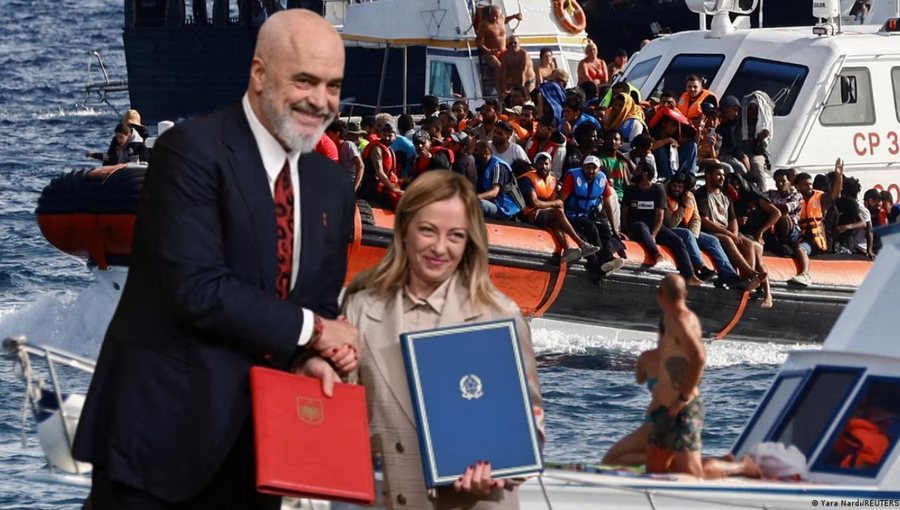
The controversial agreement to process asylum seekers' claims in Albania may violate constitutional and EU law, according to Italy's Court of Cassation, a non-binding opinion that could prompt legal challenges...
The Italy-Albania migration protocol continues to face major obstacles, the latest, and perhaps most significant, being a report from the Supreme Court of Cassation that considers the agreement potentially unconstitutional, reigniting a political clash between the judiciary and the Meloni government.
The agreement, signed last year and constantly amended due to legal obstacles, allows Italy to process some asylum seekers in centers abroad on Albanian territory.
The reactions come after the publication of a detailed legal analysis by the Supreme Court of Cassation, which pointed out numerous constitutional and procedural risks in the implementation of the protocol.
According to the court, the protocol could violate several fundamental rights protected by the Italian Constitution, EU law and international treaties. The report criticizes the vague definition of who the agreement applies to, referring simply to "migrants" and warns of unequal treatment between those processed in Italy and those transferred abroad.
Despite the harsh language, the Supreme Court's opinion has no binding legal weight. The Court's President, Margherita Cassano, stressed that the report does not interfere with policymaking.
“There is no excess,” she told Corriere della Sera, describing the analysis as a technical tool for judges. She added that “these reports are not binding and have no automatic consequences.”
However, the document could guide first-instance courts in assessing the legality of detention and deportation under the agreement. It also includes preliminary questions for the European Court of Justice, potentially opening a new front in the legal battle over Italy's approach to relocation abroad and migration control.
European Affairs Minister Tommaso Foti said the government would press ahead, denouncing what he called “obstructionism” by parts of the judiciary. “While the Meloni government’s approach to irregular migration is being adopted as a model in Europe, some judicial bodies in Italy seem more focused on undermining it.”
Forza Italia's Senate leader, Maurizio Gasparri, went further, claiming that the office responsible for the report within the Court of Cassation had been "taken over by far-left activists from social centers."
The court noted the lack of procedural protections for asylum seekers, stating that the protocol fails to provide a clear legal framework that can protect fundamental rights in an extraterritorial context.
A key concern is that, under the agreement, detention is not treated as a last resort as required by EU law, but appears to be the default option.
Furthermore, the court warned of the risk of unlawful detention. Since the protocol does not allow for the release of migrants in Albania, individuals whose detention order has expired will have to be transferred back to Italy, a process that, due to logistical delays, could result in hours or even days of “unjustified” detention. / Adapted Pamphlet by EurActive/








Lini një Përgjigje