


 Shkruar nga Pamfleti
Gross Domestic Product (GDP) per capita in the Western Balkans is entering a new phase of growth. This process of convergence with European Union standards is being dictated by a number of structural factors that the International Monetary Fund (IMF) has considered critical for long-term sustainability.
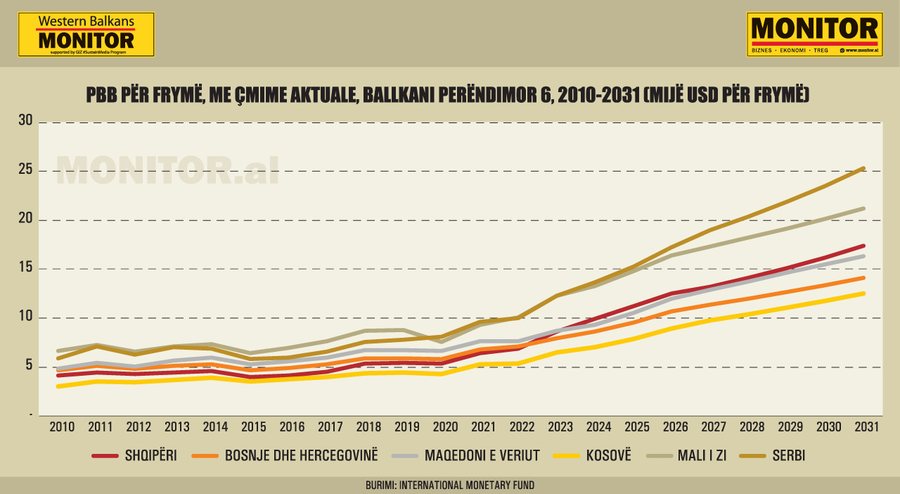
According to the Fund's database, Serbia and Montenegro top the list with the highest per capita incomes, with $17,252 and $16,377, respectively, according to this year's projections. This dominance is explained by Serbia's success in absorbing manufacturing industries and modernizing infrastructure, while Montenegro benefits from its positioning as an elite Mediterranean tourism center.
Albania, according to projections, is positioned third in the region with 12,493 USD per capita, surpassing North Macedonia (11,967 USD) and Bosnia and Herzegovina (10,701 USD). Albania's performance is related to fiscal discipline and positive developments in the tourism sector. Kosovo is expected to reach 8,958 USD in income per capita this year, ranking last in the Region. For Kosovo, the IMF notes a high growth potential if it continues to improve the business environment and invest in human capital, especially in the technology sector.
The 2031 outlook is improving for all countries
Over the five-year horizon 2026–2031, the IMF predicts an acceleration in growth for all economies in the region. Serbia is expected to reach USD 25,291 per capita in 2031, becoming the undisputed economic leader in the region.
This growth is expected to be supported by deeper integration into EU supply chains. Montenegro is expected to follow with USD 21,214 per capita, where macroeconomic stability will be key to maintaining investment flows.
For Albania, the IMF projects a per capita income level of USD 17,353 in 2031. This growth is supported by the continuation of institutional reforms, the positive impact of EU pre-accession funds and reforms. North Macedonia and Bosnia and Herzegovina are projected to reach USD 16,354 and USD 14,084 respectively, although the IMF warns that geopolitical risks and energy prices could dictate fluctuations.
Kosovo is expected to reach USD 12,483, marking the largest percentage increase, which demonstrates a rapid "catching-up" process with its neighbors.
The year 2026 marks a turning point where the differences between the countries of the region become more tangible.
Retrospective 2010–2026, how incomes increased in the Region
Looking at the period 2010–2026, the IMF’s historical data shows an often difficult journey. In 2010, the region was still reeling from the effects of the global financial crisis, with Albania recording only USD 4,098 per capita. During this 16-year period, Albania has managed to double its income, mainly from the strengthening of the local currency and inflows from abroad and growth in the tourism sector.
The most sustained growth has been observed in Serbia and Montenegro, which had stronger initial bases. However, 2020 marked a critical point due to the pandemic, with the IMF underlining that only countries with strong fiscal reserves managed to recover quickly. The post-pandemic recovery has been stronger than initial expectations, allowing the region to enter 2026 on a more secure footing. This economic maturation, closely monitored by the International Monetary Fund, suggests that the Western Balkans are leaving behind the era of transition to enter a phase of welfare consolidation.
From 2010 to the detailed projections for 2031, the region shows an upward trajectory, with each country mobilizing specific resources. Albania, according to IMF analyses, has shown high resilience thanks to the performance of the tourism sector and the increase in construction investments, which have served as the main drivers.
In Serbia, the IMF notes that foreign direct investment protection policies and the expansion of the industrial base have created a significant gap with its neighbors. Montenegro, on the other hand, remains dependent on services but is diversifying its portfolio through renewable energy.
For Kosovo and North Macedonia, the IMF emphasizes the importance of labor market reforms and productivity growth to address demographic challenges. These trajectories show that the region is moving from a phase of consumption-based growth to more sustainable growth based on exports and investments, which is reflected in the optimistic figures for the next decade./Monitor








Lini një Përgjigje