


 Shkruar nga Pamfleti
The blocking mechanism works through large companies that make exchanges, where cryptos are converted into euros and dollars.
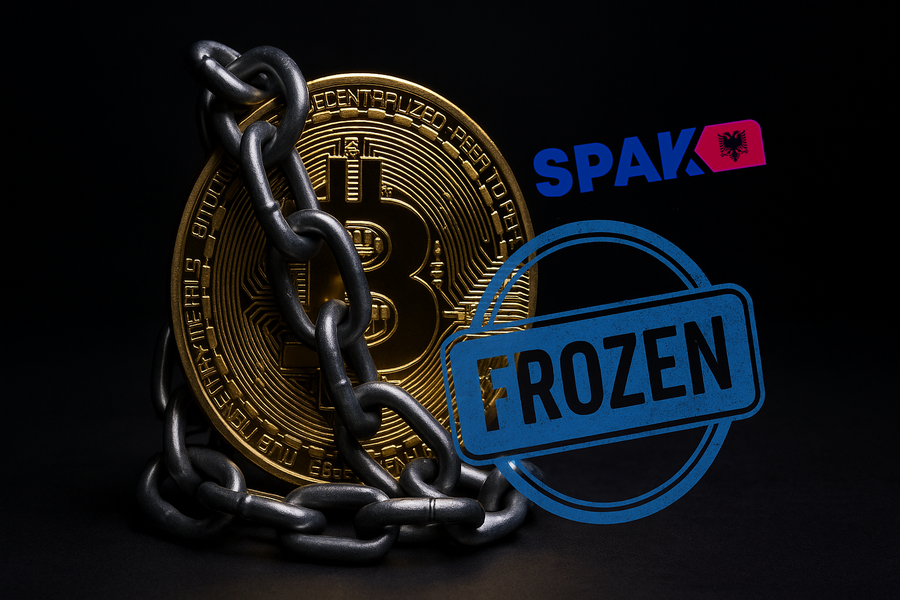
Every transaction on the blockchain is visible and permanently recorded, but this does not automatically make it easy for institutions to intervene. Anyone can hide behind an address, and funds can move from one wallet to another in a matter of seconds, disappearing into anonymous accounts where the state has no access. For this reason, SPAK is not targeting private wallets, but the moment when cryptos enter large exchange companies. There, assets are no longer just digital codes, but values that are converted into euros and dollars, and that is where the secret court order sent to the company comes into play. The moment this order is implemented, the account is blocked and the owner no longer has any possibility of moving the funds.
This mechanism is the same as that used by justice institutions in the US-EU, so it does not constitute an investigative secret, but an internationally accepted practice.
Operation Gorgon in November 2024 showed for the first time publicly that this mechanism was used. The investigation against the brothers Franc and Hajdar Çopja, conducted in cooperation with Europol and the police of several European countries, led to the seizure of a crypto wallet worth over $10 million. This blocking was made possible through a secret order communicated to a global stablecoin company and an international exchange. Without this intervention, the assets would have been transferred to anonymous wallets and would have become untraceable. This operation clearly showed that SPAK had entered new territory: the seizure of digital assets.
Just a few months later, the “FRIDA-REFOX” operation coordinated by Eurojust brought to light another case. A call center fraud ring, working to lure European citizens to invest in fake platforms, used Bitcoin and stablecoins to hide the funds. SPAK carried out checks in Tirana, Elbasan and Vlora, arrested several people and seized computer equipment, cash and crypto wallets worth around $15,000. The amount was not large, but the fact that the funds were circulating in crypto showed that this had become an integral part of cyber fraud.
In July 2023, Operation Dream Earnings, in collaboration with the Pordenone Prosecutor’s Office in Italy, targeted another fraud ring. Italian victims would initially invest small amounts, see fake profits on screen, and then withdraw more money. Around 4.7 million euros were embezzled from this scheme, which was immediately converted into Bitcoin and distributed to accounts in Cyprus, Lithuania and Estonia. SPAK seized equipment and documented the process, but the scheme clearly showed that the crime used crypto as the final stage to hide the profits.
These operations show with concrete evidence that secret orders have become a common tool. The legal framework that allows this is the combination of the Criminal Procedure Code and the Anti-Mafia Law, which give the prosecution the right to request the seizure of assets suspected of being proceeds of crime. The 2024 Manual on Asset Recovery, drafted with the support of the European Union and with the contribution of SPAK prosecutors, has clearly included blockchain analysis and the seizure of digital wallets as part of investigative practice. This manual also defines the importance of secrecy: any notification by the subject would lead to the immediate disappearance of the funds.
In practice, the procedure is clear. SPAK identifies a crypto address linked to criminal activity, gathers evidence through transaction analysis and international cooperation, requests a seizure order from the court, and then communicates it to the exchange company. The company is obliged to implement it, freezing the account and not informing the owner. This is the only moment when digital assets can be frozen.
In addition to the cases made public, the Pamphlet editorial office has received information about dozens of other orders to seize crypto accounts, with values reaching around 50 million euros. This data is in the process of verification, but shows that the practice of secret orders is not an exception, but a method that is being used constantly.
This brings a new problem. Secrecy is necessary to prevent investigations from being exposed and to ensure the immediate freezing of funds, but the lack of transparency creates loopholes.
When SPAK sends a secret order to an exchange company, the account is immediately frozen and the funds cannot be moved. But this is only the first step. Not every blocked account ends up in confiscation. Some remain frozen for months, others are released after subsequent court decisions, while some become state property. This is where the biggest gap arises: there is no public data on how many blocking orders have been reversed, how many have been converted into final seizure, and which remain suspended. Without this balance, no one knows exactly how many millions of euros have been finally stopped and how many have been returned to circulation.
However, this gap should not obscure the fact that SPAK has entered a terrain where many similar structures in the region have not yet dared to enter. Tracing and freezing digital assets requires technical expertise, international cooperation and quick decisions, and the fact that concrete freezes worth millions have been achieved indicates a major advance. This step should be encouraged, but at the same time it should be accompanied by greater transparency to guarantee public trust and avoid any room for doubt.
Albania is in a new reality where crime uses crypto for every major transaction and where SPAK uses secret orders to stop them. The blocks happen behind the scenes, at the big companies that do exchanges, where Bitcoin, USDT and other currencies are converted into euros and dollars. This is the invisible mechanism that puts millions of euros of Albanian crime under control. /Pamphlet




Lini një Përgjigje