


 Shkruar nga Pamfleti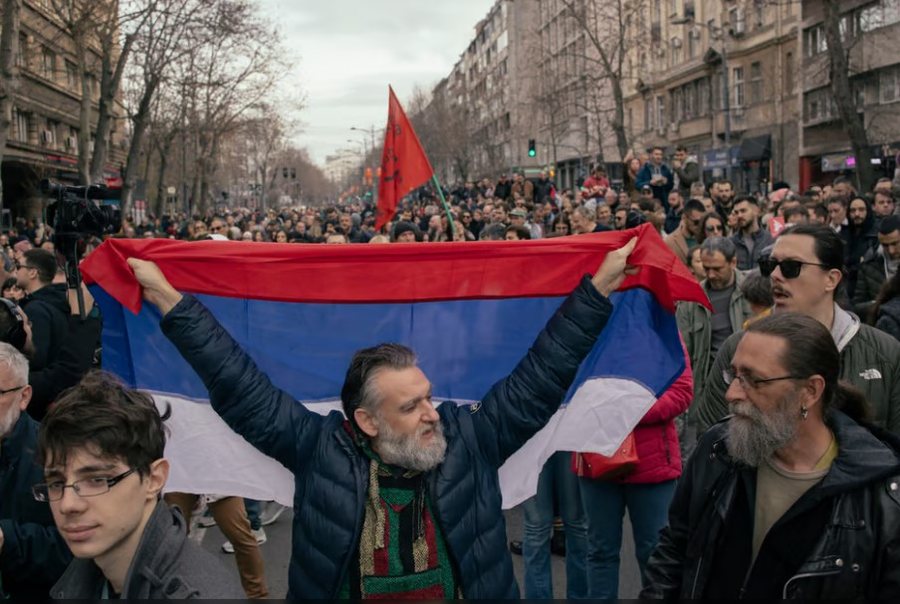
The recent events in the country are reminiscent of the protest movements during the disintegration of the former Yugoslavia...
Tens of thousands of citizens gathered in central Belgrade on Saturday in one of the biggest protests since Serbian elections two weeks ago. The opposition and citizens have asked the EU to take seriously the events taking place in the country.
"I want to invite our friends from Europe to pay more attention to what is happening here," Srđan Cvijić, a member of the Belgrade Center for Security Policy, who was an election monitor in the Dec. 17 vote, told , gathered around the Terazije fountain in the capital.
He condemned the fact that Serbian President Aleksandar Vučić, who often boasts of his close relations with EU and Western officials, only promotes European values and "hangs EU flags" when officials from Brussels and foreign dignitaries visit the country.
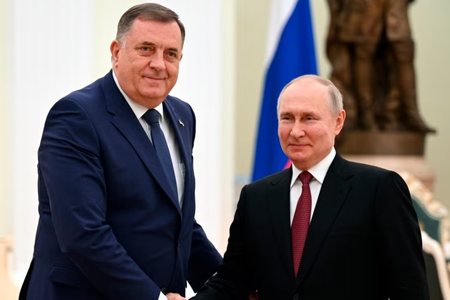
Vucic has for years skillfully navigated the tightrope between the West and Russia, often turning to the latter to shore up nationalist support. Russian Ambassador Aleksandr Botsan-Kharchenko has publicly backed Vucic's unverified claim that outside forces are driving the protests — a narrative often used by Russian President Vladimir Putin when facing dissent.
Serbia's ruling party and pro-government media have disparagingly compared the protests to the Maidan uprising in Kiev, which began in late 2013 and saw pro-democracy and pro-EU supporters engage in widespread demonstrations and civil unrest. . Notably, that move was used by Putin as a pretext for Moscow's 2014 invasion of Ukraine.
"Support for the EU may have weakened, but it is understandable because our friends from Brussels are not critical enough of the government of Aleksandar Vucic," Cvijic said, holding up a faded European flag from the 1990s, when he and his family his protested against Slobodan Milosevic.
The recent events in the country are reminiscent of the protest movements during the breakup of the former Yugoslavia. As now, a diverse crowd of all ages, but led by younger generations, took to the streets then to resist the erosion of freedoms under Milosevic's rule, a period marked by bloody conflicts in neighboring countries. .
Saturday's demonstration was organized in the same place where most of the protests were held in the 1990s.
Both local and international entities, including OSCE and European Parliament observers, have condemned fraud and electoral manipulation in the December 17 elections.
Actress Svetlana Bojković, part of the non-partisan coalition ProGlas or ProVote, which encouraged participation in the elections, passionately read reports pouring in from around the country detailing the tactics used during the elections. The list includes cases of cancer patients awaiting transplants, manipulated to support the ruling party in exchange for advancement on the donor list; senior citizens who are enticed with monetary incentives to change their residence and deceased citizens who reappear on voter rolls.
Since the Monday after the election, daily protests have unfolded in front of key institutions, including Belgrade City Hall and the Central Election Commission. Saturday's rally marked the 13th consecutive demonstration, with a notable incident on December 24 when police responded with significant force after a small group smashed the front windows of Belgrade's city assembly.
Opposition politician Marinika Tepic, who has been on hunger strike since the election, had to stand on stage due to her poor condition, while Pink Floyd's "Another brick in the wall" was blasted from the speakers. /Adapted "Pamphlet" from "Politiko"



Lini një Përgjigje