


 Shkruar nga Pamfleti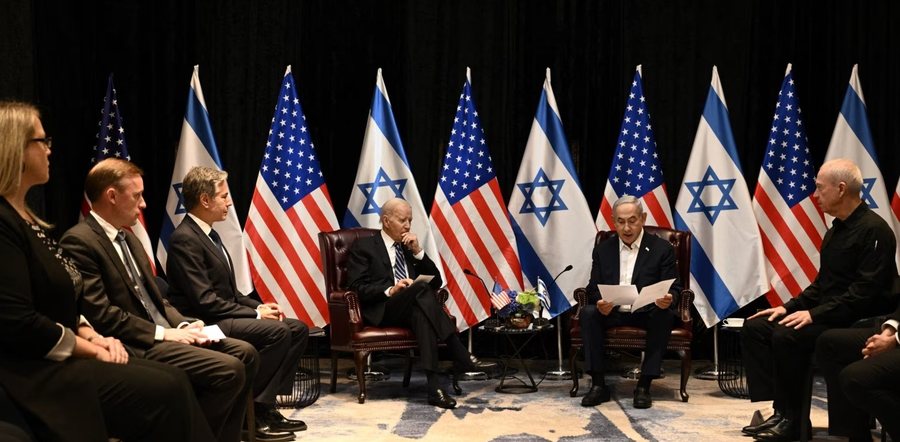
As Israeli Prime Minister Benjamin Netanyahu's government expands its ground offensive in Gaza, Iran's threats of retaliation for airstrikes that killed a senior military officer and continued attacks by Tehran-backed groups in the region are raising the prospect of an all-out war in the Middle East. It's a risk that does US President Joe Biden no good as we enter an election year in the United States.
Earlier this week, Tehran vowed to retaliate over the killing in Syria of Seyed Razi Mousavi, a senior adviser to Iran's Islamic Revolutionary Guard Corps.
Mousavi was reportedly involved in supplying weapons to Hezbollah, the Iranian-backed militia in Lebanon and Syria, which has intensified its offensive from Israel's northern border in solidarity with Hamas in Gaza. Israel refused to confirm that it was behind the airstrike that killed Mousavi.
The White House did not respond to VOA's questions about whether Israel informed Washington in advance of the airstrikes that killed Mousavi, or whether the US administration believes the war will not escalate beyond Gaza.
The conflict spreads
Shortly after the start of the war in Gaza, the United States moved military units to the Middle East to deter the attacks and sent a message to Tehran and its proxies not to get involved in the conflict. Across the region, however, there are signs that the conflict is spreading.
On Monday, President Biden ordered "necessary and proportionate" strikes against Kataib Hezbollah, the Iran-backed paramilitary force in Iraq, in response to a drone strike that injured soldiers at a US military base in Irbil, northern Iraq.
Baghdad condemned the US strikes as a "hostile act" and a violation of its sovereignty. But with about 3,500 US troops in Iraq and Syria close to the line of fire, analysts say President Biden had little choice but to strike back.
On Tuesday, Yemen's Iran-backed Houthi militia, also known as Ansar Allah, claimed responsibility for a missile attack on a cargo ship in the Red Sea. It was the latest in a string of attacks on ships in recent weeks that have prompted Washington to create a coalition of multinational naval forces to patrol the waterways.
Escalation is inevitable as Iranian-backed groups compete with each other to show their support for Hamas, says Michael Knights, a fellow at the Washington Institute who specializes in Iranian-backed militias in Iraq and Syria.
"Some players within the Axis of Resistance, like the Houthis, are trying to show that they are more committed to the cause than other Iraqi, Lebanese or Syrian factions," he told VOA, referring to groups in the region that have levels of various military and political proximity to Tehran.
"The Red Sea is the main concern because the Houthis are much more difficult to thwart, especially because no one wants to disrupt the Saudi Arabian peace process," he added.
As of 2022, Saudi Arabia and the Houthi rebels in Yemen have been negotiating a permanent ceasefire to end their eight-year war.
'On the brink of war'
Since the beginning of the conflict in Gaza, Israel has been involved in fierce cross-border clashes with Hezbollah in Lebanon.
"The situation is really on the brink of war," said Elisheva Machlis, professor of Middle East Studies at Bar-Ilan University.
Tens of thousands of Israelis have been evacuated from border towns in anticipation of an attack by Hezbollah. It is "an intolerable situation" that could be turning public opinion in favor of expanding the war in the north, Ms. Machlis told VOA.
Mr Netanyahu's government has said military action is not being ruled out to ensure Israeli citizens can return to their homes.
The danger of Israel-Iran war
"Israel's decision to kill a high-ranking member of the Iranian military in Damascus is a major provocation," said Omar Rahman, a member of the Middle East Council on Global Affairs.
"Iran has not been directly involved so far, but if its commanders are targeted, it will be difficult for Tehran to continue the path of restraint," he told VOA.
Israel neither confirms nor denies involvement in Mousavi's death.
If Israel is behind the killing, it is unclear whether it is doing so as a warning to Tehran or to provoke an Iranian response that would give Israel a pretext to expand the war, said Trita Parsi, executive vice president of the Quincy Institute. for Responsible State, a foreign policy think tank in Washington.
Israeli Defense Minister Yoav Gallant admitted that the country is "in a multi-front war", under attack on "seven fronts", including Gaza, the West Bank, Lebanon, Syria, Iraq, Yemen and Iran.
Press on Israel
As President Biden prepares for the November 2024 election with polls showing most Americans disapprove of his policy on Gaza, he is keen to avoid a wider war. Privately, President Biden's administration has urged the Israelis to show restraint in Lebanon.
In Gaza, the United States has made increasingly public and urgent calls for Israel to move to a more limited phase of the war. Israeli attacks, however, have intensified.
"We are expanding the war in the coming days," Prime Minister Netanyahu said in comments published by his Likud party on Monday.
US pressure on Israel continued on Tuesday as Secretary of State Antony Blinken and national security adviser Jake Sullivan met in Washington with Ron Dermer, Israel's minister of strategic affairs. Among Gaza-related topics, the meeting focused on "moving to another phase of the war to maximize attention on high-value Hamas targets" and "practical steps to improve the humanitarian situation and minimize harm to civilians." a White House official told VOA.
The meeting is the latest in a month-long diplomatic engagement by President Biden's top aides with stakeholders across the region, pushing for more aid to the people of Gaza and deals for the release of hostages, even as it continues to provide Israel with military aid and diplomatic support.
At the United Nations, US Ambassador Linda Thomas-Greenfield worked with Arab states to pass a resolution on temporary ceasefires and humanitarian aid delivery mechanisms. Washington abstained to allow approval by the Security Council.
President Biden "is trying every possible solution except the most obvious one: a cease-fire in Gaza," Mr. Parsi, of the Quincy Institute, told VOA. "A cease-fire would end attacks on US troops, would end attacks on ships in the Red Sea, and would most likely de-escalate the Israeli-Lebanese border."
The United States and Israel say a ceasefire at this point will allow Hamas to regain strength.
Since October 9, Israeli airstrikes and a ground offensive have killed around 21,000 people in Gaza, according to unconfirmed figures from Hamas authority sources. The October 7 Hamas terror attack in Israel killed 1,200 people, most of them civilians. This violence is the bloodiest episode in the decades-long conflict between Israelis and Palestinians./ VOA







Lini një Përgjigje