


 Shkruar nga Thomas Fazi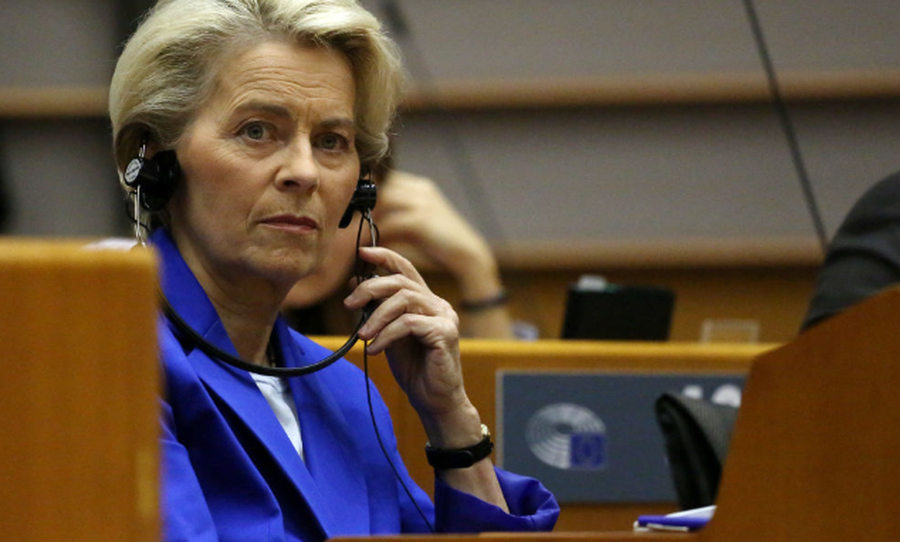
The European Commission has expanded its scope into several policy areas that have traditionally been the responsibility of national governments, such as foreign policy and defense and security issues.
The European Union announced on Wednesday its plan to "create a European spy service similar to the CIA". On social networks, many people reacted with satirical and mocking comments. "But there is already a CIA-like spy agency operating across Europe. It's called the CIA" - wrote a user on the X platform.
"I propose that the new agency be called the Gestapo!" said another. Such comments are indicative of the state of mind in Europe today, where any policy proposal coming out of Brussels tends to be met with a heavy dose of skepticism and mistrust.
And this is more than understandable, given the increasingly irresponsible nature, the ever-widening reach, and the growing list of political failures of the EU institutions, and primarily the European Commission.
So it's no wonder why most people instinctively find the idea of giving "Empress" Ursula von der Leyen a troop of supranational agents to spy on citizens and carry out other activities very disturbing. evil "like the CIA".
Politico's bombastic headline refers to one of the many proposals contained in a new report commissioned by former Finnish president Sauli Niinistö on "Strengthening Europe's Civilian and Military Readiness".
Focusing on recent crises - and especially the war in Ukraine - Niinistö advocates an approach of "comprehensive preparedness", which would ensure that the EU "works in all circumstances", through an integrated response to cross-border crises.
According to the report, this approach should include a "comprehensive framework of governments and societies", enabling active participation by citizens, private sectors and public authorities.
The report sets out some vague proposals, such as cultivating a "culture of preparedness" within EU institutions and among citizens, long-term investment in vital defense infrastructure, formalizing cross-sector crisis response and "increasing intelligence sharing of the EU".
Attention has also been paid to increasing the collection and sharing of intelligence data at the EU level, mainly in terms of improvements to the Joint Intelligence Analysis Capacity (SIAC), which currently depends on voluntary contributions from member states.
Thus, the report emphasizes the need for a more structured and reliable sharing of intelligence by member states. The most controversial aspect is the fact that, in addition to the role of SIAC, the report proposes the development of a new EU intelligence service, which would constitute a supranational body that would be complementary to national data collection activities. classified.
And that would be a very disturbing development. Equipping a non-democratic body such as the EU with such a body would be another step in the bloc's transformation into an authoritarian super-state. As in the case of the CIA, such powers are most likely to be exercised primarily against citizens and even member states, and not against "foreign enemies".
Moreover, anyone who thinks this would be a step towards greater "strategic autonomy" for the EU will be disappointed. The report calls for "strengthening EU-NATO cooperation", which means that any "EU intelligence agency" will not simply be a CIA-like agency.
It would just be a branch of the CIA. In many ways, this is already happening: EU governments are sharing the data of their intelligence services, while the US-led Five Eyes network has brought together agencies in the United States, Australia, Canada, New Zealand and Great Britain.
The same is not true in the opposite direction, as the United States does not share all the information it has with other powers. In fact, it is a well-known phenomenon that American intelligence agencies regularly spy on their European "allies".
However, it is positive that this new agency is not likely to be set up anytime soon. During the presentation of the report, Von der Leyen himself admitted that there is still a lot of resistance to such a proposal in European offices, stressing that for the moment the focus will be only on "strengthening the exchange of information".
Also, it is unclear how the EU will pay for the construction of this new agency, given that member countries' budgets are already heavily burdened, and have little appetite for issuing more joint debt.
Niinistö himself admitted that in his talks on the drafting of the basic document, he had encountered "many critical voices" about the possibility of obtaining new joint loans, since some countries refuse to engage in new mechanisms, through to which they "take from us, and give to others".
However, we must not forget that in recent years, the European Commission has expanded its scope in some policy areas, which have traditionally been a responsibility of national governments, such as foreign policy and defense and security issues. /Adapted "Pamphlet", from "Unherd"






Lini një Përgjigje