


 Shkruar nga Angelos Syrigos
Will the VMRO leadership be able to unilaterally terminate the Prespa Agreement without any particular reason?
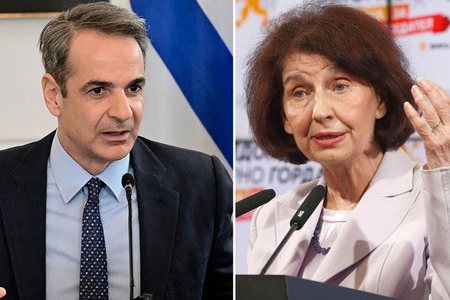
On the day when the Prespa Agreement signed between Greece and North Macedonia was ratified by the Greek parliament, then opposition leader and current Prime Minister Kyriakos Mitsotakis strongly criticized its content.
He declared from the pulpit: "If the Prespa Agreement is ratified today in the form it is, it will not be able to be canceled the next day, as it repeals every law. International law makes it immutable. Any modification of it later is extremely difficult. Any violation of the agreement could mean international isolation and an international court case for our country" (January 24, 2019).
However, the Prespa Agreement was ratified in that form by the parliaments of both countries. What applies to us also applies to our northern neighbor. The electoral dominance of the center-right nationalist party VMRO-DPMNE is the litmus test that will challenge the sustainability of the Prespa Agreement.
The first problem started with the de facto refusal of constitutional law professor Gordana Siljanovska-Davkova to be sworn in as president under the internationally accepted and constitutionally recognized name of her country: North Macedonia.
Now it remains to be seen what the next government will do in the coming days. Most likely, some kind of game will start in which Skopje will occasionally use a name other than "North Macedonia". Will the VMRO leadership be able to unilaterally terminate the Prespa Agreement without any particular reason?
Article 20, point 9, states that its provisions "shall remain in force for an indefinite period of time and are irrevocable". Also, it is emphasized that no modification of this agreement included in Article 1 (point 3) and Article 1 (point 4) of the Constitution will be allowed.
But what does this mean? That we have a framework agreement, which will forever regulate the relations between the two states. Although all provisions are expressly described as "irrevocable", this description is contradicted by the fact that provisions in particular are described as immutable.
These are the disputed provisions 1(3) and 1(4) regarding the use of the name "North Macedonia", the recognition of the term "Macedonian/citizen of the Republic of North Macedonia" and the "Macedonian" language. This means that both parties have considered the possibility of challenging the agreement in court.
They simply chose not to refer to such a possibility overtly. But they determined that in such a case, it is impossible to cancel the contested paragraphs 1(3) and 1(4) which remain mandatory. So any termination of the agreement does not release Skopje from the obligation to use the term "North Macedonia".
The only way to change this would be if both countries agreed to amend the entire agreement with a later pact, including specific paragraphs. But given the positions of both parties, such a scenario is unlikely to happen.
On the contrary, we will continue to live with the contradiction that the state will be called North Macedonia, but its language is not called North Macedonian. So, how should Greece react in these conditions? Can it request the termination or suspension of the agreement due to a material breach thereof (Article 60 of the Vienna Convention on the Law of Treaties)?
In such a case, Skopje's obligation to use the name North Macedonia would automatically end. Let's not forget that the first provision of the Prespa Agreement, in article 1 (point 1), states that upon its entry into force, the Interim Agreement of 1995 ends. So because the Prespa Agreement entered into force at the beginning of 2019 and the Interim Agreement has been repealed, there is no longer any "return" to the old name IRJM. Those Greeks who hope for the annulment of the agreement should take this into account.
Because as things have been since the beginning of 2019, a termination of the agreement will leave the country called "Macedonia". Then we will lose the only benefit we got from the Prespa Agreement: the use of the name "North Macedonia".
It is not pleasant for many of our fellow citizens, but this is the reality that took shape at the beginning of 2019, about which New Democracy and PASOK had warned in parliament, as well as many analysts, including myself in the book I published in that time.
Thus, the most logical step is to follow the procedure defined in Article 19 of the agreement: When a material violation of the agreement is found, as in the last case, Athens must first notify Skopje about this. Then, this process may also end up in the International Court of Justice.
The Prespa Agreement has many difficulties. Serving the national interest and effectively protecting the identity of Greek Macedonia requires the development of a measured, cold and systematic policy on our part. This approach will allow us to maintain the positive attitude of the international community, which is perhaps the most effective lever of pressure on Skopje. / Adapted "Pamphlet" from "Kathimerini"
Note: Angelos Syrigos, Member of Parliament for the New Democracy party in power today in Greece, and Associate Professor of International Law and Foreign Policy at the Pantheon University of Athens.



Lini një Përgjigje