


 Shkruar nga Pamfleti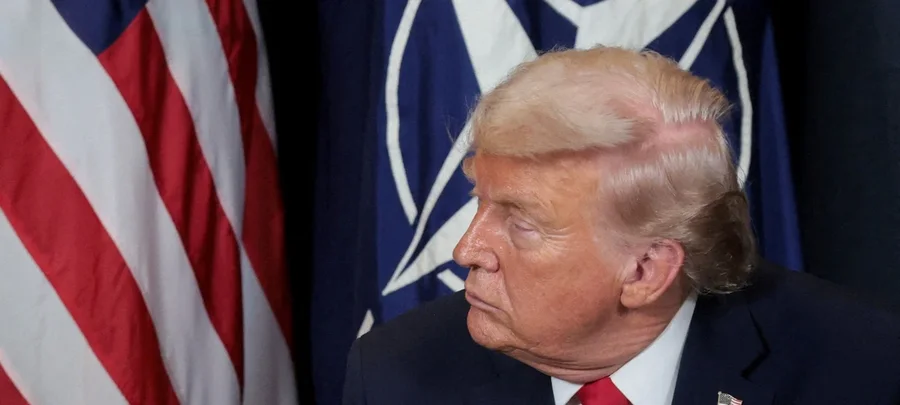
The President threatens again to leave the alliance; there are formal obstacles, but they are not insurmountable…
Whether the United States could leave NATO is no longer a purely theoretical question. President Donald Trump has repeatedly questioned membership. During his first term, he was said to have come close to deciding to withdraw.
Recently, he has expressed disappointment that European allies are unwilling to support him in the conflict with Iran over securing the Strait of Hormuz. “We help other countries and if they don’t help us, then that’s certainly something we have to think about,” he said when asked if he was considering leaving the Western military alliance. He called the disagreement over the conflict with Iran a “big test” of the allies’ loyalty.
From a formal point of view, it is not difficult to leave NATO. The legal basis of the alliance is the North Atlantic Treaty, which in Article 13 contains a provision on withdrawal: “after a period of 20 years from the entry into force of the Treaty, any Party may withdraw from it one year after having notified the Government of the United States of America.”
The notification must be made to the US government, because it is the depositary of the treaty. This means that it keeps the ratification documents of the members. For a withdrawal, the US government would only have to record such a notification in the documents it administers and inform the other members. The required 20-year period is not an obstacle. The treaty was signed on April 4, 1949, and that period has long passed.
However, in the United States, a legal and political clash could arise. Trump has already terminated many international agreements, but the North Atlantic Treaty has one peculiarity: it was ratified with the approval of the Senate, as the Constitution requires.
From this, Congress derives the right to have a role in any withdrawal decision. In 2023, it passed a law according to which the president cannot “suspend, terminate, denounce or withdraw” the US from the treaty without the “advice and consent” of the Senate. This requires the approval of 2/3 of the senators or an act of Congress. This rule was deliberately put in place to protect the alliance from unilateral actions; even within the Republican Party there are many supporters of NATO.
However, this law does not fully guarantee that Trump will remain in the alliance against his will. Many presidents have insisted on the supremacy of the executive branch in foreign policy and have claimed that they can make decisions without the intervention of Congress. A 2020 Justice Department opinion argued that withdrawing from international treaties is an exclusive right of the president, which Congress cannot limit by law. Although this position related to the Open Skies agreement, it was formulated by a Trump administration and is unlikely to change in the case of NATO.
If Trump were to announce his withdrawal from the alliance, it could lead to a conflict between constitutional institutions. It is not clear whether such a dispute would be resolved in favor of Congress in court. Two questions arise that have been controversial in other cases: who has the right to sue and whether this is an issue that the courts should consider. In 1979, the Supreme Court dismissed lawsuits by members of Congress challenging President Carter’s decision to conclude a defense agreement with Taiwan, arguing that it was a political, not a legal, issue. Such proceedings can take a long time.
In practice, it is even more important that Trump would not need to formally leave NATO. It would be enough for him to terminate US participation in the alliance's day-to-day activities. NATO operates on the basis of unanimity in its bodies.
In this context, Trump could pursue an “empty chair” policy, as France did in the 1960s in the European Economic Community. He could withdraw American personnel from NATO’s leadership structures and halt operational cooperation with allies. These measures would paralyze and weaken the alliance, since much of its deterrence capabilities and credibility rests on American military power.
On the other hand, it may be more difficult for Trump to completely or largely withdraw US troops from Europe. At the end of last year, Congress set a minimum limit of 76,000 soldiers. However, even in this case, the administration could choose to enter a legal conflict, something the president has not avoided on other occasions. /Adapted from FAZ /






Neni 5 i Aleances i Atlantikut te Veriut e percakton qarte qe ne se nje nga anetaret e saj goditet(sulmohet),atehere ajo,pra NATO, vepron si nje e vetme ne kunderpergjigje. Pra ,or PEDOFIL,sic e the edhe vete qe po ndihmon te tjeret,nuk u sulmuan SHBA-te,por KRIMINELET IZRAELIT te KAPEN PER HUNDE dhe te FUTEN ne CORRSOKAT.Ne fakt as vete Izraeli nuk ishte nen sulm edhe pse e meritonte per GENOCIDIN ne Gaza.
Teresa’s nga traktatet ushtarake ka dy ane , processing de facto dhe de jury , problemi dyte eshte me I veshtire dhe kerkon kohe . Ne kur dilemma nga traktati I Varshaves , solemn de fact o , po de jury ne kemi qene antar Te traktatit Te Varshaves deri kur ndodhi shperberja pra deri ne 1990 kur de facto kosher dale qe me 1968 Po lighters Teresa’s eshte e mindshare po kerkon kohe dhe migration e kushtetuten Amerikane