


 Shkruar nga Pamfleti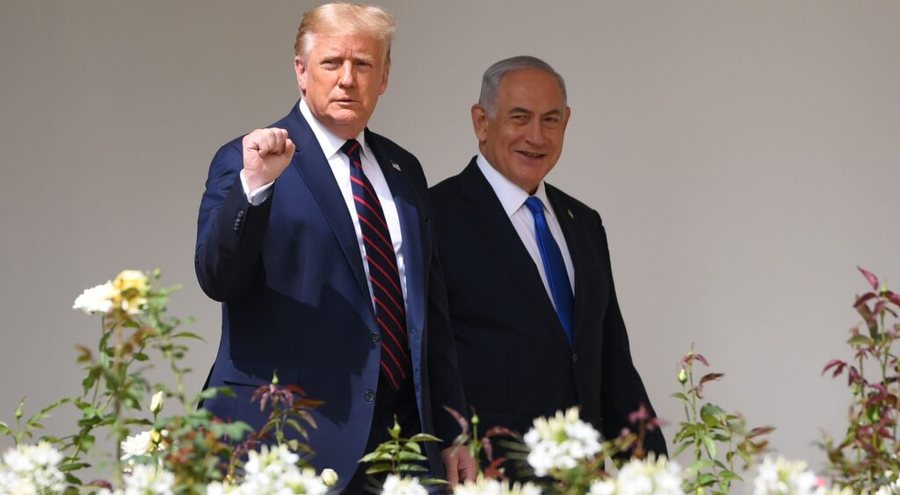
Trump is surrounded by conflict and divisions, Republicans are not united on foreign policy.
During the four years of Donald Trump's presidency, the underlying conflicts in the Middle East were under control. The election of Joe Biden was supposed to herald the return of reasonable decision-making, but chaos has arisen in the region during his tenure.
How Middle East policy might change in a hypothetical second Trump term is difficult to judge, especially given the thoroughly ambiguous nature of the former president's foreign policy vision.
Under Trump's leadership, the US delivered a double-edged message: Don't attack the eagle and let's make a deal.
On the one hand, his administration used the tradition of using military power to deter foreign aggression and strike back if the national interest was threatened. On the other hand, it embraced a policy approach of creating alliances based on strategic interests.
US airstrikes hit ISIS, and the military received orders to eliminate high-level targets, such as Iranian general Qasem Soleimani. At the same time, the Trump White House sought to strengthen an anti-Iran coalition while diplomatically integrating Israel into the Middle East.
Fostering ties with Saudi Arabia was part of Trump's Middle East policy, and his administration oversaw deals that normalized Israel's relations with some of its regional neighbors, including Morocco and the United Arab Emirates.
Conversely, Biden's approach to the Middle East has developed from a combination of using the politics of Woodrow Wilson and the idealism of the 1972 Democratic presidential candidate, George McGovern.
Biden took office vowing to make Saudi Arabia a "pariah" state and immediately sought to improve relations with Iran.
This combination may have exacerbated instability in the region. The withdrawal from Afghanistan suggested that the situation was in fact unsustainable because the United States was overtaxed, distracted, and torn by internal divisions. These were an important strategic backdrop for Hamas' October 7 attack on Israel and the Houthi's recent attacks on cargo ships in the Red Sea.
If he were to win again, Trump could be pulled in contradictory directions. One of the most prominent contemporary exponents of foreign policy, Arkansas Senator Tom Cotton, called for strikes against Houthi helicopters and drones in order to protect shipping lanes in the Red Sea.
It is not difficult to guess that if Trump returns, he will continue to develop the same hostilities and launch attacks against the Houthi rebels and other proxies of Iran, especially when his allies in Washington are defending a similar rhetoric.
This military action could dovetail with elements of Trump's past history of supporting Israel while pursuing policies to contain Iran.
During Trump's time in office, defense spending increased. However, some Trump officials are now suggesting a more sweeping reduction in the military budget.
Appointed as Deputy Secretary of Defense after the 2020 presidential election, Christopher C. Miller has been mentioned by Trump himself as a possible Pentagon chief if he wins a second term.
Miller thinks the defense budget could be cut in half, a cut that would be a major departure from the policies that led Republicans during Trump's first term and could send geopolitical shockwaves around the globe.
Trump is surrounded by conflict and division. Republicans are not united on foreign policy. What "America First" means for the Middle East may be a hasty decision, and the future of the region may depend on it. / Unherd



Lini një Përgjigje