


 Shkruar nga Pamfleti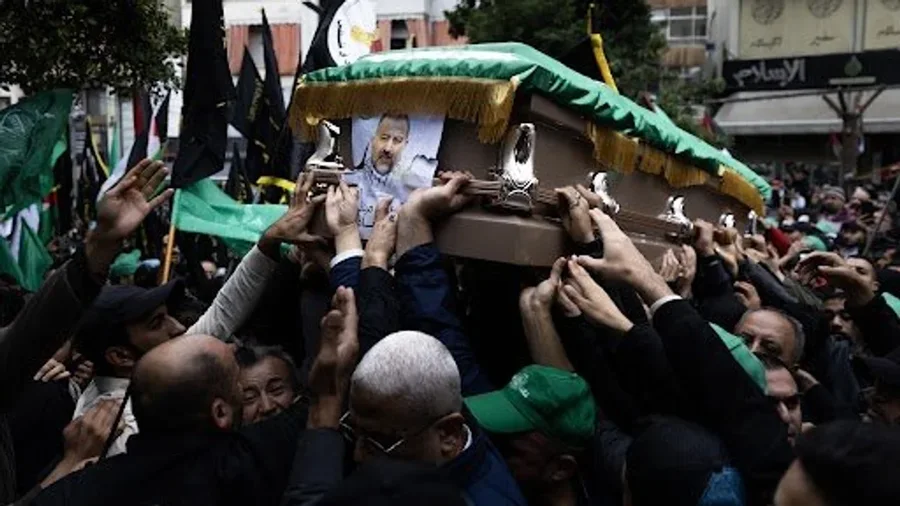
The assassination of Hamas boss Saleh al-Arouri, killed in a densely populated neighborhood of Beirut, was the work of the Mossad. Israel's famed intelligence agency relied on its on-the-ground network of human resources and state-of-the-art technology to track down al-Arouri, in an apartment building in a southern Beirut neighborhood, a security stronghold of Lebanon's powerful Hezbollah.
Al-Arouri, 57, was the first high-profile Hamas official to be killed since the war broke out in Gaza. As Hamas's deputy chief, he was believed to be the architect of the group's closer ties to Hezbollah and Iran, and was one of the founders of the group's military wing, the Qassam Brigades.
It was arguably the biggest single "victory" in Israel's stated goal of dismantling the militant group, which has included public vows to hunt down and kill Hamas leaders in Gaza and abroad. It was also a boost for the Mossad, which has been reeling since the intelligence failures leading up to 7 October.
A day after the successful elimination of al-Arouri, Mossad chief David Barnea vowed that the mission to take out Hamas leaders would resemble Israel's decade-long operation to kill Palestinian militants involved in the killing of 11 athletes. Israelis at the Munich Olympics in 1972.
"Let every Arab mother know that if her son participated in the massacre, he signed the death warrant," Barnea said, referring to the October attack. His comments came during the funeral of former Mossad chief Zvi Zamir, who oversaw Israel's operation to kill the Munich plotters.
Israelis celebrated his killing, while newspapers discussed how his killing would affect Hamas's capabilities and its supply lines to Hezbollah and Tehran. Others have debated whether carrying out the attack in Lebanon risks expanding the war across the Middle East region.
However, while few can deny that the operation was a moral boost for Israel or... unlike the indiscriminate bombing of Gaza, it was a legitimate military objective. The assassination also raises a fundamental question about the strategy driving the killing campaign.
Could killing the bosses help destroy Hamas?
The Munich 1972 analogy
Former Israeli Prime Minister Ehud Barak was quick to downplay the impact of al-Arouri's killing on Hamas, saying the movement would soon appoint another talented successor.
"It is a mistake to think that this (al-Arouri's killing) will cause a shock to Hamas and there will not be a replacement within 24 hours," Barak said in televised remarks. "Anyone who hopes his replacement will be less talented than he is is also wrong."
Hamas has already survived assassinations of its political and military leaders, ranging from Ahmed Yassin, the movement's founder and spiritual leader, who was killed by Israel in 2004, to Ahmed Jabari, the second-highest military official in Hamas. , who was also killed by Israel in 2012. Jabari's killing sparked a brief war between Israel and Hamas. / Adapted from World Crunch







Lini një Përgjigje