


 Shkruar nga Pamfleti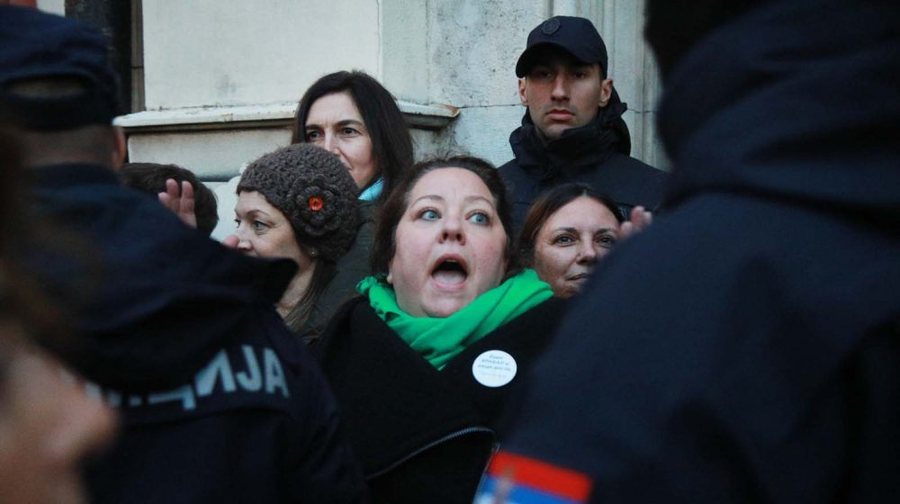
Serbia is moving towards a form of autocracy, which places the country between weak democracy and authoritarianism...
The latest international research lists Serbia mainly among countries where the type of government moves in a range between weak democracy and autocracy, but it can nevertheless be said, with some generalization, that Serbia is among the countries in the process of autocratization, Demostat emphasizes today.
Based on the conceptualization of basic notions from the habitus of autocracy and democracy in the studies of the Bertelsmann Stiftung's Transformation Index (BTI) 2026 and the Liberal Democracy Index (LDI) of the V-Dem Institute, I am inclined to think that Serbia is characterized by an "electoral autocracy" in the process of transition to dictatorship under the guise of democracy, writes Demostat's lead researcher, Srećko Mihailović.
The question arises, if electoral autocracy is the result of electoral manipulations and long manipulative and pathological formats before and during the elections themselves, can we then speak of electoral autocracy or only of autocracy that is "legitimized" through voter fraud, violence against voters, blackmail, and other pathologies.
It is, as Mihailović emphasizes, about the illegal and illegitimate establishment of autocracy – regardless of whether it is about “softer” forms of autocracy or dictatorship itself.
The Swedish institute V-Dem (Varieties of Democracy) compiles in its research project on the varieties of democracy (and autocracy) “the largest global data set on democracy.” For this multi-year project, writes Demostat, two data sets are enough: V-Dem collects, measures and analyzes more than 600 different attributes of democracy, and over 4,200 scientists and experts from many countries are involved in this work.
In this research, countries in 2025 are divided into five categories: liberal democracies, electoral democracies, neither democracy nor autocracy, electoral autocracy, and full autocracy – the latter being countries where there are neither formal elections, nor freedoms, nor fundamental rights.
V-Dem researchers conclude that democracy in the world last year returned to the level of 1978 and that for citizens of Western Europe and North America, in 2025 it is at the lowest level in the last 50 years, largely due to continued autocratization in the United States.
The authors of the V-Dem Institute report point out that at the end of 2025 there were 92 autocracies and 87 democracies in the world, while an even more worrying finding is that 41 percent of the world's population lives in countries where the process of autocratization is underway. Among these countries are Croatia, Italy, Slovakia, Slovenia and the United Kingdom.
The V-Dem report for last year was published in 2026 and according to it, Serbia is in the bottom half of the list that ranks 179 countries according to the level of authoritarianism and democracy. The state of democracy in Serbia is worse than in 111 countries, while Serbia is better than 67 countries.
It is also emphasized that the majority of the population and that part of it called public opinion is dissatisfied with the "work of the institutions", which is considered illegitimate and often even illegal.
Authoritarian power relies largely on the construction and arbitrary regulation of the gap between institutional norms and institutional practice, leading to the de facto usurpation of institutions as a whole. The usurpation of institutions enables the trading, sale, or exchange of “institutional services” for “political services,” Demostat emphasizes.
The usurpation of institutions and the trade in usurped “institutional services” enable the ruling cartel to maximize power that takes on all-encompassing dimensions. Omnipotence based on institutional pathology is presented as “soft power” and this is its (fictitious) advantage over the power of violence as the foundation of the cartel’s power.
It is also emphasized that vote rigging, vote buying, voter blackmail, fake voters and other forms of electoral pathology have caused the complete delegitimization of the March 29 elections, making it possible to say that in those 10 municipalities there are neither winners nor losers, as if the elections had not taken place at all.
It is estimated that the current "cartel" in power in Serbia, especially in the last decade, has four main sources of existing power and its expansion towards omnipotence, increasingly moving away from existing norms and approaching extreme forms of autocracy. Among them are the usurpation of institutions and the trade in institutional services.
Also mentioned are the monopoly on the use and misuse of force and violence, embodied in the official police and in purchased criminal elements, as well as violent party activists, the subjugation of the three branches of government, and the concentration of power in the hands of the "leader of the people" and the top of the cartel pyramid.
Also mentioned is the monopoly over most of the news media, whose main function is to create a "parallel reality" that suits the desires and needs of the ruling cartel. / Adapted from "Danas"






Lini një Përgjigje