


 Shkruar nga Pamfleti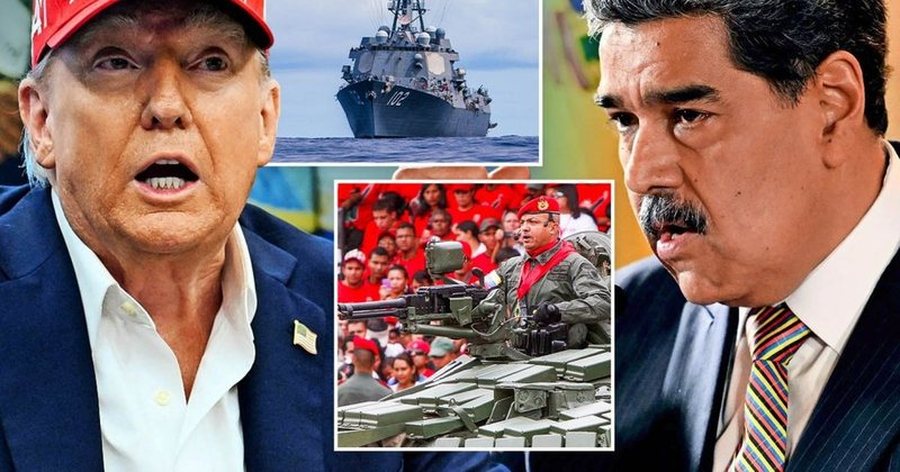
A conflict is raging between the US and Venezuela over alleged drug supplies. But the real target is the world's largest oil reserves.
Scenes of pursuit actions unfold on the high seas. US military forces fire on ships suspected of transporting drugs, Washington and Caracas mobilize troops and warn each other.
First and foremost, the US aims to stop the drug trade from Venezuela by sea to the US.
But behind the scenes, there has long been speculation about the future of Nicolas Maduro, the latter with his socialist regime leading the country, which holds the largest oil reserves in the world.
Background of the conflict
"The current conflict between the US and Venezuela is much more than an ideological dispute - it reflects competition for energy, markets and geopolitical influence in the region," Demian Regehr from the Hans-Seidel Foundation in Caracas, which is close to the Christian Social Party (CSU), tells DW.
Venezuela not only has tensions with the US, but also with neighboring Guyana, where disputes occasionally flare up.
After the discovery of large oil reserves in Guyana, the Maduro regime revived old claims to the territories of the state of Guyana, which could provide Venezuela with access to oil reserves. For this, Maduro refers to old agreements with the former colonial power Britain.
The Rise of Guyana
Since 2015, the amount of oil extracted in Guyana has only increased: "While Caracas emphasizes its claims, the US secures Guyana militarily and through diplomacy, also to protect the billion-dollar investments of its energy corporations," says Regher.
The current US military operation against Venezuela has the side effect of being quickly on the scene in the event of a possible Venezuelan invasion of Guyana, which Maduro occasionally mentions.
US companies ExxonMobil and Chevron are active in Guyana. With their investments, these companies have contributed to the country's oil production reaching around one million barrels per day.
The fall of Venezuela
While the Maduro regime now looks enviously at the oil boom in Guyana, Venezuela's industry has collapsed. This is largely due to domestic political failure. Venezuela's state-owned oil company PDVSA, once one of the most well-organized energy companies in South America, has become an arm of the socialist ruler.
Instead of experts with know-how, non-professionals, party soldiers, took over the management. From around 138 million tons in 2013, oil production fell to 34.5 million tons in 2021, only in recent years has there been a slight increase.
The decline was accelerated by US sanctions, as Venezuela's socialists ignored the significant defeat they suffered in parliamentary elections in 2015 and further intensified repression of the opposition.
China benefits
China is benefiting from these developments. Since US sanctions have made it difficult for Venezuela to access the American market, or even blocked it altogether, Caracas transports a large part of its high-cost exports to China via camouflaged fleets.
China is getting its oil at a bargain price – and it has already taken steps to secure its future supply. According to local media, Venezuela and Chinese company China Concord Resources Corp (CCRC) have signed a cooperation agreement. The agreement will see the creation of a floating platform that will increase oil production in several oil fields by fivefold to 60,000 barrels per day by the end of 2026.
This was made possible by an anti-blockade law passed in 2020, through which foreign investors can invest in Venezuela despite US sanctions.
For Beijing, Venezuela is attractive because it supplies cheap oil, even though China's refineries are not suitable for Venezuelan heavy oil and the transportation routes are long, says Regehr of the Hans-Seidel Foundation in Caracas. "China is pursuing two geostrategic objectives with this: On the one hand, it covers part of its energy needs at a favorable cost and at the same time avoids the US sanctions policy, consolidating its claim as a counterweight to Washington in Latin America," Regehr analyzes.
For the future, this means that as long as the sanctions remain in place, Venezuela will remain a “discount supplier,” meaning a supplier that is forced to sell its goods cheaply due to its isolation. But if the country manages to regain access to markets in the US and Europe, China could lose influence, as Caracas will benefit from oil exports.
Maduro targets Europe
That is precisely why Maduro is now trying to woo the Europeans. Meanwhile, Europe is just a spectator, while the world powers the US and China are securing the options in the region. “How long will Europe submit to instructions from Washington?” Maduro asked at a press conference in early September, and called on the Europeans to ignore US sanctions and come to Venezuela. “Here you are free, come and produce, let us continue to produce with or without a license,” says Maduro.
Whether Maduro succeeds in his appeal remains to be seen. European oil companies like Spain's Repsol are already lining up to take over. US sanctions place strict limits on their operations.
But another reason for the Europeans' distancing is Maduro himself: his government's serious human rights violations and electoral fraud in the 2024 elections./DW




Lini një Përgjigje