


 Shkruar nga Pamfleti
As negotiators in Geneva try to find a diplomatic solution to the nuclear crisis between the US and Iran, the latest scenarios are being prepared in military operations rooms. The process takes place amid mutual pressures, fears of hasty steps and strategic signals aimed at forcing the other side to reveal its positions.
Some of the military movements are visible. The US aircraft carrier USS Ford has departed from Souda Bay in Crete for the eastern Mediterranean. Images published on social media confirm its departure. In parallel, a private Chinese company has distributed satellite images showing the movements of the US Air Force in the region.
The Diego Garcia atolls in the Indian Ocean – a base used by the US and Britain – have been home to reconnaissance aircraft, aerial refueling tankers and F-16s transferred from Misawa base in Japan. London reportedly would not allow the base to be used for direct attacks on Iran, but this has not prevented the deployment of aircraft with a support and defensive role. Military analysts note that China is monitoring these developments to analyze American tactics from the perspective of Taiwan.
The air presence is also expanded in Jordan, at the Muwaffaq Salti base, where F-35 aircraft are located. A new development is the transfer of about 12 F-22 aircraft to the Israeli Ovda base. The Pentagon has mobilized the most advanced aircraft to strike potential targets and to face any Iranian response. The logistical dimensions are huge: over 100 tanker aircraft are deployed to various bases, from Bulgaria to the Persian Gulf and Israel, to support strategic bomber missions and long-range operations.
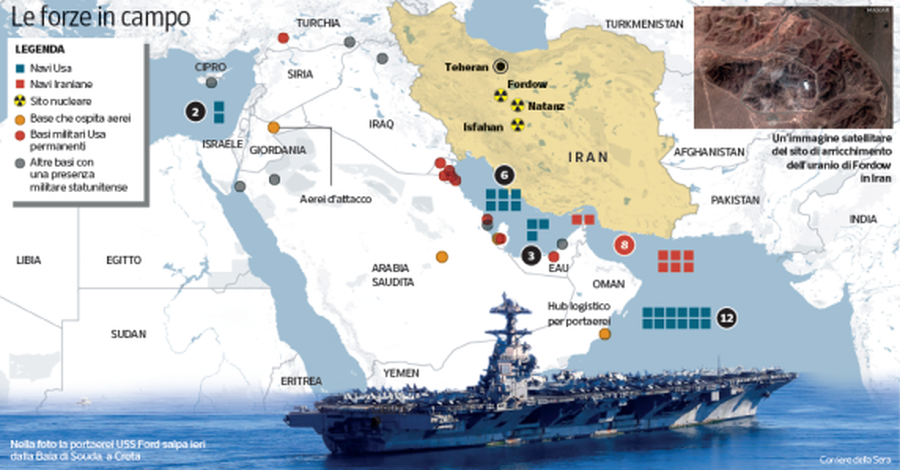
The scenarios circulating range from limited attacks aimed at pressuring Tehran to a broad air campaign. There is also intensive transport of equipment for anti-aircraft systems, supported by radar networks and reconnaissance aircraft such as AWACS, RC-135, U-2 and drones, which monitor Iranian movements and possible missile launch positions.
In addition to the Ford, the aircraft carrier USS Lincoln is also operating in the region, east of the Strait of Hormuz. The naval force includes over 20 units, including nuclear submarines and destroyers equipped with cruise missiles, capable of striking strategic targets, including nuclear installations and Revolutionary Guard bases.
However, concerns have been raised within the US establishment. The Chief of Staff, General Dan Caine, has warned of high consumption of anti-aircraft ammunition and the risk of casualties in the event of a prolonged conflict. In previous confrontations, the US and Israel used significant quantities of missiles to neutralize drone and missile attacks.
According to sources cited by the New York Times, the US can afford intensive operations for a limited period, about 7–10 days, although this is considered by some to be part of a strategic information game. The cost of maintaining such a force in the region is estimated at tens of millions of dollars per day.
The June Israel-Iran conflict revealed the weaknesses of the Iranian system, but, at the same time, demonstrated the capabilities of the Pasdaran. They studied, tried to correct mistakes and threatened retaliation on multiple levels. American bases are highly exposed and the alarm is high about the initiatives of Shiite militias. And in the background, the biggest doubt remains: what is Trump's ultimate objective. That is why uncertainty and fear of devastating consequences reign supreme.






Lini një Përgjigje