


 Shkruar nga Pamfleti
A group linked to Viktor Orban's allies is exploiting clashes over monitoring to deploy its own observers...
The emergence of alternative election monitoring groups, including a team created by allies of Prime Minister Viktor Orban, is raising the possibility of political unrest and contested results after Hungary's general election on April 12.
Concerns are already high that the election result will be appealed by the losing side, as the campaign has been marred by smear tactics and accusations of foreign interference, further increasing the importance of election observers.
Orban is facing his biggest political battle to retain power after 16 years in power, but his opponents say he has an unfair advantage thanks to media control, electoral manipulation and vote-buying. His ruling party, Fidesz, denies the charges.
The Organization for Security and Cooperation in Europe (OSCE) has sent election observation missions to more than 30 countries over four decades, but has now faced accusations of foreign interference in Hungary, particularly over the role of a former Russian Foreign Ministry employee who worked as a translator for President Vladimir Putin.
Orban's conservative allies are exploiting disagreements over election oversight to create their own observation team, a development that could create confusion by presenting different versions of events on election day.
“If pro-government missions are deployed, the result could be a clash of narratives that will cloud the outcome of the elections,” said Peter Kramer, an EU observer with over 16 years of experience and head of the 20k vote integrity group.
Russian translator at the center of controversy
The OSCE sends international teams to assess whether elections meet democratic standards. In recent years, the organization has been critical of Hungary, saying the elections are “vulnerable to a lack of a level playing field.”
However, ahead of this year’s elections, the organization has faced accusations that its operations in Hungary have been compromised. In March, journalists and human rights organizations identified Daria Boyarskaya, who had worked as a translator for Putin at key meetings with the US, as a senior advisor to the OSCE Parliamentary Assembly, helping coordinate election monitoring.
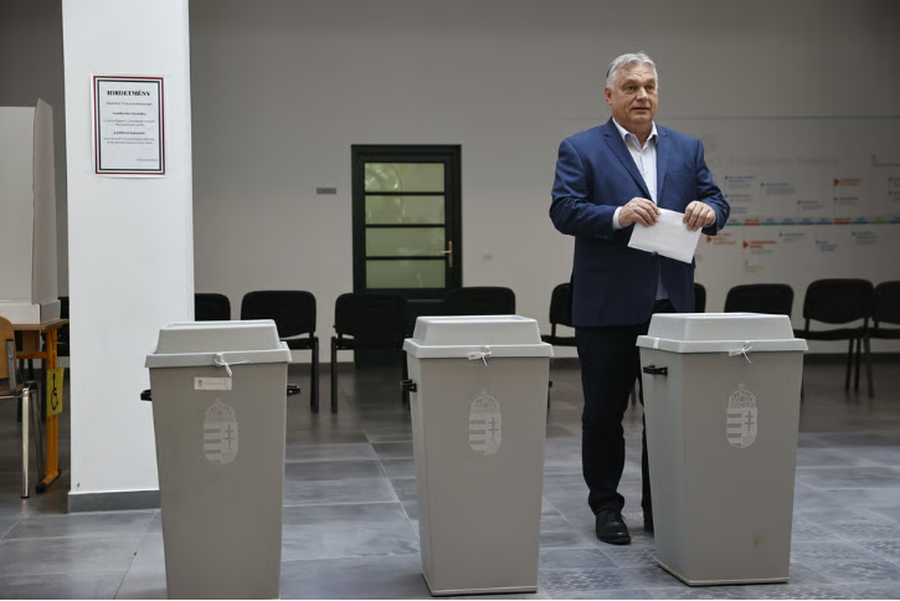
Orban is considered the EU leader closest to the Kremlin, and the issue has raised doubts about the mission's credibility. Marta Pardavi, co-chair of the Hungarian Helsinki Committee, said the situation undermines the necessary trust.
"When Putin's former translator organizes the OSCE mission, public perception undermines this necessary trust," she said, adding, "how can we be sure that the information we share will remain secure?"
OSCE spokesman Nat Parry denied the allegations, stressing that Boyarskaya was not Putin's personal translator and that the attacks against her were based solely on her nationality.
“She was an employee of the Russian foreign ministry and was occasionally assigned to translation duties for foreign delegations,” Parry said, describing this as a standard professional function.
However, organizations such as the Helsinki Committee and Transparency International Hungary insist that its past and the level of security it has had raise questions about the mission's integrity. Transparency International Hungary has announced that it will boycott this year's mission.
Pardavi added that in a context where the government exerts pressure on civil society and journalists, international observers must ensure full trust in actors who share sensitive information.
Risk of confusion
The Parliamentary Assembly mission, of which Boyarskaya is a member, is tasked with coordinating visits by foreign lawmakers to polling stations.
Parry warned that the controversy could damage the mission's own credibility. He said the public campaign against the case could cause the very damage it purports to prevent.
In parallel, the OSCE Office for Democratic Institutions and Human Rights is sending hundreds of experts to observe the process at a technical level and provide a final legal assessment of the integrity of the elections. This process also risks being affected by controversy.
In another development, international right-wing groups affiliated with Fidesz have created a new observation mission: the “Liberty Coalition for a Free and Fair Election.”
The mission is led by Anna Wellisz and Polish jurist Jerzy Kwasniewski, figures connected to international conservative networks and important political conferences.
According to their statement, the decision to monitor the elections came in response to criticism of the OSCE and the refusal of some experts to be included in the mission.
Hungarian government spokesman Zoltan Kovacs stated that he does not trust some parts of the OSCE reports, describing them as "political opinions."
Meanwhile, Balazs Orban, the prime minister's political director, welcomed the new mission, saying that "independent eyes help the result speak for itself."
Experts warn that the presence of rival missions could lead to conflicting interpretations and make it difficult to accept the final election result. /Adapted from Politico /








Lini një Përgjigje