


 Shkruar nga Pamfleti
"It is our view that a ceasefire would simply leave Hamas in a position to regroup and repeat what it did on October 7," Blinken said.
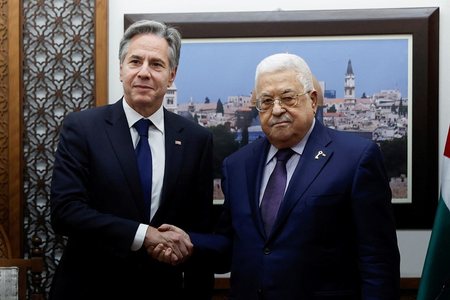
US Secretary of State Antony Blinken continued the frenzied diplomatic scramble in the Middle East over the Israel-Hamas war in the West Bank on Sunday, meeting with Palestinian President Mahmoud Abbas in his bid to ease the suffering of civilians in the Gaza Strip and to to begin drafting a scenario for the post-conflict period.
Secretary Blinken traveled to Ramallah on his unannounced visit, in an armored convoy and under tight security, just hours after Israeli warplanes struck a refugee camp in the Gaza Strip, killing at least 40 people and injuring dozens more, the territory's health officials said. Despite the secrecy and the State Department's refusal to confirm the trip until after Secretary Blinken had left the West Bank, protests erupted against his visit and American support for Israel after word of his arrival leaked.
Neither man spoke as they greeted each other in front of the cameras and the meeting ended without any public comment. It was not immediately clear whether the lack of comment indicated the meeting had gone awry.
State Department spokesman Matthew Miller said Secretary Blinken reaffirmed the US commitment to providing humanitarian aid and resuming essential services in Gaza, and made it clear that Palestinians should not be forcibly displaced.
Secretary Blinken and President Abbas discussed efforts to restore calm and stability in the West Bank, including the need to end extremist violence against Palestinians and hold perpetrators accountable, spokesman Miller said, referring to violence by Israeli settlers.
The meeting with Mr Abbas, president of the Ramallah-based Palestinian Authority, which has not been a factor in Gaza since Hamas took it by force in 2007, came at the start of the third day of a busy tour by the secretary Blinken in the Middle East, the second since the war began with a surprise attack by Hamas on Israel on October 7. Secretary Blinken visited Israel and met with Israeli Prime Minister Benjamin Netanyahu on Friday, before leaving for Jordan for meetings with senior Arab officials on Saturday.
At each stop, Secretary Blinken expressed strong US support for Israel's right to defend itself, but also stressed that it must abide by the laws of war, protect civilians and allow humanitarian aid to flow into Gaza. To do so, as well as ease the tide of foreigners fleeing Gaza, he has demanded that Israel implement permanent humanitarian pauses in its airstrikes and ground operations, a demand that Prime Minister Netanyahu has so far rejected. categorically.
US officials believe that Prime Minister Netanyahu may soften his opposition if he can be convinced that it is in Israel's strategic interests to ease the plight of Palestinian civilians in Gaza. The rising death toll has sparked international outrage, with tens of thousands of people from Washington to Berlin taking to the streets over the weekend to demand an immediate ceasefire.
The Arab foreign ministers of Jordan, Egypt, Saudi Arabia, Qatar and the United Arab Emirates, with whom Secretary Blinken met Saturday in Amman, emphasized the same request.
But Secretary Blinken said the US will not seek such a ceasefire.
"It is our view that a ceasefire would simply leave Hamas in a position to regroup and repeat what it did on October 7," he said. Instead, he said temporary humanitarian pauses in the fighting would be essential to protect civilians, deliver aid and remove foreign nationals "while enabling Israel to achieve its goal of defeating Hamas." .
Arab officials said it was too early to discuss one of the top items on Secretary Blinken's agenda, the future of Gaza after the war. Stopping the killings and restoring sustainable humanitarian aid are urgent and must be addressed as a matter of priority, they said.
Arab states are resisting US suggestions for a greater role in resolving the crisis, expressing anger at the number of civilians killed in Israeli military operations, and asserting that Gaza is a problem largely of Israel's making.
But U.S. officials believe that Arab support, however modest, will be essential in efforts to ease deteriorating conditions in Gaza and lay the groundwork for what would replace Hamas as the territory's governing authority, if and when Israel succeed in eradicating the cluster.
Ideas for the future governance of Gaza are still scarce. Secretary Blinken and other US officials are offering a vague outline that could include a combination of reviving the Palestinian Authority alongside international organizations and a possible peacekeeping force. American officials admit that these ideas have been met with an apparent lack of enthusiasm./ VOA







Lini një Përgjigje