


 Shkruar nga Pamfleti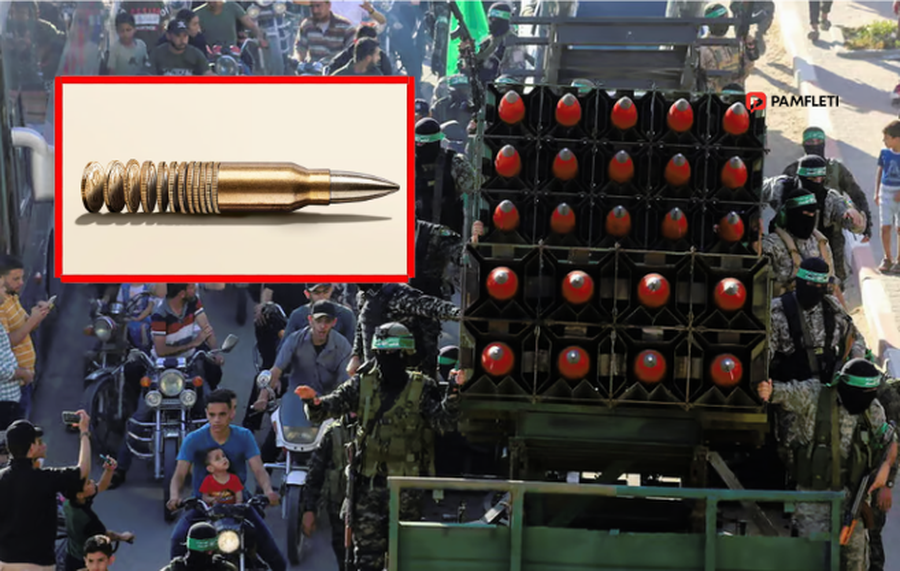
For Israel, the scenario of Hamas becoming richer despite the ongoing war in Gaza would be very bad. Because with its wealth and financial roots intact, it, or a similar organization, can thrive after destruction.
Seen from one of Istanbul's finest restaurants, the Bosphorus looks majestic. The country is a favorite retreat of businessmen, celebrities and Hamas financiers. A man on whom America has imposed sanctions for financing the Islamic group talks about the roles he has on various boards.
"They are ridiculous," he says, when asked about the US accusations. But in the end he admits: "Now, if you're asking me what our employees do with their money, why should I know?". Hamas has three sources of its power: physical strength inside Gaza, the breadth of radical ideas, and its income.
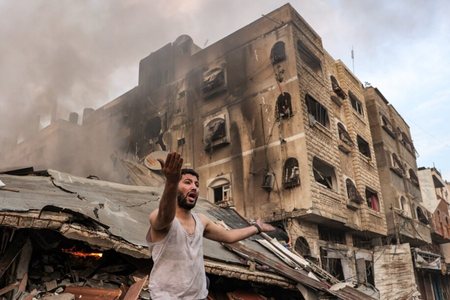
Since the Hamas attacks on October 7, Israel has killed more than 12,000 Palestinians in Gaza in an effort to destroy the extremist organization. But Israel's stated intention to do so also requires dismantling its financial base. And very little of the latter is found in Gaza.
At most, it is mostly found outside Gaza, in countries friendly to the movement. Equipped with money launderers, mining companies and many other tools, Hamas's financial empire is estimated to rake in more than $1 billion a year. Since it was carefully designed to avoid Western sanctions, it may be out of reach for Israel and its allies.
Hamas' income pays for everything from teachers' salaries to rockets. About $360 million is collected annually from import taxes on goods brought into Gaza from the West Bank or Egypt. This is the easiest source of money that Israel can block.
After withdrawing from the Gaza Strip in 2005, it severely restricted the movement of goods and people across the border. Now it is stopping the entry of even the most basic products for normal living. However, a much larger flow of income comes from abroad.
Israeli officials believe it amounts to about $750 million a year, making it the main source of funding for Hamas' current arms and fuel stockpiles. Some come from friendly governments, and most belong to Iran. The US estimates that Iranian Ayatollahs provide $100 million to Palestinian Islamist groups, mostly in military aid. The task of Hamas financiers is to move this money without falling prey to America's sanctions. In the past month alone, US officials have imposed 3 rounds of sanctions on people and companies for funding Hamas.
Avoiding US sanctions requires some ingenuity. Millions of dollars go to Hamas through cryptocurrency markets.
"You would be surprised how much of the commercial activity goes to the account of Hamas" - says Firuze Segzin, economist at Bilkent University.
The US Treasury Department says Hamas has smuggled more than $20 million through Redin, a foreign exchange agency located in Istanbul's old Fatih neighborhood. But the bulk of Hamas' money — at least $500 million a year, according to Israeli officials — comes from its investments, some of which are companies registered in Middle Eastern countries.
They are run by experts from the Hamas investment office, and the employees are members of the movement. US officials say these companies donate money to charity, which they in turn send in the form of funds to Hamas. Turkish officials acknowledge that sometimes profits are distributed directly. Unraveling the flow pattern through which these revenues move is quite complicated for Western regulatory bodies.
One such company built "Afra Mall", the first shopping center in Sudan, while another a mine near Khartoum, the capital of the country. A third built several skyscrapers in Sharjah, in the United Arab Emirates. Most of these companies boast of their business deals, but deny any connection to Hamas.
Can any of Hamas' remaining revenue streams be cut off? It depends on the countries through which they flow. Since 1989, when Israel arrested several senior Hamas leaders in Gaza and the West Bank, the organization's bankers have lived abroad.
But over time, geopolitical changes have forced them to keep moving from time to time. Thus Hamas abandoned its first financial center, Amman, after Jordan's ties with America were greatly strengthened.
Today, while Hamas politicians prefer Doha, the capital of Qatar, and its companies stretch from Algeria and Sudan to the United Arab Emirates, the organization's financiers live en masse in Istanbul. Zaher Jabarin, accused by Israel of running Hamas's finances (a charge he denies), also lives there, as do several other individuals who are under US sanctions for funding the organization.
Keen to gain regional influence by supporting the Palestinian cause, Turkey's president, Recep Tayyip Erdogan, repeatedly offers them shelter. Israel says the Turkish government gives it passports (a charge it again denies), and allows Hamas to have its headquarters in the country.
Meanwhile, Turkey's banking system helps Hamas evade US sanctions, managing to conduct complex transactions around the world. It is also helped by the booming cryptocurrency market. Many of Turkey's biggest banks, including Kuveyt Turk, have been accused by Israel and the US of knowingly storing Hamas money. There are even rumors that Erdogan tacitly approves of this practice. In 2021, the Financial Action Task Force, an oversight body of G-7 countries, placed Turkey on the "grey list" of countries that do too little to freeze terrorist assets. No one benefits more than Hamas businessmen.
The Turkish government's tacit approval "opens doors and makes it easier to do business," says one of the group's finance employees. Trend Gyo, an Istanbul-registered company that has been placed under US sanctions for funneling funds to Hamas, recently won a tender from the Turkish government to build the Istanbul University of Commerce.
Construction companies, which feature heavily in Hamas' investment portfolio, can quietly absorb large amounts of money and regularly take out large loans. And all this allows Turkish officials to say that they are not directly covering Hamas's finances.
So far, Hamas seems impervious to strikes, at least financially. Israel has caused damage to the infrastructure, but not to the income and monetary savings of the organization. Turkish banks have not been cooperative at all. The many sanctions imposed by America are less effective if their targets are able to keep money outside of its banking system.
And Hamas knows how to hide its companies well.
"Every time you think you have a big fish in your hands, it changes its name" - says a former US Treasury official in despair. There is even a risk that Hamas's finances will improve even further. As Israel ramps up its attacks on Gaza, Western governments may be greatly affected by the humanitarian catastrophe there.
Under these conditions, countries with pro-Palestinian populations can make it even easier for Hamas to make money. For months, there have been rumors that some civil servants in the Ministry of Economy in Turkey are coordinating actions with the finance office of Hamas.
For Israel, the scenario of Hamas becoming richer despite the ongoing war in Gaza would be very bad. Because with its wealth and financial roots intact, it, or a similar organization, can thrive after destruction.
Meanwhile, the people of Gaza are mired in a great tragedy so that Israel can destroy a group whose money and power are safe elsewhere. Compare their situation a little with the panorama of the leaders of Hamas in Istanbul: eating lobsters, and gazing with delight at the Bosphorus. / Taken from The Economist





Lini një Përgjigje