


 Shkruar nga Pamfleti
US aims to hit Iranian economy as risk of escalation in Hormuz grows
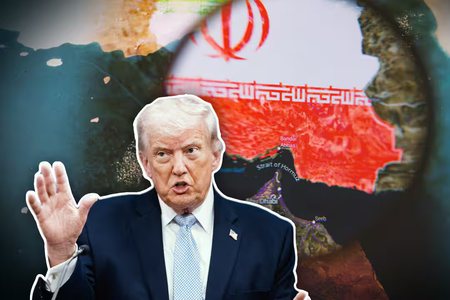
US President Donald Trump appears to have reached a conclusion that is defining the new phase of the conflict with Iran: if weeks of airstrikes have not broken Tehran's resistance, then economic pressure may do so.
In this logic, the naval blockade of the Strait of Hormuz came into effect at 17:00 Greek time, immediately after the failure of weekend talks in Pakistan, which produced no progress. In this context, Trump warned through a post on “Social Truth” that the US would strike any ship approaching the blockade zone.
" The Iranian Navy is at the bottom of the sea, completely destroyed - 158 ships. What we have not hit are some of the small so-called 'fast attack' boats, because we did not consider them to be a major threat. Warning: if any of these boats come near our blockade, they will be hit immediately, with the same system we use against smugglers at sea. It is fast and hard. 98.2% of the drugs entering the US by sea are stopped ," Trump wrote.
This move does not simply represent an increase in military pressure, but opens a new chapter in the conflict, where Washington aims to strike Iran not only on the battlefield, but also on its economic bases: exports, ports and trade flows. In this way, not only Iran's military capacity is tested, but also the regime's resilience in the face of prolonged economic pressure.
However, it remains unclear for the American side whether this strategy will bring the expected results. Experts emphasize that Tehran has shown in the past the ability to withstand high costs, especially when it considers that its strategic interests and survival are at stake. This means that the blockade can increase pressure, but does not necessarily guarantee a political retreat.
On the other hand, Iran has several options to respond. According to analysis by the International Institute for Strategic Studies (IISS), Tehran could try to bypass the Strait of Hormuz through alternative export routes, such as pipelines to Iraq, Turkey and Armenia, or through terminals in the Caspian Sea.
Another option is to expand informal trade networks, including smuggling fuel across the border with Pakistan or mixing Iranian oil with Iraqi oil, a practice used before.
The third, and most dangerous, option remains military response, including attacks on US naval units or activating regional allies, such as the Houthis, to exert pressure on other strategic points such as Bab el-Mandeb.
The situation on the ground already reflects this climate of tension. Traffic in the Strait of Hormuz continues, but under increased surveillance and with a high level of uncertainty. Dozens of ships have been reported in the areas around the main Iranian ports of Bandar Abbas and Bushehr, while the movements of tankers and merchant ships show increased caution and diversions.
The American strategy seems to aim not necessarily at the total closure of the strait, but at creating an environment where cost, risk, and uncertainty gradually increase for Iran and its trading partners.
However, Trump's threats against small Iranian vessels point to another dimension of the conflict. Military analysts point out that these small, fast vessels constitute a key element of Iran's asymmetric strategy, capable of creating major destabilization with relatively limited means.
In this context, the US may aim for a model of continuous and time-distributed pressure, with targeted strikes and without immediately entering into an open, large-scale conflict.
However, the Strait of Hormuz remains one of the most sensitive points of the global economy. Any prolonged escalation in this area is expected to be reflected not only in military terms, but also in energy prices, transportation costs and global economic stability.
At this stage, the main question remains whether US economic and military pressure will be enough to force Iran into concessions, or whether the conflict will turn into a long test of endurance between the two sides. / Adapted from "Protothema"



Lini një Përgjigje