


 Shkruar nga Pamfleti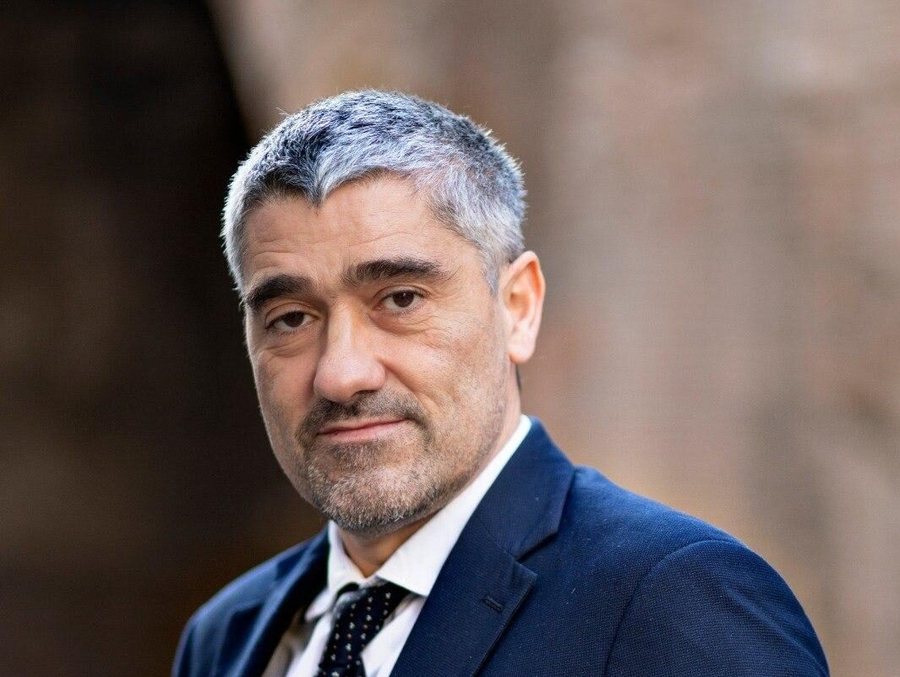
Italian MP Roberto Traversi (M5S) spoke to local media after a visit to Albania. He saw the Gjadri camp up close. He described it as a prison.
"They objectively look like real prisons. The fact that they were built abroad highlights the bureaucratic and legal complexities, as well as the logistical and diplomatic ones, associated with the construction and operation of the two complexes," he told La Notizia.
-Traversi, returning from your mission in Albania – we recall that you are also a member of the Italy-Albania Interparliamentary Group – what impressions do you bring about the two centers in Shëngjin and Gjadra?
The two migrant centers are in all respects the emblem of another “communication illusion” of this government. Albania is a developing country with rich potential, with a welcoming population that has always been very united with our country. But my opinion on the management of migrants on Albanian soil is very negative and the path of cooperation should be followed despite the various projects with which all the first structures were designed. They objectively look like real prisons. The fact that they were built abroad highlights the bureaucratic and legal complexity, as well as the logistical and diplomatic ones related to the construction and operation of the two complexes. Connected by a difficult road, is the second one in Gjadra, where three structures have been built: a detention center for asylum seekers (880 places), a CPR (144 places) and a prison (20 places). Obviously everything is managed by the Police, Guardia di Finanza and the Italian Prison Police, as well as legal figures, cultural mediators and magistrates who must be contacted from Italy to resolve disputes.
-Can the externalization of borders and the Italian model really be the key to managing illegal migration flows in Europe?
I would say absolutely not. There is no doubt that Italy alone cannot face such a huge phenomenon as immigration with its own forces, but thinking about doing so is illusory. Those who speak in a purely ideological way of welcoming, without going into the merits of the difficulty of management, fall into hypocrisy. First, because those who flee from despair are better off if they are going to do anything in the future. They have the opportunity to move, they do so in the hope of not being intercepted. Second, those who manage and profit from the trafficking of illegal immigrants, identically will not stop cursing the despair of others, regardless of their destination. They have become a cathedral in the desert, a failure that cost a billion and having hastily taken 40 people from Italian centers last Friday, is just a formal exercise in pretending that they are being used after almost a year.
-Meanwhile, according to the conclusions of the Advocate General of the Court of Justice of the European Union, the mere fact that a third country has been designated as a safe country of origin by a legislative act cannot have the consequence of excluding it from the examination of its legitimacy. Good news?
Of course, because we have always held the position that the judge will assess on a case-by-case basis whether the accelerated border procedure (applicable only in the case of origin from a safe country) can be applied in the specific case, taking into account the territorial specificities of the individual country and the interested party.
-How can we reconcile the fight against illegal immigration with the need for labor denounced by Confindustria and which has not found sufficient response in the decree on flows?
It is essential to combat illegal immigration and this can be attempted by identifying paths that guarantee protection and rights and training for all, so that what is a problem also becomes an opportunity for the needs that Confindustria seeks. Unqualified reception is equivalent to non-reception and for this reason it is important to identify appropriate selection methods in relation to asylum seekers”.
-Thinking about justice, we have seen that – precisely in the migrant file – tensions between the judiciary and the executive have worsened. What is the current health of the relationship between these two branches of state? Is the climate right for reform?
We have always defended the principles provided for in the Constitution, strongly recognizing the autonomy of the judiciary and have always fought the actions of this government that is shaking the weapons of justice day after day. At the same time, being elected and being a majority does not mean “we can do what we want” and even less that we are inclined to respect, or not to modify, the law. not respecting the sentences of judges So, ultimately, we are very concerned about the health situation and the relationship between the two powers and, given this, we can safely say that there are no premises to implement a wise reform.







Lini një Përgjigje