


 Shkruar nga Pamfleti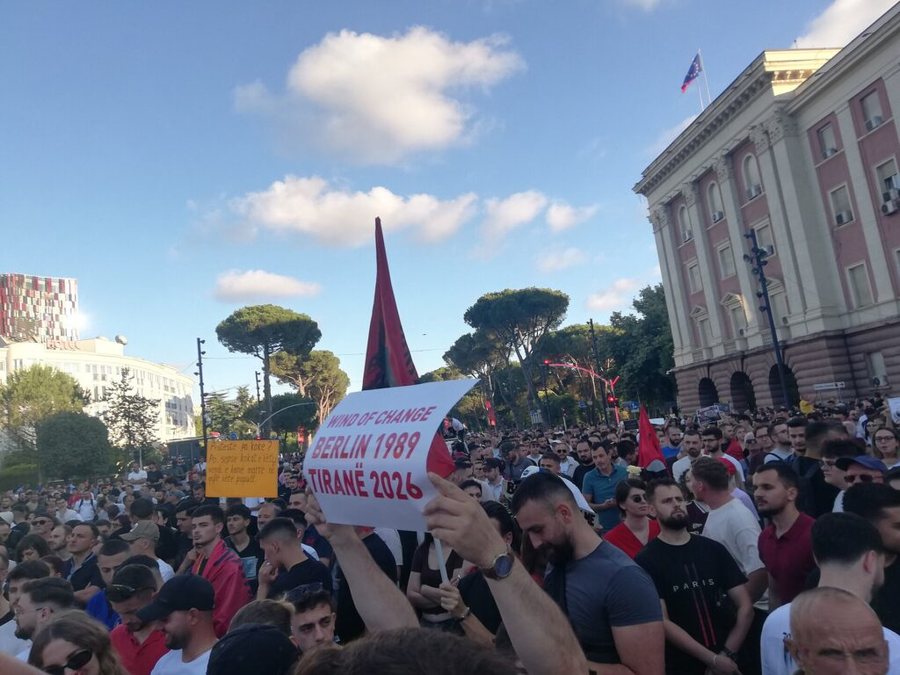
From a protest to protect the Narta Lagoon, the movement has transformed into a political challenge to Edi Rama's government, with demands for the resignation of the prime minister, constitutional reform, and a stronger fight against corruption.
What initially seemed like an environmental mobilization quickly turned into something much broader: a protest against the government of Prime Minister Edi Rama, whom demonstrators accuse of a lack of transparency, corruption, and a personal way of exercising power.
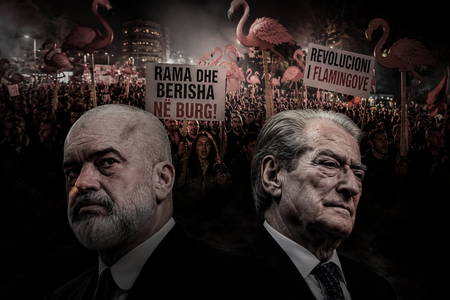
Footage from recent weeks shows an extraordinary turnout. Tens of thousands of people have marched along the grand "Martyrs of the Nation" boulevard to Skanderbeg Square, giving life to what the media has already dubbed the "Pink Flamingo Revolution." The name comes precisely from the bird symbol of the Narta Lagoon, a natural habitat that environmentalists believe is threatened by the construction project.
From the environment to the demand for a new place
However, the demands are no longer just about environmental protection. Over the days, the movement has developed a much broader political platform. Organizers are calling for the resignation of Prime Minister Edi Rama, the temporary replacement of the government, deep constitutional reforms, a more effective fight against corruption, and more transparency in institutions. The slogans heard during the protests speak of a "New Albania" and a country that is no longer hostage to the economic and political interests of a minority.
The square is surprisingly diverse. Alongside the environmentalists are students, professionals, civil servants, businessmen, artists, retirees, and families. Many of them do not identify with any political party, but share the conviction that the Zvërnec project has become a symbol of a governance model that prioritizes large investments and private interests, to the detriment of citizen participation.
The word that is repeated by everyone: "fear"
However, the word heard most often among protesters is not "change." It's "fear."
It's not the fear of road accidents. It's something much more everyday. The fear that you might lose your job. That you might be subject to administrative controls. That your economic activity might be damaged. That you might pay the price for a photo published on social media.
A taxi driver says he shares the reasons for the protest, but cannot participate in it. He also works in public administration and fears that his presence in the square could cost him his job. Others explain that they constantly receive calls from family members, who ask them not to publish photos from the protests, not to appear in videos and not to expose themselves.
Even many small entrepreneurs report living in fear of possible retaliation in the form of tax or administrative audits. Whether these fears are well-founded or simply perceived, their effect is real: they fuel silence and self-censorship.
And that's exactly how the words take on a special meaning. Arben, one of the most recognizable faces of the protest, says: "I've been waiting for this moment for twelve years. If something happens to me, at least I'll know I did the right thing."
It is a sentence that sums up the feeling of a part of Albanian society: the conviction that the cost of silence has become higher than that of protest.
Flamingos as a symbol of freedom
It is no coincidence that the symbol of mobilization is precisely a pink flamingo.
The poster, created by the Trivet Art collective, depicts a flock of flamingos in flight, accompanied by the phrase "Together, free, without fear." The image directly references the Narta Lagoon, where thousands of flamingos stop each year during migration, but it has also become a metaphor for a movement that is trying to transform an environmental battle into a broader demand for freedom and participation.
After more than a month of daily protests, the "Flamingo Revolution" is now much more than a protest against a resort. It has become the story of a country that, starting from the protection of a protected natural area, has chosen to question the relationship between citizens, power and democracy. And perhaps it is no coincidence that the most spoken word in Tirana's squares continues to be "fear": because it is precisely out of fear, today, that the organizers of the protest are trying to liberate Albania. / Adapted from “ Italia-Informa ”



Lini një Përgjigje