


 Shkruar nga Pamfleti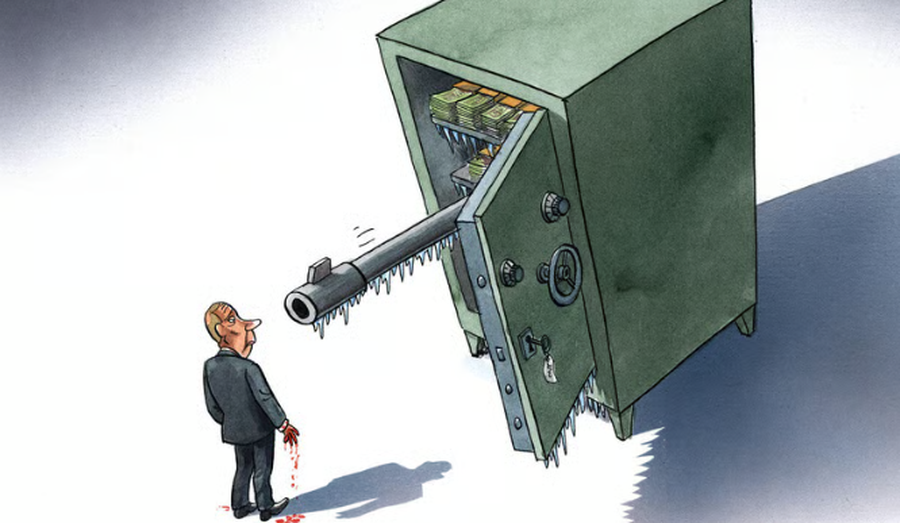
Europe wants to turn frozen Russian assets into Ukrainian firepower...
In 1997, David Bowie shocked the world again with his creativity, this time in the unexpected realm of financial engineering. The rock icon convinced Wall Street guys to pay $55 million in exchange for which they would be entitled to all royalties generated from his old albums.
It's not just pop stars who need to finance their rock lifestyles who might want to turn tomorrow's uncertain income into today's cash. The US has similarly transformed the money it expected big tobacco firms would one day pay them in compensation for destroying public health into cash from investors.
A similar scheme is being repeated with Russia's alleged war reparations for Ukraine. Given that the Kremlin will one day have to pay Ukraine compensation for the damage it has caused there, the thinking goes, why not convert the money that is needed tomorrow into an amount available today, then send it to Ukraine to help it defend itself against Russia?
How such a “repair loan” might work is currently being discussed in European Union circles. This creative fundraising tactic is partly a symptom of desperation. Ukraine needs nearly $100 billion a year in foreign aid, fiscal and military, to stay afloat and continue the war. The Trump administration is no longer willing to intervene. Europe is, but EU-level facilities are almost exhausted and many national governments are in financial distress. So everyone is willing to listen to financial wizards who claim to have invented a way for Russia itself to finance its Ukrainian enemy.
At the heart of the reparations loan scheme is a stash of sanctioned Russian money. Before the war, over $300 billion in bonds and cash belonging to Russia were sitting in various parts of the global banking system. Shortly after Russia launched its full-scale invasion of Ukraine in 2022, most rich countries froze the assets as part of a package of sanctions. Many hardliners, especially in Central Europe but also in America, have long argued that the Russian money should simply be seized and handed over to Ukraine. Others, including France and Germany, worry that the outright confiscation of assets belonging to a foreign government sets an embarrassing precedent. The European Central Bank (ECB) worries that seizing Russian bonds without compensation would damage confidence in the euro.
Despite these concerns, the frozen Russian loot has been used in part to help Ukraine. A legal loophole has allowed European authorities to, in effect, expropriate the interest generated by roughly 200 billion euros ($235 billion) in Russian cash held in Europe, without touching the cash itself. The seized interest alone amounts to about 7 billion euros a year, which the G7 countries have then repackaged, like Bowie, into a bond worth about 45 billion euros, the proceeds of which are flowing to Ukraine.
That is no longer enough. A proposal last year by Hugo Dixon, a financial commentator, Daleep Singh, a Biden administration veteran, and Lee Buchheit, a lawyer, suggested a way to tap not only the interest from Russian assets but also about 200 billion euros of principal.
The gist of the scheme is that Ukraine would in effect be lent €200 billion in cash and would only be forced to pay it back if Russia in turn pays reparations, as Ukraine’s supporters insist it should. The end result is a circular logic in which Russia ends up losing, no matter what. At the end of the war, either the Kremlin compensates Ukraine and thus gets its €200 billion back into its coffers, or it refuses to pay the reparations and the €200 billion remains frozen indefinitely. Meanwhile, Ukraine has a large amount of money to sustain itself in the war, without having to spend a lot of money on EU countries.
Dixon calls it “a down payment on the Kremlin’s obligation to pay war damages.” To some, this still smacks of the kind of expropriation that the ECB and others worry about, given that Russia would have to go through some hurdles (agreeing to pay reparations) to get its money back. Although many insist that Russia has an obligation to compensate Ukraine, this is an issue that has yet to be resolved. Only the UN Security Council or the International Court of Justice can impose reparations, and Russia can block both.
Ultimately, whether compensation to Ukraine is mandatory will be a matter for a peace deal, the contours of which are more vague than ever. But the G7 has already made it clear that sanctions will only be lifted when Russian compensation to Ukraine is paid. The European Commission is working on a variant of the reparations loan idea, which would potentially see Russia lose money if it fails to compensate Ukraine, but in a way that still requires ECB approval. A draft is expected by the time EU leaders meet in October.
Beyond Russia’s annoyance. Dmitry Medvedev, a former president, has lashed out at “euro-degenerates” who seek to keep their money. Donald Trump wants Europe to increase sanctions against Russia as a condition for America doing more. A new EU sanctions package in the works, the 19th since the war began, involves Europe giving up what little energy it still imports from Russia. A dozen Chinese entities and three Indian ones are also included, signaling that Russia’s trading allies will also be hit, an approach that America has well planned. Punishing Russia financially remains the right course of action. But using its frozen assets to punish the Kremlin and help Ukraine at the same time, if it can be done legally, would be a wonderful thing. / Adapted from “Pamphlet” by “TheEconomist”





Lini një Përgjigje