


 Shkruar nga Katja Hoyer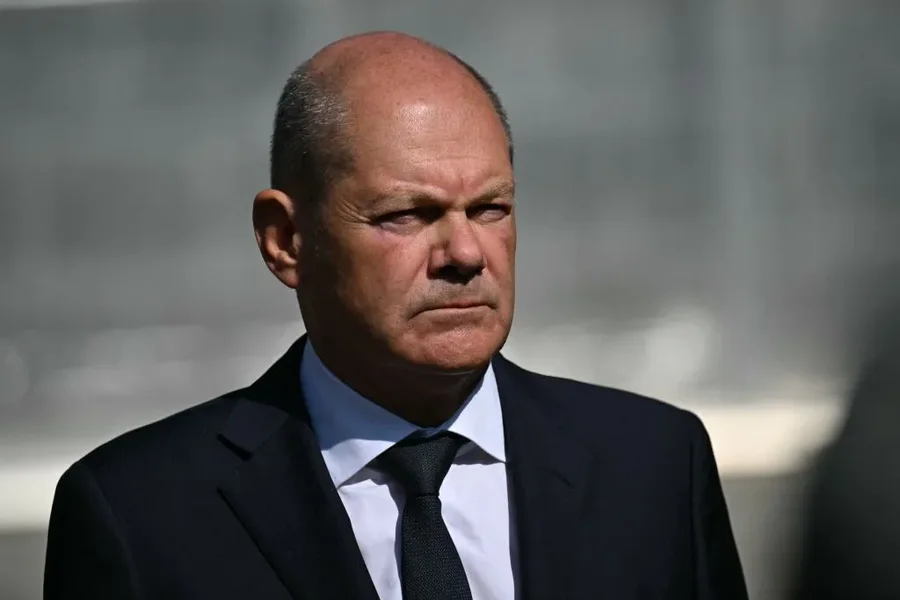
Merz called for a turnaround in German policy on migration. And he has challenged Scholz, saying he is ready to work with him to bring about change. The offer to cooperate with the opposition on the very sensitive issue of migration has put Scholz in a very difficult position.
The shock quickly turned to outrage in Germany when a Syrian asylum seeker was arrested for the brutal stabbing in the town of Solingen last weekend. Three people lost their lives and eight others were injured by a man who had no right to stay in Germany.
Politicians from the coalition government responded with a flurry of statements, calling for everything from tougher knife laws to faster deportations of illegal immigrants. But many voters want to see more than just a few changes to the migration system before they can start feeling safe on Germany's streets again.
Seeing the tense situation throughout the country, opposition leader Friedrich Merz has called on Chancellor Olaf Scholz for a reaction that goes beyond the "empty rituals" of grief.
"Enough... In this aspect, there should be no more taboos!" - declared the Christian Democrat in a press conference on Tuesday afternoon.
Merz called for a turnaround in German policy on migration. And he has challenged Scholz, saying he is ready to work with him to bring about change. The offer to cooperate with the opposition on the very sensitive issue of migration has put Scholz in a very difficult position.
If he refuses Merz's offer, his hands will be tied. In recent months, his fragile 3-party coalition has been on the verge of falling apart. With the pro-immigration Green party an integral part of his majority, Scholz is unlikely to take any measures to limit the number of people entering the country.
Foreign Minister Annalena Baerbock, who comes from the ranks of the Greens, is showing no sign of changing her attitude towards migration even after the event in Solingen. During an electoral meeting in the eastern state of Saxony, where regional elections are held on Sunday, she said: "Even if many people speak hatefully about immigrants, we will not change our approach to them."
Her words echo Angela Merkel's famous slogan "We can do it!", with which she tried to rally support for her border policy in 2015, when she allowed more than 1 million asylum seekers into the country. Baerbock went even further on Wednesday, declaring "We can do this again!"
So the message for Scholz is clear: if he wants to toughen the migration policy, he must do it without the Greens. One option for the chancellor is to do nothing, hoping that this wave of anger will pass. A risky strategy, which could further reduce his already very low popularity level.
The Social Democrats have long trailed the far-right AfD in the polls and are heading for their worst election result in modern history. Or he can cooperate with the opposition, specifically with the Christian Democrats (CDU) of Merz, with whom he would have the majority of seats in the parliament.
But it will force him to accept their leadership, on an issue that is incredibly important to voters. Merz has been very careful, positioning his bold move as motivated by genuine anger and concern, rather than party-political considerations. At the press conference, he emphasized that he is not just the leader of the opposition, but also a "citizen of the state".
He repeated 6 times that there is "no political tactic" in his demands, but only concern for the state of the German nation. However, the fact is that he is using the Solingen event for his own political purposes. Because it was his party, then under the leadership of Angela Merkel, that opened Germany's borders to a record number of asylum seekers and illegal immigrants.
Since the 2015 crisis, more refugees have arrived in Germany, mostly from Syria and Afghanistan. At the end of last year, more than 3 million asylum seekers were registered in Germany, or as much as 4 percent of the country's population. And instead of taking on the legacy of his colleague Merkel, Merz is now criticizing her policies, moving the CDU back to the conservative bedrock it was founded on after World War II.
Many analysts say that Merz's plan for a radical change of the current migration policy may be unrealistic. One of his immediate demands was not to accept new asylum seekers from Syria and Afghanistan, which would require a change in basic legal principles such as anti-discrimination laws.
Minister of Justice Marco Buschmann from the Liberal Democratic Party (FDP), said that "we cannot say without regret that from now on no one is allowed to come to us". However, Merz is unlikely to be bothered by the legal difficulties his demands present. Offering Scholz a way out of the chaos of his unpopular coalition is intended as a message to voters about the path Merz himself would take if he were chancellor.
With federal elections scheduled for next year, Merz wants to run for chancellor, and he is already preparing. This scheme of his is likely to work. The CDU was leading the polls by a large margin even before the Solingen event.
While the first poll after the attack showed a 1 percent increase for his party, which now has 31.5 percent of the vote. Scholz's SPD lost half a percent and now ranks with just 15 percent. Interestingly, the AfD also lost half a percent, indicating that Merz's move could draw voters from the political fringes to the center-right.
Another online poll showed that nearly 80 percent of people no longer trust Scholz's coalition in the face of extremism. Merz's strategy can work well even if the specific measures it aims for will not be realized. Scholz has responded to the request, agreeing to the creation of a task force composed of representatives of the opposition and 16 German states.
Many Germans acknowledge that significant change to this issue will take time. A poll conducted after the Solingen massacre showed that most would rather have a well-thought-out response than a quick one. So Merz doesn't need to offer anything specific at the moment.
And it gives the opposition leader time to present himself as someone willing to act on curbing illegal migration and the number of asylum seekers, without leaning as far to the right as the AfD. Earlier, Merz had a more ambiguous attitude towards refugees.
He also has a problem with popularity. In a recent poll, only 8 percent of people thought he was the best candidate for chancellor. His colleague Marcus Söder from the CDU's Bavarian sister party, the Christian Social Union (CSU), was ahead of him in the polls.
Whether Germany will actually change its migration policy in the foreseeable future is still doubtful, as the ruling coalition lacks the will and unity to implement the measures, and the opposition cannot act on its own. But as all the traditional parties fear the rise of the AfD, they now have the chance to deprive the far right of political oxygen. /Adapted "Pamphlet", from "The Spectator"
Note: Katja Hoyer, Anglo-German historian. Her latest book is entitled "Beyond the Wall: East Germany in the years 1949-1990".




Lini një Përgjigje