


 Shkruar nga Pamfleti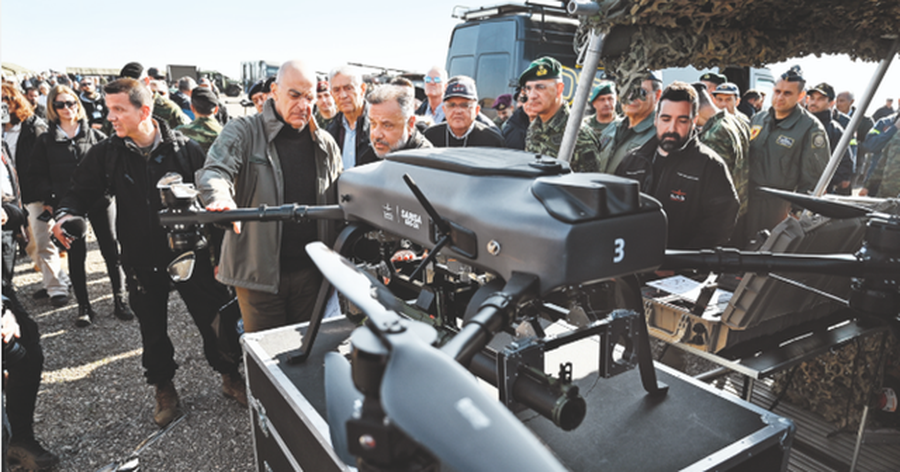
Greek Defense Minister Nikos Dendias has presented a new doctrine of the Hellenic Armed Forces, emphasizing that the global geopolitical environment has radically changed.
According to him, Greece must adapt to the new realities of modern threats.
According to him, the country is located in an insecure area, surrounded by conflicts, failed states, and technological challenges that require new defensive responses.
Dendias emphasized that, since 1952, Greece has been in a constant contradiction within NATO, as the main security threat comes from a member of the same alliance, Turkey.
In this context, he argued that Athens should develop an advanced defense ecosystem, capable of producing advanced technology and providing strategic advantage.
One of the most prominent points of the speech was the new naval doctrine. Dendias stated that the Navy will no longer have the defense of the Aegean as its primary task, as the narrow maritime environment makes it vulnerable to new means of warfare, especially drones.
According to him, frigates, although high-tech and expensive, can be neutralized by much cheaper means.
Instead, the defense of the Aegean will be accomplished from land, with missile artillery distributed across the islands of the Archipelago.
Hundreds, even thousands of land positions will create a complete "closure" of maritime space, leaving the Greek Navy free to operate in the wider Mediterranean, not limited to the Aegean.
"We have completely changed the doctrine. The Aegean will no longer be defended only by the Fleet. It will be defended primarily by missile artillery, which will be dispersed and mobile across the hundreds - if not thousands - of islands of the Archipelago.
"We will close the Aegean from land. The fleet will be free to operate, but not tied to the narrow sea," he stressed.
He also confirmed that new French and Italian frigates will be equipped with strategic missiles with a range of over 1,500 km, creating a strong deterrent capacity in the Eastern Mediterranean.
The Air Force and the "Achilles Shield"
Dendias explained that modern warfare no longer depends on fighter jets as the primary means of air defense.
Taking examples from the Israel-Gaza wars and the Russian aggression against Ukraine, he argued that effective defense is achieved by ground-based anti-aircraft systems that prevent aircraft from operating freely.
For this reason, the new doctrine called "Achilles' Shield" that the Mitsotakis government is preparing aims to create an integrated land-sea-air system, combining missile systems and new anti-drone technologies.
Focus on drones: "The warrior's new weapon"
Dendias announced a radical transformation in the Land Army, saying that the soldier's new "weapon" is no longer the rifle, but FPV drones.
He underlined that Greece is preparing to train the entire corps in the use of drones, while also creating an active reserve of 150,000 volunteers, with the aim of a total force of 250,000 trained reservists.
" What we call a weapon is a drone. A drone. That's what he fights with. That's both the weapon and the bullet. And it's usable. The Greek army must, therefore, and we are doing it very quickly, leave the era of weapons and go to the era of drones. Which means that every soldier must be trained in the use of drones ," Dendias said.
Dendias also presented the new Greek anti-drone system "Kentaurus", tested in the Red Sea, which will be deployed on all frigates and on a number of land variants ("Orion" and "Telemachos") for extensive protection against drones, especially important since the country that poses the main threat to Greece, according to him, Turkey, is producing and possessing over a million drones.
Dendias concluded that the new defense approach is holistic and oriented towards advanced technology, aiming to close Greek space in the air, sea and under the sea.
Faced with an unpredictable environment, Greece is building a 21st century defense system, according to its Defense Minister, where drones, missiles and ground capabilities play a central role.







Lini një Përgjigje