


 Shkruar nga Pamfleti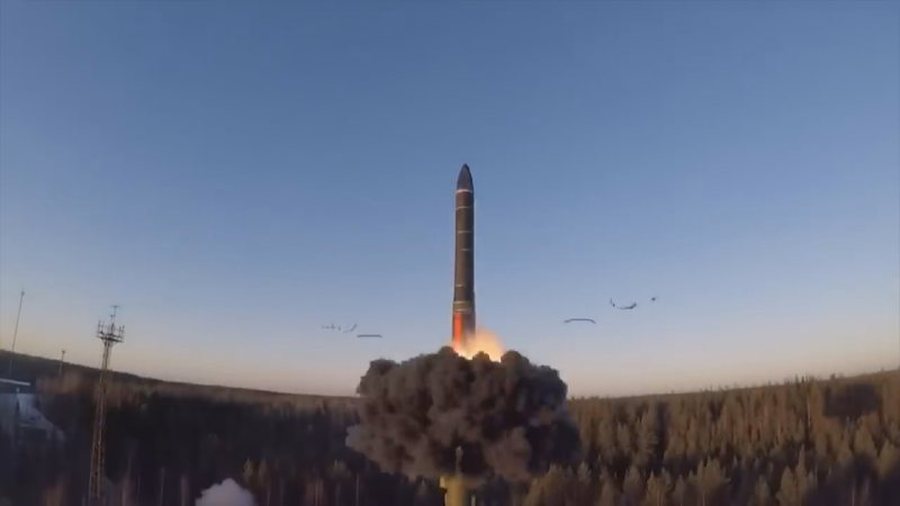
The Kremlin wants to intimidate Europe and has chosen joint maneuvers with Belarus. Western military experts say that the “Zapad 2025” (West) exercise will simulate a nuclear attack, using the newly developed Oreshnik and Burevestnik missiles. The Burevestnik is a nuclear-powered guided missile and, because of its vulnerable reactor, is sometimes called the “flying Chernobyl.”
The world first learned about such a “product” from Putin himself on March 1, 2018. In his annual speech, he showed cartoons of previously secret defense industry projects, an expression of his obsession with a Russian “miracle weapon” that would give Moscow an overwhelming advantage.
Among the many weapons projects supposedly in development at the time, the "product" also emerged from the depths of state secrets. The Kremlin chief described it as a self-guided cruise missile powered by an integrated nuclear reactor.
With such a thrust, the missile, which is itself a "dirty bomb", could "circle the Earth for weeks", orbit the Earth several times and maneuver at different altitudes, leaving behind a trail of radioactive decay products, to evade air defense systems. A formidable weapon, invulnerable to all defense systems.
After Putin had already unveiled the “product,” the Defense Ministry invited the nation to participate. It held a contest to name the “wonder weapon.” The winner was “Burevestnik.” Literally translated into English, this sounds exciting, as it’s just a little bird. In Russian, it sounds more dramatic, as it also means “storm herald.”
Experts greeted the Kremlin chief's comments with skepticism. They pointed out that scientists in both Russia and the United States had already been working on such a nuclear-powered rocket in the 1950s. The Americans even conducted tests with the engine they had developed for it. However, over time, both Moscow and Washington abandoned the idea as impractical, costly and dangerous.
However, since the search for the name, the world has learned little new about the "Burevestnik." Intelligence reports speak of eleven tests of the missile, and only one can be considered quite successful.
However, one incident is dramatic. It occurred at a military training ground near the village of Nyonoksa in the Murmansk Region on August 8, 2019. Apparently, a radioactive explosion occurred there, killing five scientists from the All-Russian Research Institute of Experimental Physics in Sarov (a "closed" city in the Nizhny Novgorod Region). It is this institution that is working on the development of the "Burevestnik".
There are different versions of the event. The clearest evidence that an explosion occurred was a sudden and brief increase in radioactive radiation in nearby Severodvinsk, precisely on August 8, 2019.
A week ago, Putin visited the institute in Sarov. The president wanted to know if the "product" was ready and could be delivered to the armed forces this year.
Meanwhile, extensive preparations are underway at the nuclear test site on the Novaya Zemlya archipelago, which forms the northernmost tip of Europe between the Barents Sea and the Kara Sea.
The Russian military deployed several transport aircraft, two fighter jets, eight helicopters and a radar reconnaissance aircraft there in early August. Some of these were withdrawn from the front lines. The air base there also received two command and control aircraft from the Rosatom agency. Nine ships are anchored off the west coast of Novaya Zemlya, awaiting deployment.
Apparently, the Russians are preparing for a test flight of the "Burevestnik", which will be launched from special facilities previously built on Novaya Zemlya.








Lini një Përgjigje