


 Shkruar nga Jo Adetunji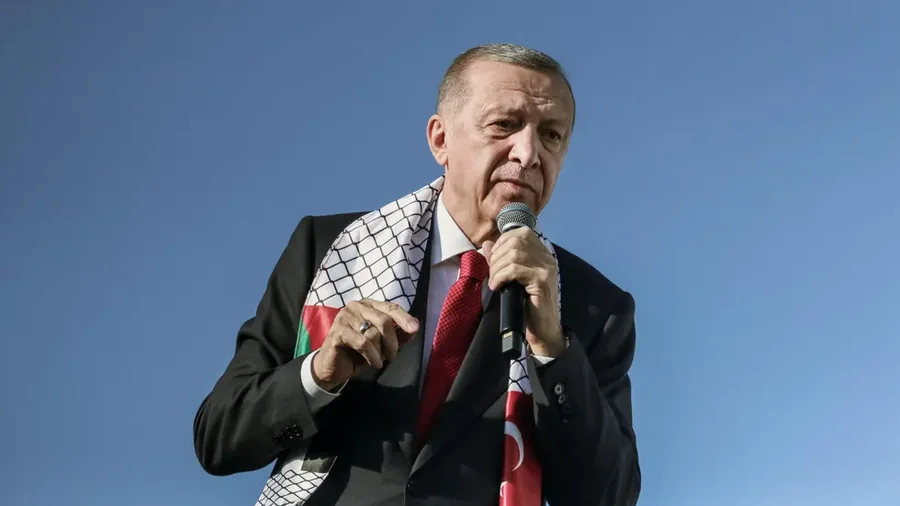
Erdogan's reaction to the conflict reflects an attempt to strike a balance between two forces: domestic politics and realpolitik on the international stage...
Turkish President Recep Tayyip Erdogan withdrew his ambassador from Israel on November 4, 2023. Less than a month earlier, he was offering diplomatic assistance to calm the situation in the Middle East.
This diplomatic shift is indicative of how, in just a few short weeks, Turkey has recalibrated its stance on the escalating violence in the Gaza Strip.
Erdogan's initial reaction to the Hamas-led carnage in Israel on October 7 was a carefully balanced one, calling for restraint and an end to "aggressive acts. But amid a mounting death toll in Gaza, he quickly veered to a pro-Hamas and seemingly anti-Israel position.By October 25, the Turkish leader was accusing Israel of "one of the bloodiest and most brutal attacks in history" while defending Hamas as a "liberation group".
As an expert on Turkish politics and international affairs, I believe that Erdogan's evolving rhetoric cannot be understood without considering the domestic and international constraints surrounding Turkey's leader. In responding to the crisis in the Middle East, Erdogan faces an important dilemma: he must appease his political base in the country – which has strong pro-Palestinian sympathies – while not completely alienating Israel, with which Turkey has important geopolitical and economic ties.
At the same time, Erdogan is eyeing an opportunity to project himself as a key regional player in Middle East politics — and a potential mediator in the current crisis. And to understand how he intends to do all this, you need only look beyond the rhetoric and diplomatic gestures.
Politics against realpolitik
Erdogan's reaction to the conflict reflects an attempt to strike a balance between two forces: domestic politics and realpolitik on the international stage.
Since the renewed conflict in Gaza, Erdogan has faced pressure from various quarters in Turkey. His initial response drew widespread outrage among the country's Islamist circles, which have long shared deep sympathy for Hamas. Ahmet Davutoglu, a former prime minister and foreign minister, criticized the Turkish president for hesitation and called on him to align with his Islamist base. Leaders of other Islamist parties and Erdogan's coalition partner, Devlet Bahçeli, head of the right-wing Nationalist Movement Party, also called on the government to take a stronger anti-Israel stance.
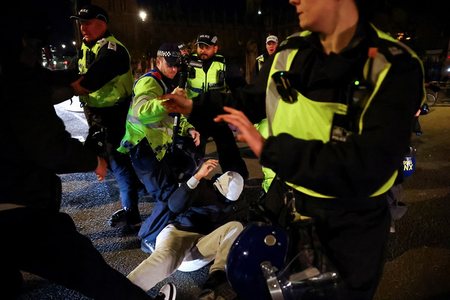
The rise of anti-Israel sentiment in the international arena also encouraged Erdogan to take an overtly pro-Hamas stance. On October 26, 120 countries in the United Nations General Assembly voted in favor of a resolution calling for an "immediate and lasting humanitarian ceasefire". Meanwhile, protests in the streets of Western capitals have put further pressure on governments there to tone down support for Israel. They have also facilitated Erdogan's repositioning.
Erdogan is aware that his criticism cannot go too far and risk a complete severance of ties with Tel Aviv. Israel is an important partner for Turkey. Both countries have seen growing trade relations, with Turkish exports to Israel doubling from 2017 to 2022. This includes the extensive arms trade, with Israeli and Turkish manufacturers seeing the highest growth in arms sales worldwide in the year 2021.
Meanwhile, regional geopolitical dynamics have shifted to bring Israel and Turkey into greater alignment. Recently, the Azerbaijan-Nagorno Karabakh conflict has brought Ankara and Tel Aviv closer together – both of which support the Azerbaijani government with arms.
And in its fight against Kurdish separatists, Turkey deployed Israeli surveillance drones in the late 1990s and 2000s before developing its own drones.
Erdogan as a peacemaker?
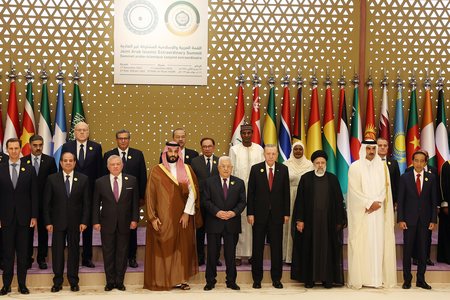
There is another critical factor at play as Erdogan's stance has developed. Since the beginning of the crisis, Erdogan has sought to assert himself as a mediator. To this end, he has held talks with regional leaders, in which he signaled an intention to act as a peace broker. Senior Turkish officials have also revealed attempts at negotiations over hostages being held in Gaza by Hamas.
This approach echoes Erdogan's strategy in Ukraine, where he also presented himself as a potential mediator.
In some ways, the challenges of balancing these domestic and regional concerns are what make Erdogan uniquely suited as a potential mediator: he has maintained ties to Hamas while recently deepening a relationship with Israel.
But for Erdogan to relinquish the role of mediator, he will need to manage those ties well. Initial proposals for Turkish mediation on the crisis were reportedly rejected by Hamas.
If Erdogan's harsher rhetoric towards Israel was intended to lure Hamas to the negotiating table, then it could be said that he went too far. Calling Hamas a freedom fighter group and accusing Israel of war crimes in Gaza has damaged relations with Israel. It may be that Erdogan may have already lost the opportunity for an arbiter role.
But go beyond the words and see something else at play. While speaking tough on Israel, Erdogan has taken concrete steps to prevent a full-blown deterioration in strained relations with the West and Israel. On October 23, he signed Sweden's NATO membership protocol, raising hopes for an end to a sometimes tense standoff between Turkey and its NATO allies. On the same day, Turkish law enforcement arrested 33 ISIS members in Ankara, potentially to head off Western criticism of Erdogan's support for radical Islamist networks.
Meanwhile, Turkish media circulated reports of the departure of the Hamas leadership from Turkey at the same time.
It is also obvious what Turkey has not done. It has not tried to stop Azeri oil shipments through Turkey to Israel and continues to allow the US to use its Incirlik air base in Turkey, despite growing public pressure. The police had to disperse the pro-Palestinian crowds who intended to attack the base on November 5. / Taken from "Conversation".



Lini një Përgjigje