


 Shkruar nga Pamfleti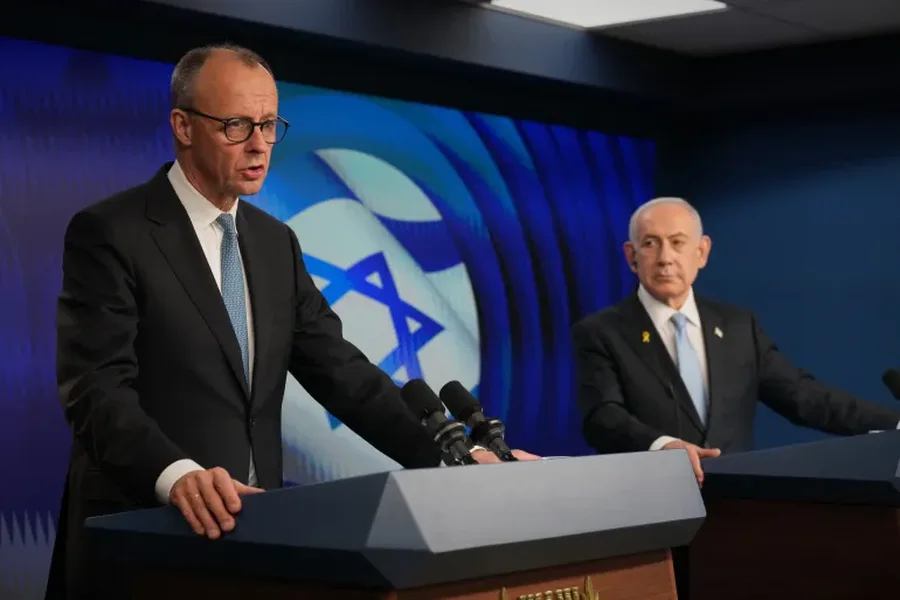
German Chancellor in Israel: Yes to Palestinian state, but not now
German Chancellor Friedrich Merz has reaffirmed support for the creation of a Palestinian state, while Israeli Prime Minister Benjamin Netanyahu has reiterated his opposition to such a move, during Merz's first official visit to Israel as chancellor.
In a joint press conference held in Jerusalem following the meeting between the two leaders, the two outlined their positions on the issue of Gaza and the occupied West Bank territories.
Merz's visit is taking place in the shadow of Israel's war in Gaza, a conflict that many international voices have described as genocide. However, Merz, the leader of one of Israel's closest allies, does not consider the war as such.
Merz said Germany aims for a new Middle East, where the state of Palestine exists side by side with Israel. He called this vision “the best prospect for the future.” But on the other hand, he added that his government has no intention of recognizing a Palestinian state in the near future. According to him, such recognition should only come at the end of a peace negotiation process, not at its beginning, a stance that puts Germany in contrast to several other European countries such as France, Spain and the United Kingdom, which have already announced official recognition of Palestine.
Netanyahu, on the other hand, stated that the Israeli people are against any two-state solution and reiterated that the issue of political annexation of the West Bank, which Merz opposed and which was also rejected by the previous US administration of Donald Trump, still remains a topic of discussion, although the status quo will remain unchanged for the foreseeable future. Netanyahu added that “the goal of a Palestinian state is the destruction of the Jewish state,” without giving further details.
He also announced that the first phase of the Gaza plan, according to Trump's formula, is nearing completion and that at the end of December he will hold "very important talks" to ensure the implementation of the second phase. He confirmed that he will also meet with Trump himself during this period.
The war in Gaza has tested the traditionally strong relationship between Germany and Israel, as support for Israel is part of the core of German foreign policy, strongly linked to a sense of historical responsibility for the Holocaust.
In August, Israel's military intervention in Gaza prompted Germany, Israel's second-largest arms supplier after the United States, to restrict arms exports for use in Gaza. At the time, Merz publicly criticized Israel's actions, a rare move for a German leader, stating that his government could no longer ignore the consequences for Palestinian civilians.
Those restrictions were lifted two weeks ago, and Netanyahu had openly expressed his displeasure with them. At the press conference, Merz tried to soften his tone, stressing that the decision to temporarily restrict arms exports had not changed “Germany’s basic stance on Israel’s security and its military support.”
Merz's visit to Israel, which took place seven months after taking office as chancellor, came later compared to his predecessors: Olaf Scholz had visited Israel after three months in office, while Angela Merkel after just two months.
At the joint press conference, Merz confirmed that no possible visit by Netanyahu to Berlin had been discussed, a topic that remains sensitive due to the international arrest warrant issued by the International Criminal Court (ICC) against Netanyahu for war crimes in Gaza. Merz said there was “no reason to discuss this at the moment,” but did not rule out such an invitation in the future, “if conditions allow.”
Earlier this year, Merz had stated that if he invited Netanyahu to Germany, he would not be arrested on German soil.






Lini një Përgjigje