


 Shkruar nga Pamfleti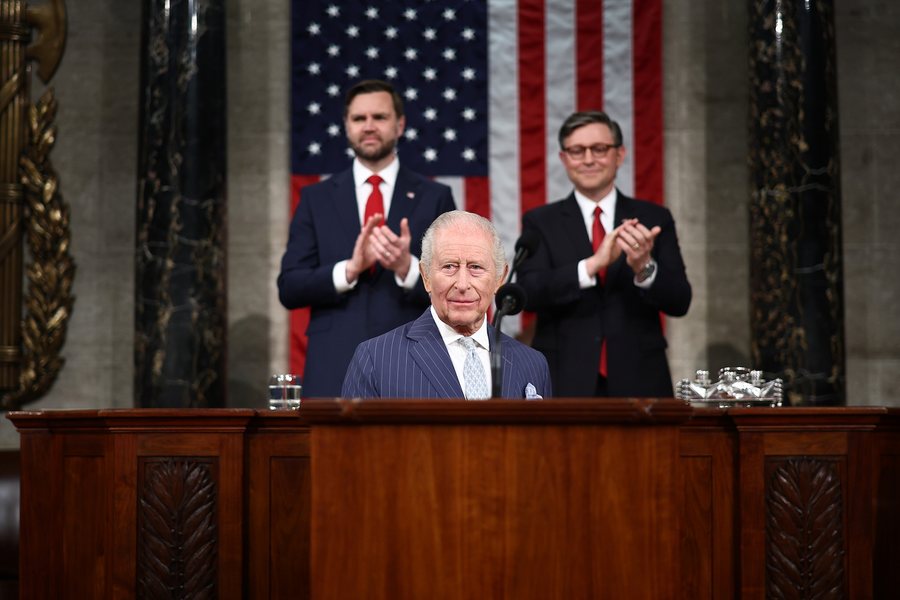
The visit aims to strengthen bilateral relations, while his messages touch on democracy, NATO and global challenges...
King Charles III's visit to the United States was intended as a celebration of America's 250th anniversary, of enduring Anglo-American ties, and of the so-called "special relationship." However, it was also seen as a mission to improve relations.
The current state of US-UK relations is tense, due to London's reluctance to fully support the joint US-Israeli war against Iran. In this context, the King's aim was to defuse these tensions through a diplomatic approach, particularly through his speech to both houses of Congress on Tuesday afternoon.
There is reason for optimism. President Donald Trump is known for his unpredictable personality: warm relations can quickly deteriorate, but the opposite is also possible, opponents can return to his favor.
A tension does not necessarily constitute a breakdown in relations. At the end of the speech, the King emphasized the “reconciliation and renewal,” which he said have characterized interactions between the two countries over the centuries.
Whether these messages, both in public and in private meetings, will be enough to strengthen the Anglo-American alliance remains unclear. However, after a meeting at the White House, President Trump spoke positively: he called the King “a fantastic person” and the visit “a great honor.”
However, some parts of the speech, the first by a monarch to Congress since Queen Elizabeth II's speech in 1991, were interpreted as messages that may have resonated more with Democrats and raised questions in the White House.
1) Accepting uncertainty
The king began his speech by acknowledging that the US and Britain face “times of great uncertainty.” He cited conflicts in the Middle East and Europe — which have been a source of disagreement — as well as threats to democracy from political violence.
He stressed that the two countries have not always been in agreement: “With the spirit of 1776 in mind, we can agree that we do not always agree.”
This preceded his conclusion that, when aligned, the two countries can achieve great results not only for their peoples, but for the entire world.
2) A message that was well received by Democrats
When the King mentioned that executive power should be “under checks and balances,” a principle that stems from the Magna Carta and is enshrined in the U.S. Constitution, he received loud applause.
They started on the Democratic side and then spread throughout the chamber. Trump's critics often accuse him of overstepping his authority, and the idea of institutional control has been one of the motives for the "no kings" protests.
At the end of the speech, he added: “America’s words carry weight and meaning… the actions of this nation matter even more.”
3) Emphasis on NATO and the transatlantic alliance
Quoting former Secretary of State Henry Kissinger, the King spoke about the Atlantic partnership and recalled that NATO has only been activated once for collective defense, after the September 11 attacks.
He cited his service in the Royal Navy and used this to emphasize the importance of security and intelligence cooperation between the US, Britain and Europe.
He also included the issue of climate change, emphasizing the role of the armed forces and allies in protecting security from global challenges.
4) Lack of references to the Epstein case
One of the most discussed issues before the visit was whether the King would mention Jeffrey Epstein or his victims. He did not do so directly.
The closest reference was a general statement about the need to support victims of problems that exist in both societies.
The Epstein case continues to have repercussions, particularly in the United Kingdom, where his connections to important figures have been the subject of debate.
5) Use of humor
Despite the seriousness of the visit, the speech included elements of humor. The king quoted Oscar Wilde about the language differences between the US and England and joked about British parliamentary traditions.
He also ridiculed the idea of restoring British rule over the US, presenting it as a historical idea with no real basis.
Overall, although tensions remain, King Charles III's speech appears to have contributed to easing the atmosphere and strengthening communication between the two allies. /Adapted from BBC /



Amerika monarki presideciale apo gjyshma presideciale le te pranoje monarki ne amerike