


 Shkruar nga Anthony Bellanger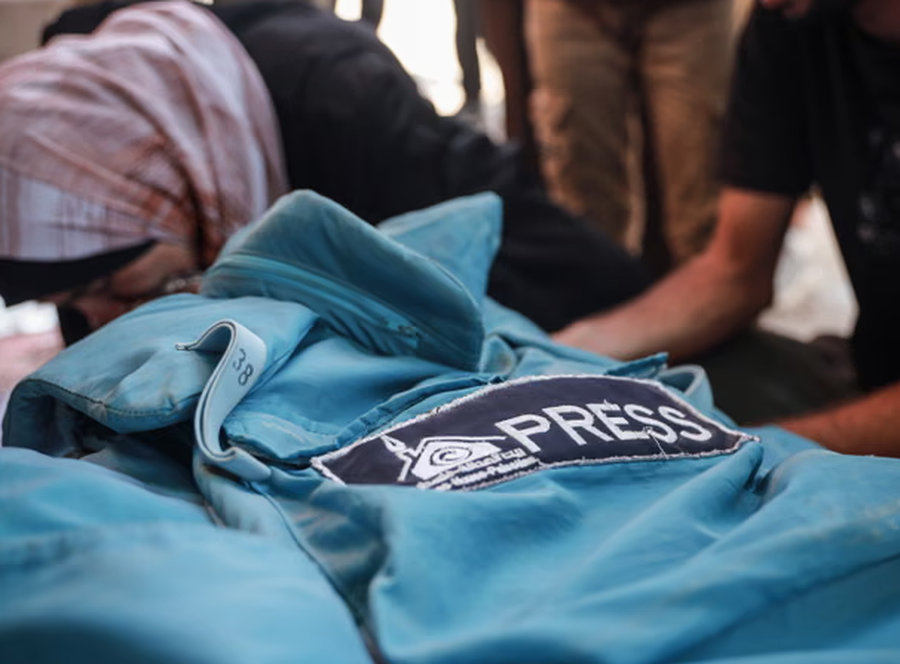
If we accept that journalists are dying in Gaza, we pave the way for other regimes to consider the killing of journalists a normal instrument of war.
In Gaza, the name of Anas al-Sharif, a young Al Jazeera journalist killed on August 10, 2025, has been immortalized. Gaza will also remember the 222 other Palestinian journalists killed in the past two years by the Israeli army, according to the International Federation of Journalists’ own monitoring. But those who chose to eliminate these media workers will remain forever condemned.
Over the past 24 months, Gaza has become the most dangerous place in the world to practice our profession. Israel bars foreign journalists from entering the territory, so the truth relies exclusively on Palestinian journalists, almost all of whom are members of the Palestinian Journalists Union, affiliated with the IFJ.
Too often they work without protection and shelter for their families. And too often, they are directly targeted.
Never before has the journalism profession seen such a massacre among its ranks. The International Federation of Journalists, founded in 1926 and celebrating its centenary in Paris in May 2026, has not recorded a comparable number of deaths since its formation, not during World War II, nor in Vietnam, Korea, Syria, Afghanistan or Iraq. Gaza has become the worst graveyard for journalists in modern history.
But this is not a series of accidental tragedies. It is a clear strategy: kill the witnesses, close down Gaza, block the narrative. Preventing the international press from entering means silencing independent foreign observers of this conflict. And at a time when Israeli Prime Minister Benjamin Netanyahu promises to recolonize Gaza, controlling the narrative is as important as controlling the territory itself. Colonization also means erasing the ruins, the dead, the survivors, and those who tell their stories.
From the northern border to Gaza City, hundreds of thousands of people have been forced to flee south. But even there, the south is no refuge: it offers neither safety nor escape. Families are huddled together, trapped between bombs and the sea, with no way to escape the atrocities of this war. This reality of total siege is also that of journalists, condemned to work locked up in an enclave where survival becomes more and more impossible every day.
In this context, the recognition of the state of Palestine by a growing number of countries at the UN is symbolic. But it comes too late. It neither protects the living nor brings justice to the dead. Diplomacy is catching up with history, but only after it has become irreparable.
So who is protecting these witnesses? It is neither the paralyzed United Nations nor the great powers, complicit through arms shipments and their silence. The Palestinian journalists continue their lone mission, to the point of exhaustion. To the point of death.
The IFJ, for its part, is taking action on the ground. It directly supports journalists and their families through its International Fund for Safety. It chronicles the daily lives of its colleagues, Sami Abu Salem, Ghada Al Kudr and others, so that their cruel reality is not reduced to simple statistics.
And for several years, she has called for an international UN convention that would oblige states to protect journalists and punish their killers. Until such a convention exists, impunity will prevail and protect the Israeli leaders responsible for these crimes.
An essential reminder repeated for years by the IFJ to journalists and media workers holding international press cards is: " No story is worth a human life . "
This is not a slogan: it is a rule of survival. The mission of journalists is not to die as martyrs, but to report in safety.
Their protection is a collective responsibility. Every helmet, every bulletproof vest, every training course for safety and hostile environments is vital.
In Gaza, many of our colleagues are asking themselves: " What's the point of continuing? "
The evidence is mounting, the testimonies are piling up, but nothing is changing. But surrender would be worse, because silence is a victory for the executioners. It allows them to say that nothing happened.
One hundred years after its founding, the International Federation of Journalists (IFJ) faces the most terrible test in its history. Gaza has become the graveyard of journalism.
If we accept that journalists die there amidst indifference, then we pave the way for other regimes to consider the killing of journalists as a normal instrument of war.
Anas al-Sharif did not want to die. He wanted to inform the world, in safety. His death and that of 222 of our colleagues compels us to act.
Israel kills journalists. Killing journalists is killing the truth. And a world without truth is a world where executioners reign. / Taken from “ The Guardian”, adapted by “Pamphlet”.





Lini një Përgjigje