


 Shkruar nga Pamfleti
The United Nations, historical precedents, and international pressure that is taking shape without Washington's blessing.
The question "What if...?" has been asked for decades. But in the coming months, Al Jazeera will examine some of the biggest challenges of our time, asking the best experts: "What if...?"
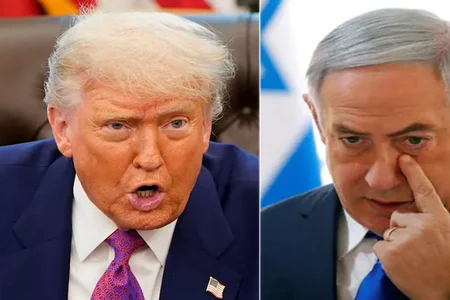
US President Donald Trump has given the Palestinian group Hamas an ultimatum by Sunday to accept a deal he says would end Israel's war in Gaza - but would also allow Israel to remain in parts of Gaza for a short period of time.
Critics are skeptical. They recall that Israel has continued attacks in Lebanon even after a ceasefire agreement there last year, and also regularly carries out raids in the occupied West Bank. Therefore, they doubt that this agreement will actually stop the aggression and bring peace to Gaza.
If the deal fails, many expect Israel to continue the military offensive that has devastated Gaza, killing over 66,000 Palestinians - a campaign that continues despite international condemnation.
In September, a UN commission backed the conclusions of human rights organizations – both inside and outside Israel – that Israel’s war in Gaza constitutes an act of genocide. The European Union has proposed suspending trade privileges for Israel, while a UN-backed body concluded that a deliberate, man-made famine has been created in Gaza.
Meanwhile, Israel's traditional allies - including France, the United Kingdom and Canada - have recognized the Palestinian state, following the example of Norway, Spain and Ireland. This development is prompting states to review their positions and consider concrete actions.
Individual politicians have also begun to react. Spain’s Prime Minister Pedro Sanchez last month called for Israel to be expelled from international sports organizations “until the barbarity stops.” Slovenia’s President Natasa Pirc Musar in May called Israel’s offensive in Gaza “genocide.”
But what happens if these countries go beyond symbolic statements? Can they cooperate and force Israel to stop the attacks and withdraw from Gaza – even without US support?
Four international experts have given their opinion on this scenario: Michael Lynk (professor of international law at the University of Western Ontario), Michael Becker (human rights expert and former employee at the International Court of Justice), Nick Cull (historian of cultural boycotts at the University of California) and Daniele Bianchi (economist and sanctions specialist at Queen Mary University of London).
According to Michael Lynk, the United Nations remains the most legitimate channel to stop the Israeli aggression in Gaza. He recalls that Israel is in violation of the UN Charter, the 1948 Genocide Convention, and the 1998 Rome Statute – all international instruments that impose an obligation to intervene in cases of genocide and mass atrocities.
So far, ironically, only the Houthis in Yemen – one of the poorest countries in the world – have taken concrete action by cutting off sea lanes and hindering commercial ship traffic to Israel.
Lynk points to a historical precedent: in 1950, the UN General Assembly adopted the “Uniting for Peace” Resolution, to act when the Security Council is blocked by vetoes. This resolution was used to authorize intervention in the Korean War and to restore South Korea’s sovereignty. Today, 75 years later, the same mechanism could be used for Gaza.
A UN-mandated international force could be deployed to the devastated territory, where the UN has previously declared that Israel has no right to remain. It could undertake an immediate humanitarian mission, rebuild infrastructure, restore vital services such as water and electricity, and set up a transitional administration until a political solution is reached.
The question is no longer whether Israel will be stopped, but whether the world will have the courage to act without the US? /Al Jazeera






Lini një Përgjigje