


 Shkruar nga Pamfleti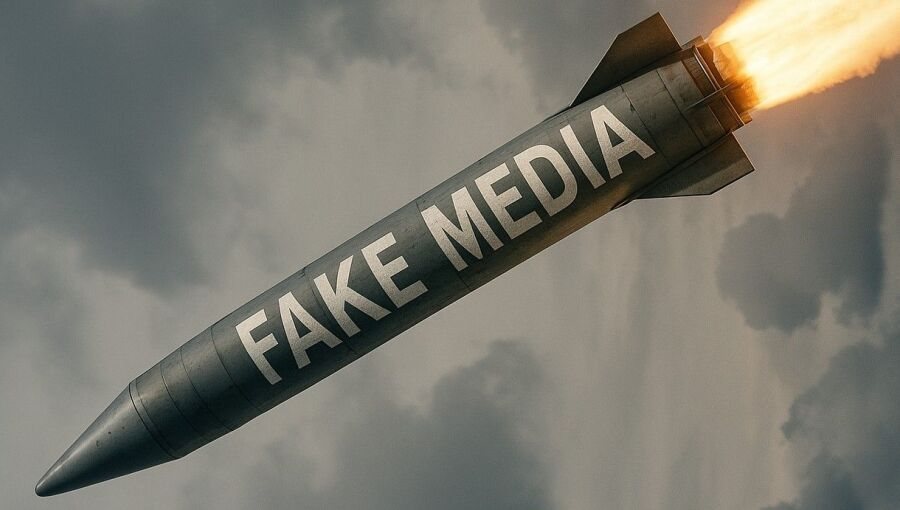
In another investigation, several widely shared posts on X show footage of Israeli missiles targeting Iranian territory or, alternatively, Iranian missiles launched in retaliation...
Following Israel's large-scale military operation in Iran in the early hours of June 13, an avalanche of videos and images purporting to document the attack and Tehran's alleged response have flooded social media. However, not everything shared is true.
A closer look by German news agency DW Fact Check – part of German international public broadcaster Deutsche Welle – reveals that a significant volume of content circulating online is fabricated, manipulated or taken from unrelated events. Much of it is generated in Iran or in support of the regime.
It is unlikely that Iran is alone in generating such false images, however, at present no effective or credible third-country media source has yet shown that Israeli sources work in the same way to deceive the world.
A wave of images generated by artificial intelligence
In one example, a viral TikTok video, which has amassed more than 660,000 views, shows the exact locations in Iran targeted and destroyed by Israeli missile strikes on the first day of the attack. DW research showed that the initial images were indeed fabricated and that the video was entirely generated by artificial intelligence; a fact betrayed by several telltale inconsistencies.
In one scene, a teddy bear with an unnaturally clean appearance and a distorted face stands awkwardly among burning vehicles. Elsewhere, in what appears to be a burning airport supposedly attacked by Israel, a group of firefighters remain eerily frozen while others disappear completely, both clear signs of digital manipulation, DW claims.
A data check on the TikTok account responsible by the German news agency, called Malka.415, shows a pattern of artificial intelligence-generated news content posted around major world events, suggesting a deliberate attempt to generate viral engagement through sensational but fake footage.
In another investigation, several widely shared posts on X show footage of Israeli missiles targeting Iranian territory or, alternatively, Iranian missiles launched in retaliation.
DW's verdict on these videos is clear: they are fake.
The footage in question predates the current escalation. A reverse image search reveals that the same material was uploaded eight months earlier, most likely depicting an Iranian missile launch in October 2024 following an earlier Israeli strike. Notably, this clip has been repeatedly recycled, previously debunked when it was used to illustrate the Kashmir conflict between India and Pakistan in May, which in itself highlights a recurring tactic in the disinformation space: repurposing old footage to fuel a false narrative, often relying on viewers’ limited awareness or the fog of rapidly unfolding events.
Mislabeled military exercises
Another image that circulated widely on X and was viewed more than 3.6 million times shows Iran launching missiles at Israel in direct retaliation for the June 13 attacks. DW considered this image to be misleading and unrelated.
Although Iran launched drones, as is well documented after the Israeli attacks, there had been no official confirmation of the missile strikes at the time the image was posted. The key point is that another image search in contrast traced the photo to December 2021, when it was taken during the Iranian Revolutionary Guard Corps’ “Great Prophet 17” military exercises.
Digital fraud model
This latest wave of disinformation is part of a broader trend observed in recent conflicts - where artificial intelligence tools, old footage and military propaganda are used as weapons in the information space alongside conventional weapons on the battlefield.
The goal is simple and nothing more than an attempt to sow confusion, stir public emotions, and shape perceptions in real time.
Disinformation experts, DW says, warn that the speed and scale with which such fabricated material can spread, especially during rapidly unfolding geopolitical crises, has outstripped the ability of ordinary users and even social media platforms to verify authenticity.
The result is a digital smokescreen, where truth competes with spectacle for attention.
And for Tehran alone to act in this way would be as naive as believing all the claims that appear on social media showing firefighters disappearing while fighting a fire and teddy bears appearing clean in the midst of battle. China, too, is already working to sow disinformation about Taiwan on its eastern shores every day. Any future invasion of the self-governing island, as has long been predicted, will be accompanied from day one by a worldwide social media onslaught by People’s Liberation Army units specially trained to do so.
As such, as Israel and Iran currently continue to exchange both rhetoric and orders in the latest conflict to capture the world's attention, it is becoming increasingly difficult for untrained observers on social media to separate reality from fiction.
One day it may be the turn of China and Taiwan, China and India, North and South Korea, Pakistan and India, etc., but by then perhaps the world will be a little wiser to the ways of artificial intelligence and the efforts of governments eager to use such methods. / Adapted Pamphlet from IntellNews /




Lini një Përgjigje