


 Shkruar nga Pamfleti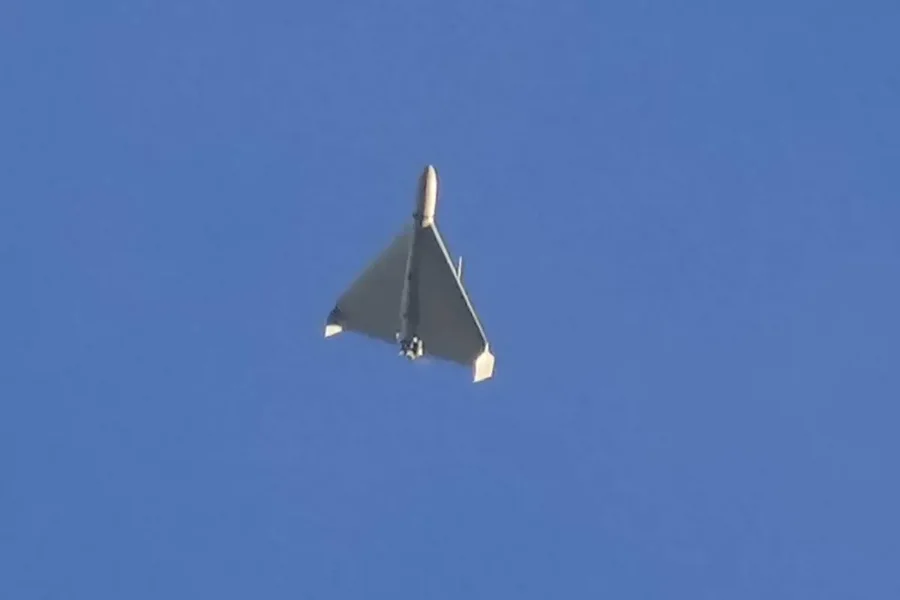
The drone has a warhead of 40 kilograms of explosives and a maximum range of 1,800 to 2,000 kilometers...
US President Donald Trump has authorized Ukraine to launch long-range strikes against Russia, US special envoy Keith Kellogg told Fox News. According to Kellogg, the president has authorized long-range strikes against Russia, "but sometimes the Pentagon has not given Ukraine the authority to execute them."
When asked what the US authorized, Kellogg replied: "I think, after reading what he said, the answer is yes. You have to use the deep strike capability. There are no safe places."
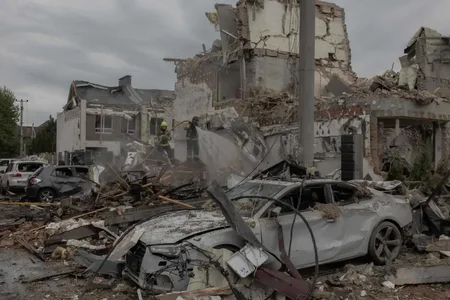
Trump's reaction came after Syria launched one of its most severe attacks on Ukraine, launching 595 explosive drones and 48 missiles. The attack lasted for 12 hours, with Ukrainian President Volodymyr Zelensky describing it as a "cowardly attack".
But that's not all! The Ukrainian president warned that "Italy could be Putin's next target."
Would such a thing really be possible?
To carry out such an attack, the Russian military would use the "Geran-2" UAV, a locally produced and improved version of the Iranian "Shahed-136".
This drone has an explosive payload of 40 kilograms and an estimated maximum range of 1,800 to 2,000 kilometers.
Its flight altitude can vary from 60 to 4,000 meters, and its engine propels it to a maximum speed of 180 km/h for a maximum flight time of approximately 12 hours.

Given these data, and considering that the minimum distance between the national territory and that of the Russian Federation is approximately 1300 kilometers in a straight line (from Crimea to Puglia), this would indeed be possible.
The same distance would increase to approximately 1500 kilometers from the Russian region of Bryansk to Friuli, and decrease to approximately 1000 kilometers from Belarus to our northeastern border.
Given that the drone would not fly in a straight line and would have to cross natural barriers represented by mountains of considerable height, the autonomy necessary to reach the national territory would increase, bringing it to the limit of the assumed operational range.
On paper, it would be possible, assuming there were no air defense systems along NATO's eastern front, which were already on extremely high operational alert following the Russian drone incursion into Poland on September 9.
The alliance has increased its surveillance by moving assets along its entire eastern border, including air defense missile batteries and associated radars capable of detecting targets in flight. Furthermore, a drone launched from the territory of the Russian Federation would have to cross the airspace of at least two NATO countries (Poland, the Czech Republic or Slovakia) from the north and at least Bulgaria, plus that of several Balkan countries (such as Albania) from the south.
The possibility of this happening without the air defenses of the respective countries being activated is extremely remote, if not impossible, especially in this particular international situation.
However, there was a precedent: on March 10, 2022, just days after the outbreak of war in Ukraine, a Russian-made Tupolev Tu-141 drone, a relic of the Soviet era, crashed in Croatia after flying intact through the skies of Romania and Hungary.
To this day, we do not know who flew the drone that crossed NATO skies, as the countries involved have maintained state secrecy.
Of course, the situation today is very different from March 2022, especially after the events in Poland. / Adapted from Il Giornale /







Lini një Përgjigje