


 Shkruar nga Uwe Parpart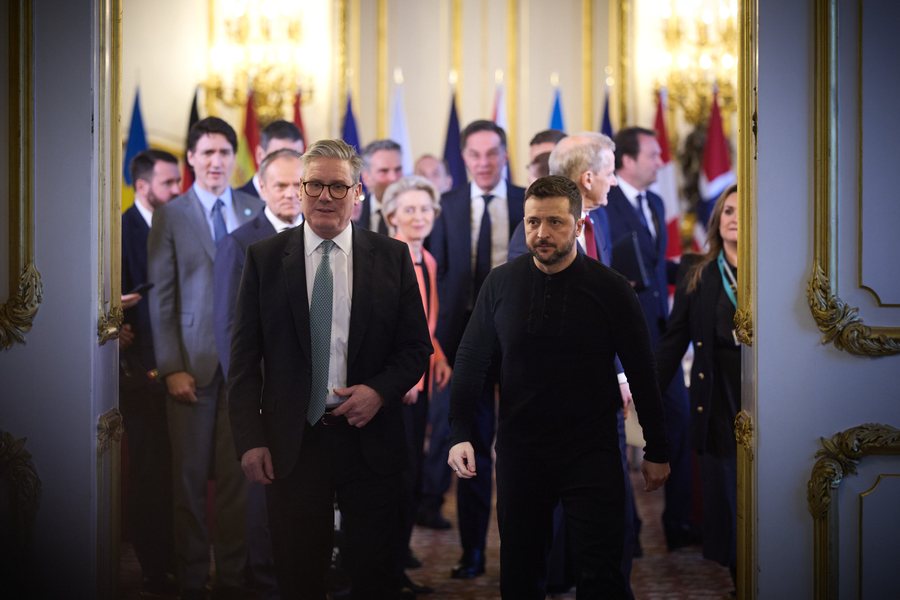
Europe may dream of strategic autonomy once peace is achieved in Ukraine. But it does not have the military capability to challenge or undermine Trump’s peace plan. In reality, no one can
US President Donald Trump unceremoniously showed Ukrainian leader Volodymyr Zelensky the door after a heated exchange at the White House on Friday. Trump's angry words to Zelensky were broadcast on television for all of America to hear and undoubtedly shocked many in the viewing audience.
“You’re gambling with the lives of millions of people. You’re gambling with World War III. You’re not winning. You’re not winning this. But you’re either going to make a deal or we’re out, ” Trump said.
Just as shocked as American television audiences were by Trump's blunt words of " make a deal or be alone ," were the US's European allies, rushing to pledge their support for Zelensky and condemn Trump - moves and words they may soon regret.
European Union chiefs Ursula von der Leyen and Antonio Costa tweeted together: "Be strong, be brave, be fearless. You are never alone, dear President @ZelenskyyUa.
Spanish Prime Minister Pedro Sanchez said: “Ukraine, Spain stands with you ”; his Polish counterpart Donald Tusk wrote: “Dear [Zelensky], dear Ukrainian friends, you are not alone.”
Incoming German Chancellor Friedrich Merz addressed a tweet directly to him, “Dear Volodymyr,” and pledged to stand with Ukraine “ in good times and in trials.” Emmanuel Macron, Olaf Scholz, and Keir Starmer joined in with similar depth.
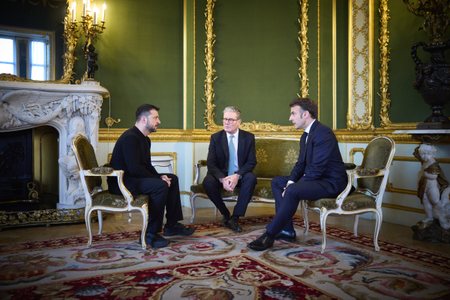
Most of them were scheduled to meet the Ukrainian leader on March 2 in London for a summit on Ukraine hosted by Prime Minister Starmer. Zelensky was to be received with honors by King Charles III at his Sandringham estate.
As a welcome to London on Saturday, Zelensky was presented with a cheque for £2.6 billion (a loan), an advance on the UK's stay.
In a Nikkei Asia article, Trump's peace initiative is portrayed as "forcing Kiev to give up its occupied lands and deny its ambition to join NATO, are closer to appeasement than smart deals."
In the same article, Trump is compared to "British Prime Minister Neville Chamberlain, who proclaimed that he had brought 'peace for our time'." But this ultimately led to the Nazi march into Czechoslovakia in March 1939 and the outbreak of World War II. Similarly, Richard Nixon's 1973 'peace with honor' deal in Vietnam resulted in the fall of Saigon just two years later.
Apparently, in this British-inspired charade (Nikkei owns and channels the Financial Times), Zelensky has been assigned the role of Churchill.
The only dissenting European voices were those of Hungarian Prime Minister Victor Orban, who wrote: “Strong people make peace, weak people make war. Today President Donald Trump stood courageously for peace… Thank you, Mr. President!”
And for a man who may be worried about losing his job, NATO Secretary-General Mark Rutte, who told the BBC he had called Zelensky, said: "I said: I think you need to find a way, dear Volodymyr, to restore relations with Donald Trump and the American administration. This is important for moving forward."
Which European stance and perspective will prevail? This is dictated by reality, not by the will and delusional thinking of Eurocrats like von der Leyen and Kallas or the leaders of Great Britain, France and Germany, just to choose the first three.
Trump's basic peace plan, which does not specify NATO membership for Ukraine, territorial concessions, and no NATO Type 5 security guarantees but relies on repairing US-Russia relations and new security structures for Europe, will either be implemented or there will be continued war ending in Russian victory or, if European NATO forces intervene directly, World War III as Trump has warned.
Europe today does not have military forces capable of successfully confronting a full-scale Russian attack without relying on the US military and the US nuclear umbrella, nor is it likely to ever have such capabilities even with a sustained rearmament program.
Even in the 1980s, when this writer served in the (West) German army, with its peak strength of 500,000 soldiers and 7,000 tanks, it was not even conceivable to defend Western Europe without the U.S. Today it is a dangerous fantasy.
The authoritative German Kiel Institute for the World Economy (IfW) published detailed studies proving this point in September 2024.
Germany did not significantly increase procurement in the year and a half after February 2022 and accelerated it only at the end of 2023. Given Germany’s massive disarmament in recent decades and the current pace of procurement, we find that for some key weapons systems, Germany will not reach its 2004 armament levels for about 100 years. When considering weapons commitments to Ukraine, some German capacities are even declining.
For the record, Germany currently has 180,000 active personnel (61,000 in the army, 27,000 in the air force, 16,000 in the navy, the rest in support staff); 350 main battle tanks compared to 2,398 in 2004; 120 howitzers compared to 978 in 2004; 218 combat aircraft compared to 423 in 2004. It is not currently able to field a single combat-ready division of 20,000.
Other European NATO forces are similarly short of manpower and equipment, with no immediate change on the horizon. This includes the UK. The UK Ministry of Defence last published detailed figures on the number of personnel trained in combat-ready roles in July 2024. British Army: 18,398. Royal Air Force: 21,915.
Meanwhile, according to the International Institute for Strategic Studies, the Russian military is expected to reach its target strength of 1.5 million by mid-2025. The only NATO member besides the US in the same overall class is Turkey, with 511,000 under arms.
The Kiel Institute estimates that Europe will need 300,000 additional troops and an increase of about $250 billion in defense spending to even begin to correct this dire state of military affairs. The spending seems feasible even in the near term; the increase in manpower is not.
And the extremely important role that the US plays in NATO, planning, coordinating and commanding large-scale multinational forces, will not be replaceable for many years. Nor will the US's real-time tactical intelligence and targeting capabilities.
It is hard to believe that even the most belligerent European leaders, speaking grandly about "strategic independence" (such as Germany's Merz) and going it alone, are unaware of these facts.
And the same Merz, so eager to launch German Taurus missiles against Russia, is likely to think twice about such bravery if the US is not around to back him up.
Europe may dream of strategic autonomy once peace is achieved in Ukraine. But it does not have the military capability to challenge or undermine Trump’s peace plan. In reality, no one can. /Adapted from “Pamphlet” by “AsiaTimes”




Lini një Përgjigje