


 Shkruar nga Will Marshall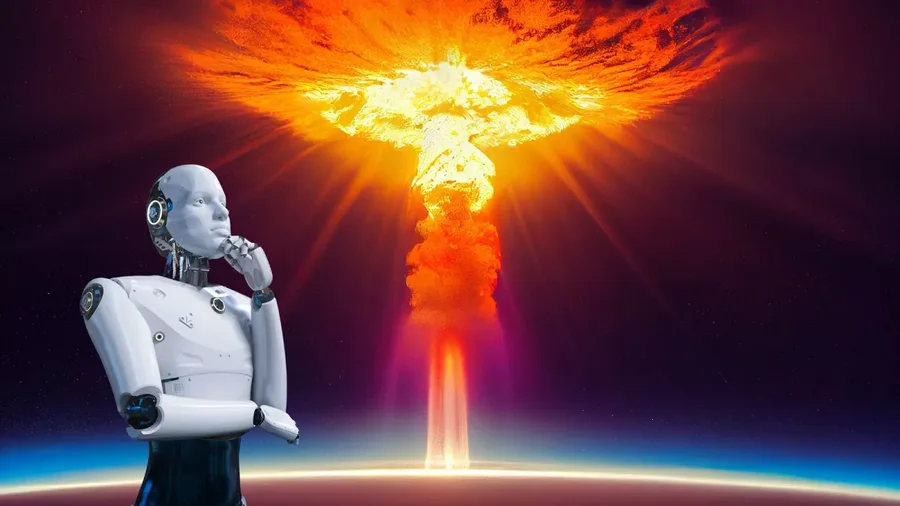
There is also the existential threat posed by the ease of developing biological weapons and the risk that, as artificial intelligence advances, humanity will completely lose control over it...
Artificial intelligence is an extraordinary tool that has the potential to help solve humanity’s most complex challenges. The companies developing the technology view progress as a race. So do countries. Yet many key figures, including the founders of next-generation AI, also openly acknowledge the profound risks it poses.
These risks are not limited to job losses or disinformation, both of which are challenges enough. There is also the existential threat posed by the ease of developing biological weapons and the risk that, as artificial intelligence advances, humanity will lose control of it entirely. Simply put, it is hard to imagine how we can be confident that we will be able to manage something that is, by definition, smarter than us. We have never solved such a challenge before.
While there has been much discussion about this risk, it has so far been woefully inadequate: there has not yet been any international norm, or even a serious, sustainable technical and legal process, in place.
I'm a big advocate of technology in general and artificial intelligence in particular. But the lack of any proper effort to address the existential challenges it poses is striking.
As a new book co-authored by artificial intelligence researcher Eliezer Yudkowsky puts it: If someone builds it, everyone dies. That is indeed dramatic, perhaps too dramatic. A more accurate statement would be “if someone builds it, humanity will most likely lose sovereignty.” That too would be, to put it mildly, unprecedented.
The answer is coordinated international regulation. But a common challenge to such efforts, widely embraced in Silicon Valley and now in Washington, uses a version of game theory: global coordination on AI security would be futile because any agreed-upon controls would be ignored by rogue companies. Keeping American companies alone would allow Chinese rivals to win, and so a no-holds-barred approach is essential to maintaining U.S. technological superiority.
This is a careless reasoning. History provides an important counterpoint. During the Cold War, the United States and the Soviet Union were locked in an uncertain nuclear arms race. There was very little trust on both sides. Yet both countries signed treaties such as the Strategic Arms Limitation Treaty, the Nuclear Test Ban Treaty, and the Intermediate-Range Nuclear Forces Treaty. How? By engaging in decades of complex negotiations.
I don’t see evidence of that level of seriousness today. That needs to change. Stronger track two processes (informal dialogue) are needed between leading thinkers on artificial intelligence both inside and outside global tech companies, and stronger support from key governments. This could create a path through the risks that are presented and craft treaties that can curb the risks.
There is precedent for this. In the 1950s, a group of scientists recognized the dangers of nuclear war and formed the Pugwash Conferences on Science and World Affairs. It began in 1955 with a manifesto by Albert Einstein and Bertrand Russell, signed by nine other prominent scientists, most of whom were Nobel Prize winners. Throughout the Cold War, members from both sides of the Iron Curtain continued to meet, even when their governments were at a standstill. We should be grateful to them for their work in drafting most of the treaties above.
Artificial intelligence is not nuclear; the technology is different, and the developers are mostly companies, not countries. The challenges in verifying development will be complex. But nuclear arms treaties show that it is possible to manage a high-stakes geopolitical race with a rival, even when trust does not exist.
We simply need to accept the task before us and begin the hard work of carrying out the required verification. For example, we could use satellites as we did in the nuclear age and monitor the data centers essential for training the most advanced artificial intelligence models. We could also use inspections and create an agency similar to the International Atomic Energy Agency to do this.
The work to create nuclear weapons treaties took decades. AI leaders today estimate that artificial general intelligence will be a reality within two to 20 years, so even in outward terms we should have started years ago. It took the Cuban Missile Crisis in 1962 to set the nuclear treaty effort in motion. Will we need its AI equivalent to galvanize us, and will we survive it if we do?
The solution is not to give up, but to devote our brightest minds to the complex problems involved. We need to shift our focus from “can we trust each other?” to “how can we verify each other?” The future of technology, and perhaps of humanity itself, depends on us embracing the hard work of creating a verifiable framework for a safe and sustainable future of artificial intelligence.
Technology is outpacing the ability of society's traditional mechanisms to adapt to the challenges it brings. Society therefore needs a new institutional mechanism. The answer? A Pugwash for the digital age mandated by major governments. It must start today./ Adapted from "Pamphlet" by "Financial Times"





Pse e ngopni miletin me marrina?! IA nuk eshte gje tjeter se grumbullimi dhe perpunimi i te dhenave me te mira te inteligjences njerezore boterore. Duke qene e tille nuk ka lidhje edhe nuk do te kete ndonjehere me inteligjencat mbinjerezore qe friksojne dike. Thenia "rri se e hoqa spinen" eshte gjetja me e bukur e momentit...