


 Shkruar nga Pamfleti
A 2020 report from the United States Air Force's National Air and Space Intelligence Center said that if Russia were to successfully field the Burevestnik, it would give Moscow a "unique weapon with intercontinental range capabilities."
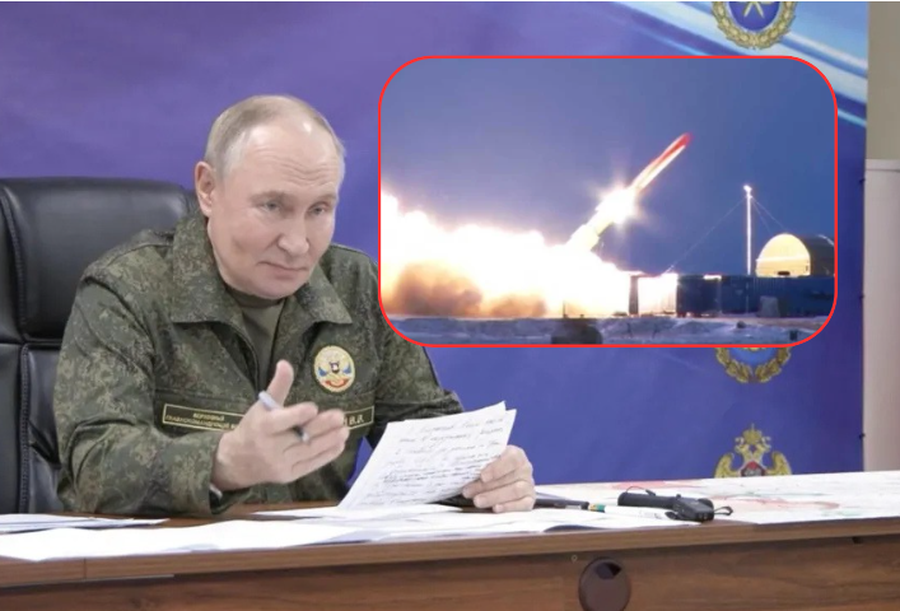
President Vladimir Putin said on Sunday that Russia had tested its Burevestnik nuclear-powered cruise missile.
But what makes this missile so special and invincible, as the Kremlin leader puts it?
The 9M730 Burevestnik, whose name translates as "storm cavity," is a low-flying, ground-launched cruise missile that is not only capable of carrying a nuclear warhead, but is also nuclear-powered.
NATO refers to it as the SSC-X-9 Skyfall.
Putin, who first unveiled the project in March 2018, has said it has an unlimited range and can evade U.S. missile defenses. But some Western experts have questioned its strategic value, saying it would not add capabilities Moscow does not already have and could release radiation along its flight path.
Putin said on Sunday that the weapon was unique. Russia's top general, Valery Gerasimov, chief of the general staff of Russia's armed forces, told Putin that in the Oct. 21 test the missile traveled 14,000 km (8,700 miles) and stayed in the air for about 15 hours.

He said it traveled on nuclear power, could defeat any missile defense, and had an unlimited range.
Its nuclear propulsion is designed to allow it to fly much farther, for longer, than traditional turbojet or turbofan engines that are limited by the amount of fuel they can carry. This would allow it to "loiter" for an extended period before hitting a target.
The Nuclear Threat Initiative, a US-based non-profit security organization, said it could potentially stay airborne for days: "In operation, Burevestnik would carry a nuclear warhead (or warheads), circle the globe at low altitude, evade missile defenses and terrain; and drop the nuclear warhead(s) at a location (or locations) difficult to predict," the 2019 report said.
Some Western experts say that the Burevestnik's subsonic speed would make it noticeable and more vulnerable the longer it remained in flight. Responding to this, Russian military expert Alexei Leonkov wrote in 2019 that the Burevestniks' role would be to eliminate the "remnants" of enemy command posts, military bases, factories, and power plants after Russia had already fired intercontinental ballistic missiles, at which point the adversary's air defense systems would be unable to stop them.
The International Institute for Strategic Studies, citing a Russian military magazine in 2021, said the Burevestnik would have a range of up to 20,000 km (12,400 miles), so it could be deployed anywhere in Russia and strike targets in the United States.
Russian media said the missile's alleged altitude was only 50 to 100 meters, much lower than a conventionally powered cruise missile, which would make it more difficult for air defense radar to detect it.
A 2020 report from the United States Air Force's National Air and Space Intelligence Center said that if Russia were to successfully field the Burevestnik, it would give Moscow a "unique weapon with intercontinental range capabilities."
Experts estimate that it would be launched by a small solid-fuel rocket to feed air into an engine containing a miniature nuclear reactor. The superheated and possibly radioactive air would explode, providing forward thrust.
The Burevestnik has a poor test record with many past failures, according to Western experts. In 2019, at least five Russian nuclear specialists were killed in an explosion and radiation release during an experiment in the White Sea, and U.S. intelligence sources said they suspected it was part of a Burevestnik test. Putin has given their widows high state awards, saying the weapon they were developing was unparalleled in the world, although he did not mention its name. Putin announced a successful test of the missile in October 2023./ Reuters







Lini një Përgjigje