


 Shkruar nga Harlan Ullman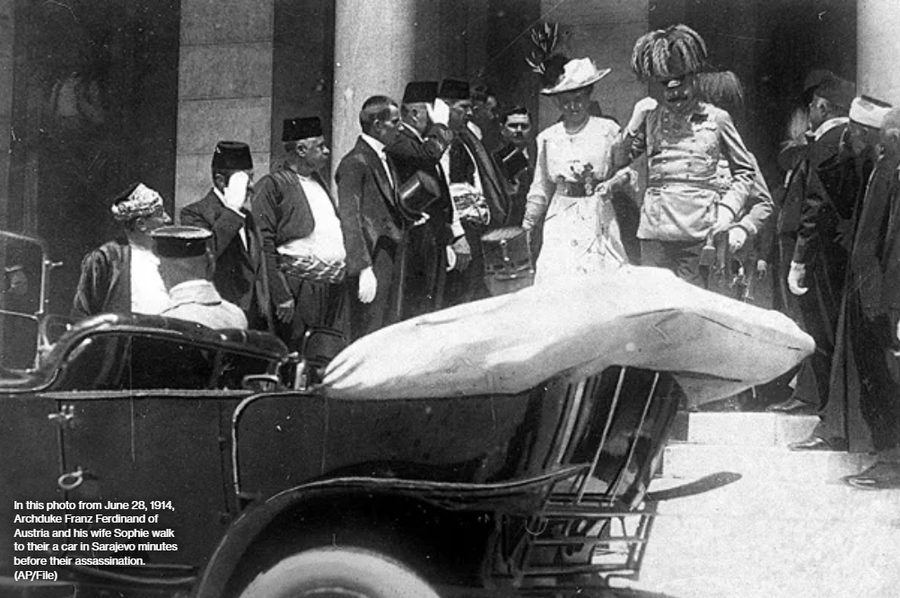
As tensions in the Middle East reach a peak, historical analogies to 1914 warn that a single spark could destroy the global order and ignite a conflict of world proportions.
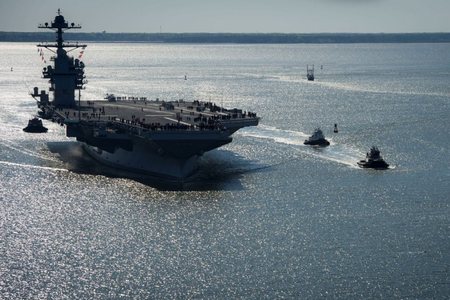
As two US military strike groups gather in the Arabian Sea, the chances of an armed conflict with Iran are very high, although it may be a week before the USS Gerald Ford strike group arrives in position. In fact, there could hardly be a more theatrical occasion to announce or threaten military action against the mullahs than President Trump’s State of the Union address today, unless the Iranians agree to give up their nuclear weapons and stop killing and imprisoning their own citizens.
Unfortunately, other circumstances are emerging that raise disturbing historical parallels. I am referring specifically to June 28, 1914, when Archduke Franz Ferdinand and his pregnant wife, Sophie, were shot and killed on a bridge in Sarajevo by 19-year-old Gavrilo Princip.
This assassination triggered a series of mobilizations among the major European powers, based on the flawed and outdated premises that "whoever mobilizes first, wins" and that Germany could easily and quickly defeat France by using the railways for mobilization.
More than 110 years later, it is not mobilization that is leading us to disaster, but a series of crises that can be ignited into a great fire by a single spark, or even by a coal burning silently.
Look at what is happening to the international security order. As the Trump administration focuses its attention on the Western Hemisphere, defending the country, and keeping China within its first chain of islands in the Pacific, U.S. interest in Europe is fading.
And this is despite statements by Secretary of State Marco Rubio about securing allies at the Munich Security Conference. Moreover, Vladimir Putin’s banker, former Goldman Sachs executive and Harvard and Stanford-educated Kirill Dmitriev, is the main Russian negotiator for ending the war in Ukraine, along with American real estate tycoon Steve Witkoff and Trump’s son-in-law Jared Kushner.
Given these ties, potential economic and trade agreements could become the basis for a political solution. Meanwhile, Europe is increasingly fixated on a resurgent Russia and the possibility that Putin will move militarily towards the West within five years, or perhaps even sooner.
This threat is reinforced by Russia’s more aggressive use of “active measures,” beyond open conflict, to weaken NATO and European alliances. These include violating airspace, using disinformation, propaganda, espionage, and damaging undersea communications cables.
Moscow has declared that, despite any conventional military imbalance, it has an overwhelming numerical superiority in short-range nuclear weapons.
Poland has already talked about developing its own nuclear deterrent force.
Other countries, such as Sweden and Germany, possess the necessary nuclear know-how. Meanwhile, French President Emmanuel Macron and British Prime Minister Keir Starmer have discussed the creation of a joint European deterrent force. Europe has already taken on the burden of supplying and supporting Ukraine, easing the burden on the US in this regard.
China continues its military buildup, while its “borderless partnership” with Russia strengthens Putin’s position. North Korea’s involvement in Ukraine gives it access to Russian drone and submarine technology in return for supplying troops and ammunition.
Although not directly related to the June 28 scenario, Donald Trump's Peace Board could bypass the United Nations by providing an alternative venue for handling conflicts.
Such a rival organization could undermine the legitimacy of the UN, raising the question: Will Trump's involvement in foreign policy be seen as legitimate after he is no longer president?
And that brings us back to Iran and the question: “What if?…” It is understandable why the Trump administration has not signaled what an attack would achieve, how long the military engagement would last, and what the consequences or exit strategy would be.
Another “Midnight Hammer”-style attack, lasting about a day, does not seem to be enough to force the mullahs to accept Washington's terms. However, if the US attacks Iran, will this be a 21st century Sarajevo and a prelude to a wider war?
We can only hope that someone in the US administration is carefully analyzing these critical questions./ Pamphlet from "The Hill"



Lini një Përgjigje