


 Shkruar nga Pamfleti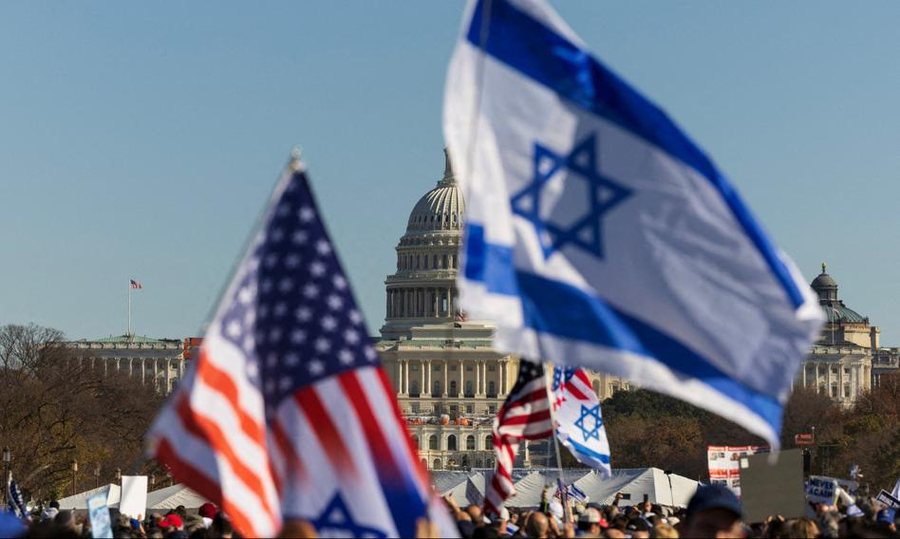
For Israel, no strategic mistake could be more dangerous than breaking with America...
On September 14, after showing Marco Rubio, the US secretary of state, the massive 2,000-year-old blocks of the Western Wall at Jerusalem's holiest site, Benjamin Netanyahu declared that the alliance between their countries is "as strong and as enduring as the stones... that we just touched." Unfortunately, he is wrong.
As Israel isolates itself over its war in Gaza, it is increasingly dependent on America. At the UN General Assembly, old friends including Australia, Britain, Canada and France will recognize a Palestinian state, even as Israel’s settlement expansion in the West Bank makes true statehood less likely. America is the only thing standing between Israel and a status of a pariah that would have dire consequences for its diplomatic, legal and military security.
For all Netanyahu’s careless assurances that relations with America are perfectly strong, they are not. The prime minister has exasperated the Trump administration and is ignoring deep cracks within the alliance’s foundations. Democratic voters have long been turning away from America’s most comfortable ally. Republican voters are increasingly losing trust, too. A sudden loss of American popular support would be a disaster for Israel, a small country of 10 million in a dangerous and hostile neighborhood.
The polls in America are shocking. The percentage of Americans who support Israel over the Palestinians is at a 25-year low. In 2022, 42% of American adults had an unfavorable view of Israel; now that figure is 53%. A recent YouGov/Economist poll finds that 43% of Americans believe that Israel is committing genocide in Gaza. In the past three years, unfavorable views of Israel among Democrats over 50 have risen by 23 percentage points. Among Republicans under 50, support is evenly split, compared with 63% for Israel in 2022. Between 2018 and 2021, the percentage of evangelicals under 30 who supported the Israelis over the Palestinians fell from 69% to 34%. Pollsters think that shift has continued.
To understand why this matters, go back to the years when America’s relationship with Israel was a powerful blend of values and interests. Both are democracies founded by pioneers seeking refuge from persecution. Both believed their country was extraordinary: one a shining city on a hill, the other a light to the nations. At the same time, their interests overlapped. During the Cold War, Israel was a bulwark against Soviet expansion into the Arab world. After the collapse of the Soviet Union, they were still allies against Iran. After the attacks of September 11, 2001, they were united by a hatred of Islamist terrorism.
What went wrong? For Democrats, the fight is about values, especially among young people. Democrats tend to project their frustration with America’s history of slavery and neocolonialism onto oppressed Palestinians and Israeli settlers, though the comparison is strained. This has been exacerbated by a rightward shift in Israeli politics. Moreover, Netanyahu has placed Israel firmly in the Republican camp, in part in the hope that Republicans will attack any Democratic administration that pushes it for settlements or peace talks.
The decline in support among Republican voters has less to do with clashing beliefs than with diverging interests. Anger over the use of taxpayer money to prop up Ukraine spills over into the roughly $300 billion that America has given Israel since its independence in 1948. Israel’s attacks on Qatar and Syria have undermined Trump’s efforts to create regional peace. Led by a president who knows where the money is, some in the donor class are leaning toward the Gulf monarchies.
The war in Gaza has exacerbated this whole situation. When Americans see pictures of starving children, they rightly shudder. Some Republican commentators, like Tucker Carlson, don’t like the idea that Israel could drag America into another Middle East war by attacking Iran. Whenever Israel is criticized, its defenders hurle charges of anti-Semitism, not always fairly. With overuse, a hateful accusation is losing its sting. That’s bad for Jews everywhere, including in Israel.
Optimists will call this a panic attack. The Israeli and American governments have clashed in the past. Their militaries are closer than ever, fighting together in June for the first time against Iran. When the war in Gaza ends and a new Israeli prime minister takes office, Israel’s interest in being close to America will resurface. They say Israel’s rise in the Middle East means America cannot ignore it.
This is complacency. Long-term shifts in public opinion are more dangerous than infighting between governments. Although they are slow to gain momentum, they are difficult to reverse. When voters change their minds, political taboos can suddenly crumble. Even today, some Israeli analysts fear that Joe Biden will be the last instinctively Zionist American president.
The military support is underpinned by a ten-year agreement. The current one, which provides Israel with $3.8 billion a year, expires in 2028 and needs to be renegotiated. But Israel is worried that Trump will refuse to provide the money and is seeking to repackage the deal as a “partnership.” Money is less important than sharing technology and guaranteeing access to advanced weapons, especially in war.
A new vision
It is a mistake to assume that a successor to Netanyahu can fix things. Israel is also a democracy; and it is a divided democracy in which many voters embrace the nationalist-religious right. Gaza will be a constant wound, even when the fighting stops. Powerful factions are determined to expand settlements and annex Gaza and parts of the West Bank.
This week, Netanyahu spoke of Israel as a “super-Sparta,” ready to stand alone. As Israel fights in Gaza and attacks Arab capitals at will, it is betting that military dominance over the Middle East will make it more secure. This muscle-bound, autarkic vision is a tragic misunderstanding. It could eventually alienate its irreplaceable protector. For Israel, no strategic mistake could be more dangerous than breaking with America. /Adapted from “Pamphlet” by “The Economist”







Lini një Përgjigje