


 Shkruar nga Pamfleti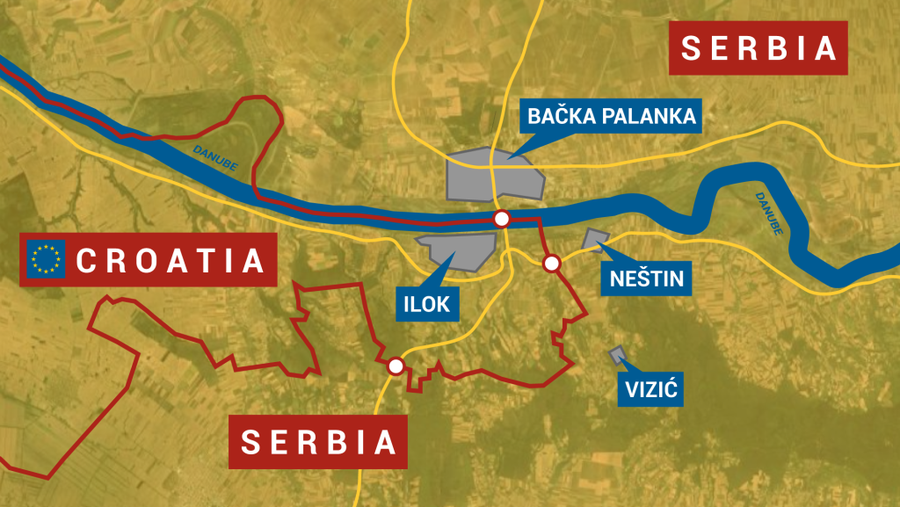
New EES system restricts movement of residents in two Serbian villages near the border with Croatia
The introduction of the European Entry/Exit System (EES) in the Schengen Area has left residents of two Serbian villages without regular access to basic services such as administration, education and healthcare.
While the public debate in Serbia has focused mainly on the impact of this system on business, the greatest consequences are felt in the daily lives of the residents of the villages of Neštin and Vizić, which belong to the municipality of Bačka Palanka.
These villages in the Srem region are located between the Fruska Gora mountain and the Danube river, but are administratively connected to Baçka Palanka on the other side of the river. Between them lies the territory of Croatia, which forces residents to pass through another country to reach their town.
For decades, this daily transit to schools, institutions and health services has taken place without major obstacles. The shortest route passes through the Baçka Palanka–Ilok border crossing, just 9 kilometers from Vizic and 13 kilometers from Nestin.
The situation changed after Croatia joined the Schengen area in 2023 and was further complicated by the entry into force of the EES system. This system digitally records every entry and exit of third-country nationals, implementing the rule of a maximum stay of 90 days within 180 days, writes EWB.
Even though residents only spend a few minutes on Croatian territory and do not actually stay in the Schengen countries, each crossing is counted as a day of stay. This quickly brings them to the permitted border.
"We travel several kilometers to reach our side. Now we have to count how many times we go to the city," a resident told the media outlet "Savremena politika".
According to municipal data, around 240 residents live in Vizic, while 613 in Nestin. Most travel to Baçka Palanka every day for work, school and other services.
Local authorities explain that all administrative and health services are located in the city, while primary and secondary school students attend school there. Currently, eight students from Neštin and five from Vizić attend primary school in the city, while a total of 24 students attend secondary school.
As an alternative, residents are considering other routes, such as passing through Banoštor and then taking a ferry to Begeč. However, this route extends the journey from 9–13 kilometers to 36–42 kilometers and depends on weather conditions and sailing schedules.
The long-term solution remains the construction of a bridge over the Danube near Baçka Palanka, a project that has been promised for years. At the end of last year, a contract was signed in Belgrade with the Spanish company "Centunion" for its construction.
The Ministry of Construction emphasizes that the bridge will be of strategic importance for the Vojvodina region and will improve life on both sides of the river. The 2026 budget foresees around 15 billion dinars for this project, while construction is expected to last four years.
Until then, the residents of Neštin and Vizić remain dependent on a border crossing that functions simultaneously as an international border and a local road.
The coordinator of the National Convention for the EU in Serbia, Bojana Selaković, considers this situation to be a political consequence and not simply a technical one.
According to her, the impasse in the European integration process and the lack of concrete reforms have led citizens to face predictable consequences of European rules.
“The European Union will not change its systems for two Serbian villages, but the candidate country has an obligation to protect its citizens through agreements and infrastructural solutions,” she emphasizes.
Selaković adds that credibility in Brussels is built through reforms and implementation of rules, not through political rhetoric.








Lini një Përgjigje