


 Shkruar nga Pamfleti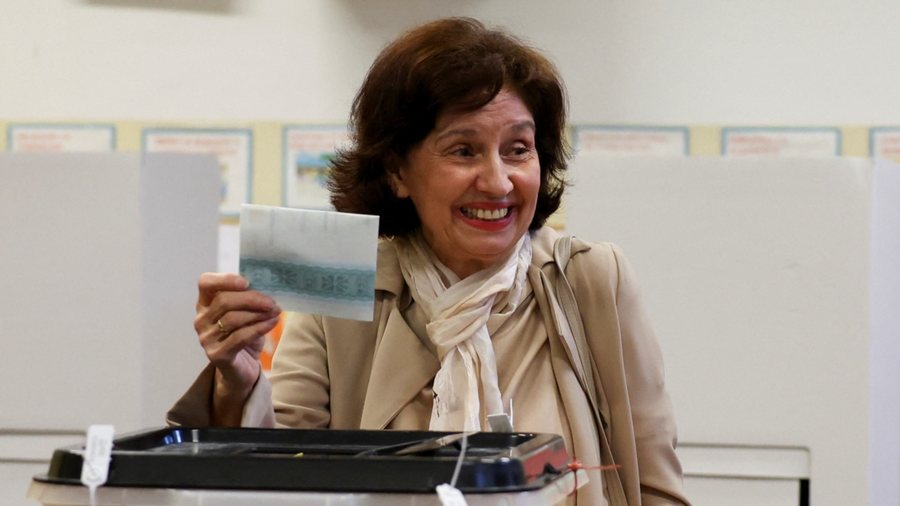
In North Macedonia, on April 24, the citizens voted for the new president of the state.
According to the first results published by the State Election Commission, the candidate of the opposition party, VMRO DPMNE, Gordana Siljanovska-Davkova, is convincingly leading in the race for the first of the state.
According to the published results from 59 percent of the polling stations, Silanovska-Davkova won 197,741 votes or 37.80%. She was VMRO's candidate for president in the 2019 elections.
The candidate for president of the coalition for the European Future, the current president of North Macedonia, Stevo Pandarovski, received 97,592 or 18.66% of the votes.
According to these results, the new president will be elected in the second round of elections, where the two candidates with the most votes will go. This is because in the first round it is required that the president be elected with 50 percent of the votes, with the condition that the participation in the election is over 40 percent of the electorate.
At the same time, these elections have been evaluated as very important for the political parties, since the result they will achieve will be a test for the parliamentary elections, which will be held on May 8, together with the second round of the presidential elections.
Earlier, the SEC said that in the first round of the presidential elections, about 49 percent of eligible citizens voted.
After the polls closed at 19:00, the chairman of the SEC, Aleksandar Dashtevski, said that the election process was conducted in an orderly manner, while the Albanian opposition denounced irregularities in several areas in the municipality of Likova.
According to the State Election Commission (SEC), 1,814,317 voters had the right to vote.
Seven candidates competed in the race for the head of state.
The European Front, under the leadership of the Democratic Union for Integration (BDI) competed with Bujar Osmani, the current Minister of Foreign Affairs. According to the first results, he is third with 81,748 votes or 15.63% of the votes won.
The united Albanian opposition, which makes up the VLEN coalition, took part in the elections with Arben Taravar, the current mayor of Gostivar municipality. He secured 59,591 or 11.39% of the votes.
Maksim Dimitrievski, the mayor of the municipality of Kumanova, Stevçe Jakimovski, the mayor of the Karposh district in Skopje, and Biljana Vankovska, candidate of the "Left" party, were also part of the election race. Of these candidates, Dimitrievski received the most votes, namely 42,296 votes or 8.09%.
Citizens of North Macedonia whom the Radio Free Europe team met at the polling stations on Wednesday while the election process was taking place, said that whichever of the seven candidates is elected, they expect that with his authority he will influence the unblocking of the integration process. in the fight against corruption and stop the trend of young people leaving the country.
As they voted to elect the new president of North Macedonia, they also asked for an increase in the quality of education, so that the new generations with their knowledge can contribute to the development of the country.
Velika Minovska, a pensioner from the municipality of Čairi in Skopje, who voted together with her husband, told Radio Evropa e Lire that it is of particular importance to her that the state moves forward and creates conditions for a life with dignity for the oldest.
"Yes, I voted with the hope that it will get better, we expect that better days will come. We hope that the country moves forward and has perspective for the citizens. A life with dignity even for us older people", said Velika Minovska.
Even Sunaj Iljazi, in his 30s, said that he expects from the presidential elections that North Macedonia will speed up the steps towards membership in the European Union, enabling a better standard for the new generations.
"There should be more jobs for young people. To be a state that has orderly, reliable institutions", he said.
Even Behar Memishi affirmed that he expects from the state president that with his authority he will influence the unblocking of the integration process for North Macedonia:
"We are waiting for the process (of integrations) to be unblocked, we have this request from him (the new president of the state)".
Meanwhile, Zlatko Ardirovski said that he expects the new president to influence the push for money in the fight against corruption.
"I expect (the new president) to do more in solving the problem with corruption at high levels, to insist on creating the conditions for young people to remain in (North) Macedonia by raising the quality of education. This is what I expect from the president of the state, who will be elected", emphasized Zlatko Argirovski from the municipality of Center of Skopje.
Otherwise, according to the legal provisions, in the first round it is almost impossible to elect the president, since a candidate must receive more than half of the votes of those registered on the electoral list, or half of the votes of over 1.8 million voters.
In the second round, the two candidates with the most votes pass, while the winner is elected the candidate who wins more than 50 percent of the votes, provided that more than 40 percent of the electorate turn out for the election.
In all presidential elections so far, a census of at least 40 percent has been ensured.
The electoral campaign lasted 20 days and was accompanied by numerous accusations between the candidates.
The topics that have dominated the campaign were mainly related to European integrations, amending the Constitution to include the Bulgarian minority in its preamble, the fight against organized crime and corruption, the situation in the judiciary and Russian influence in North Macedonia and the region.
At the same time, these elections are considered very important for the political parties, since the result they will achieve will be a test for the parliamentary elections, which will be held on May 8, together with the second round of the presidential elections.
The presidential elections were monitored by 342 local observers, 517 foreign observers and 32 international media.
“This morning, I had the opportunity to visit two polling stations and it was a good start to the day and as you know these are just two of many polling stations across the country. At the end of the day, we will collect information and show how the election process continued. We have more than 200 observers spread across the country. On Thursday, we will hold a press conference where we will give statements about the election process", stated the head of the OSCE mission, Jillian Stirk, earlier in the day.
Meanwhile, the American ambassador to North Macedonia, Angela Ageler, through a message on social networks, said that the citizens should choose the candidate that reflects their expectations for the future of the country.
"They should go out there and elect the candidate who reflects their dreams for the future. Go to the polls because nothing will be achieved by not voting", wrote Ageler on Facebook.
From the Ministry of Internal Affairs and the Prosecutor's Office of North Macedonia, they also supervised the progress of the election process.
The Ministry of Internal Affairs has not disclosed the number of police officers who were deployed at the polling stations, but from this department earlier they said that special attention will be paid to the course of the process in the western part of the country. /REL


Lini një Përgjigje