


 Shkruar nga Pamfleti
If the Russian invasion of Ukraine has shaken the foundations of the international order, a Chinese invasion of Taiwan would lead to a profound global geopolitical realignment, including the end of America's global preeminence.
It is clear that the single greatest threat to American security is not posed by a declining Russia, but by a rising China, which is seeking to replace the US as the world's power.
However, President Biden rightly emphasizes the importance of talks with Beijing, with Defense Secretary Lloyd Austin calling the dialogue "not a reward" but "a necessity" after his Chinese counterpart refused to hold a meeting with him on the sidelines of the Summit. of Security Asia in Singapore.
Yet strangely, the Biden administration avoids dialogue and diplomacy with Russia, thus prolonging the war in Ukraine, which, far from advancing America's long-term interests, is a drain on US resources.
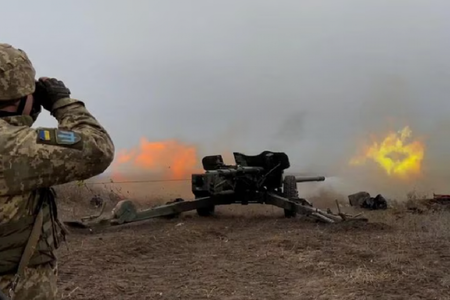
The war is exposing Western military shortcomings, with America's critical munitions running low and the capacity to reload proving insufficient.
The last thing Chinese President Xi Jinping wants is to end the war in Ukraine, because that would leave the US free to focus on the Indo-Pacific.
Biden's strategy is to continue Russia's bloodbath in Ukraine. In fact, Biden's joint communique with other Group of Seven leaders in Hiroshima, Japan, on May 20 committed to "increasing costs for Russia" while pledging "unwavering support for Ukraine as long as necessary."
More ominously, Biden and the other six leaders laid out maximalist demands to end the war in Ukraine, including that Russia "completely and unconditionally withdraw its troops and military equipment from all internationally recognized territory of Ukraine."
But with the conflict devolving into a war of attrition that prevents both sides from making significant advances on the battlefield, a full and unconditional Russian withdrawal is unlikely ever to happen.
In fact, after the official annexation of large areas of Ukrainian territory that it has taken control of, Russia has strengthened its defenses. In their joint statement, Biden and the other G7 leaders also pledged to ensure that "Russia pays for the reconstruction of Ukraine."
In their statement, the G7 states "will continue to take available measures within our domestic frameworks to locate, restrain, freeze, seize and, as appropriate, confiscate the assets of those individuals and entities that have been sanctioned for of relations with Russia."
Not only does the seizure of Russian assets run counter to a rules-based international order, but the maximalist demands put forward by G7 leaders are a recipe for an endless conflict that can only benefit China economically and strategically, while weakens Russia and damages the West.
Meanwhile, CIA Director Bill Burns' recent visit to Beijing shows Biden's efforts to appease China as he ramps up sanctions and military pressure on Russia.
Xi is determined to make China an undisputed world power. Indeed, China and Russia, with important allies such as Iran, are in the process of forming a "Eurasian axis" to challenge the American-led global order, including the dollar's status as the world's main reserve currency.
Against this backdrop, it would be in America's interest to encourage quiet diplomacy to explore ways to enact a ceasefire that is having a negative impact around the world by causing energy and food crises, which in turn contribute to inflation. high and slowing global growth. Meanwhile, Ukraine's imminent launch of its long-planned counteroffensive promises to raise the risk of a direct Russia-NATO conflict.
After more than 15 months of war, it is clear that neither Russia nor Ukraine and its Western allies are able to achieve their main strategic objectives.
In the Korean war, it took two years to reach an armistice agreement. An equally long delay in reaching an armistice agreement in the current war would mean greater bloodshed and destruction, without achieving any significant strategic gains.
A prolonged war in Ukraine will help formalize a Sino-Russian strategic axis, increasing the likelihood of Chinese aggression against Taiwan.
Conversely, a frozen conflict in Ukraine stemming from a ceasefire will keep Moscow worried while leaving America to focus less on Russia, the world's most sanctioned country, and more on a globally expansionist China. Taken from The Hill, adapted from Pamphlet




Lini një Përgjigje