


 Shkruar nga Pamfleti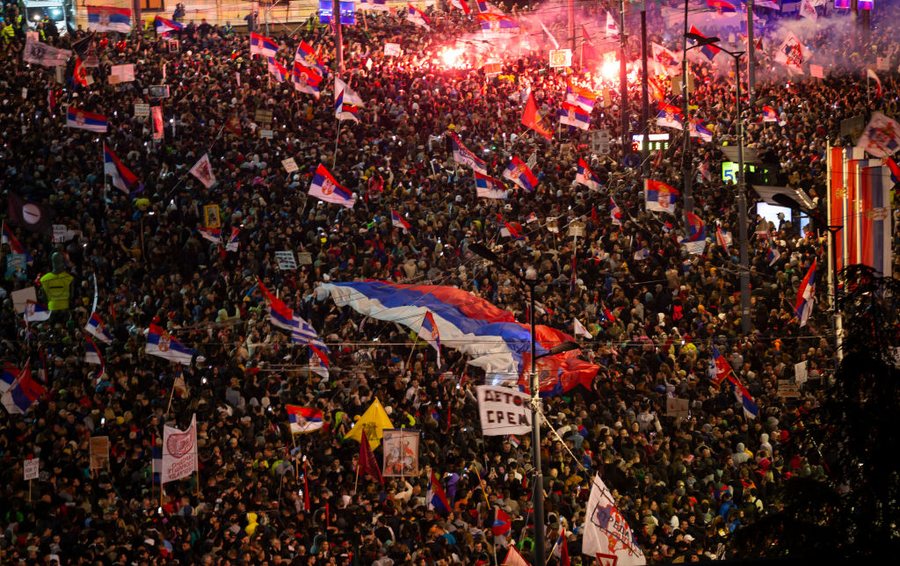
International politics has dictated a desire to prevent Serbia from sliding into Russia's orbit. But this "no intervention" approach is no longer sustainable.
After about a decade in power, authoritarian leaders with many years in power usually face a crossroads: either increase repression, strengthen their clientelistic circle, and squeeze out any remnants of independent media, or respond to opposition calls for reform.
This has been seen many times around the world in the decades since the Cold War. Autocrats almost always choose the first path and become even more harsh. Now, with anti-government protests on the streets of Belgrade, Aleksandar Vučić is faced with that choice.
For eight years as Serbia's president, and before that as prime minister, he has ruled with an increasingly intrusive hand, but still leads a "well-managed democracy" rather than a full-blown autocracy.
Vučić has also played a delicate balancing act in the international arena.
It has maintained fair relations with Moscow, without irritating it where it does not support the European Union and the United States, and has turned a blind eye to Serbian arms sales to Ukraine. On the other hand, it has lured Beijing with billions of dollars in investments in industry and infrastructure.
Although Serbia is still only a candidate for EU membership, Vučić has close ties to the bloc's leaders such as French President Emmanuel Macron and European Commission President Ursula von der Leyen, not least through the lithium card, the untapped resource that European companies hope to use to accelerate Europe's energy independence. He has also built relationships with close associates of Donald Trump during the latter's first presidential term.
This balancing act of Vučić can be taken as an example by states with multiple orientations.
But domestically, his journey is coming to an end, as discontent with his unchecked and unclear rule has turned into protests. The spark was ignited by the collapse of a train station roof in Novi Sad in November, killing 16 people. The opposition blamed the disaster on state corruption, mismanagement and a lack of control, all considered hallmarks of Vučić's regime.
Since November, demonstrators have taken to the streets en masse and have recently been demanding early elections.
Last week marked the most violent protests yet, with clashes with police in several cities. Over the years, Vučić, once seen as a fierce nationalist, has exploited the nationalist sentiments of Serbs in Bosnia and Kosovo to consolidate his power. But now that tactic is losing its effectiveness…
In theory, Vučić could lift restrictions on non-state media, open up the political arena for the opposition, and launch independent investigations into scandals like the Novi Sad station collapse. All of this would also help Serbia's stalled bid to join the EU. But reform is not the autocrat's way: Vučić is following the usual pattern and is cracking down even harder.
The EU and the UK have tolerated it for too long.
International politics has dictated a desire to prevent Serbia from sliding into Russia's orbit. But this "no intervention" approach is no longer sustainable.
Vučić must be encouraged to be more accountable and hold genuinely fair elections; this is also essential for any hope of EU membership. The alternative is for Serbia to slide down the path that Georgia has unfortunately ended up on: becoming a sham democracy over which the EU has no influence and can only react with protest statements.
Meanwhile, the US seems to have left the Balkan field empty for the time being. But Britain and the EU do not! They must act and use their economic leverage.
If they don't, and Serbia goes further down the authoritarian path, the culprit will not only be Vučić, but also the Western backers who turned a blind eye./ Financial Times


Lini një Përgjigje