


 Shkruar nga Pamfleti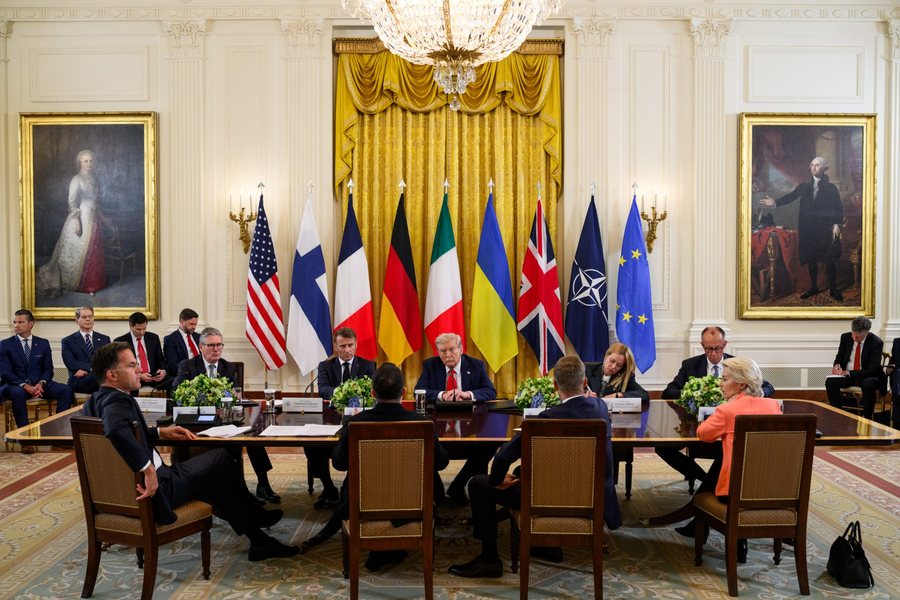
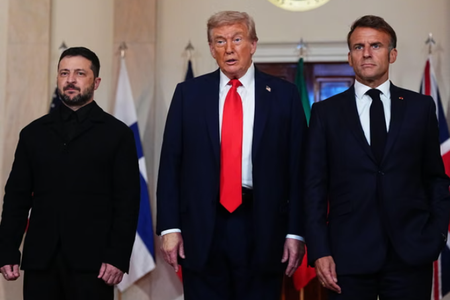
When the six European leaders and Ukrainian President Volodymyr Zelensky entered the White House, they feared they would face the worst: perhaps a public humiliation, or a new threat to abandon Kiev altogether. They got neither.
But the choreography could not mask the weakness of the outcome. There is still no clarity on what security guarantees for Ukraine might look like, no sign of a ceasefire, and little confidence that a Putin-Zelensky summit will ever happen.
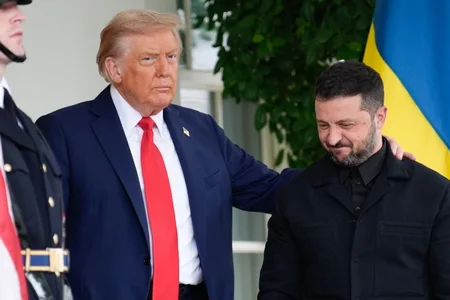
European leaders had headed to Washington with a sense of unease, haunted by the prospect of another televised spat between Trump and Zelensky. Instead, their exchange was, by Trumpian standards, almost graceful.
Likewise, the prospect of a three-way meeting in the Oval Office between Trump, Zelensky, and the six European leaders who joined in to flatter the American president was reassuring. It seemed as if the Europeans had done their part according to Trump's plan, and followed through.
On the other hand, the Europeans went to Washington with three main objectives: to ensure Zelensky's survival, to counter Putin's maximalist demands after Friday's talks in Alaska, and to determine what Western security guarantees could realistically be offered to Kiev.
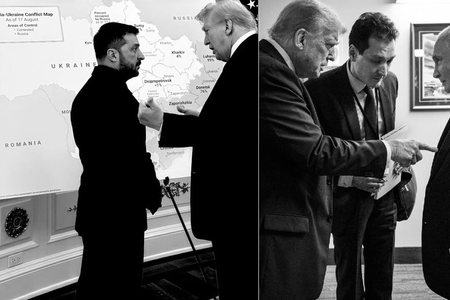
Monday's discussion focused mainly on preparations for a possible trilateral summit between Russia, Ukraine and, possibly, Trump, as well as on security guarantees.
Ukraine had also tried to persuade Trump with a promise to buy $100 billion worth of US-made weapons, financed by Europe, in an attempt to get his commitment to US guarantees, according to the Financial Times.
Meanwhile, public statements subsequently suggest that territorial concessions were, instead, not discussed.
What came out empty? Everything solid.
While Europeans may have breathed a sigh of relief that Trump may have backed the idea of Western security guarantees, their form remains unknown. The details, European officials say, will be carefully worked out, most likely in the coming weeks.
It is also uncertain whether Putin will actually meet Zelensky in person. Finland's President Alexander Stubb told CNN that Trump's decision to call Putin during the meeting had been a "coordinated" move with the Europeans and Kiev and was intended to test the waters for such a summit.
The meeting between the two leaders could take place within two or three weeks, according to several participants in the White House meeting.
US Secretary of State Marco Rubio told Fox News that the US side is "working on it right now, trying to get it ready for them to meet somewhere," while France's Emmanuel Macron cited Geneva as a "neutral place."
The only point that European leaders emphasized in public comments after the exchange of views in the Oval Office was their desire for Trump's help in securing a ceasefire before any further steps.
But the US president was not convinced by this idea: "I don't think you need a ceasefire."
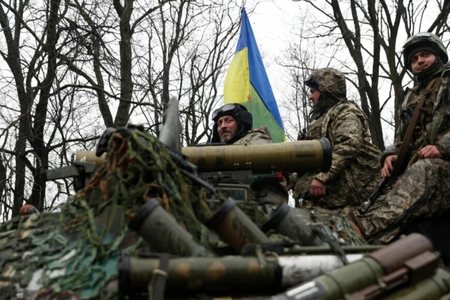
The request also comes at a time when Moscow has made unexpected advances in Ukraine in recent weeks and has shown no signs of stopping its offensive.
EU leaders met virtually on Tuesday at 1:00 p.m. Brussels time to coordinate further steps on security guarantees for Ukraine after Washington.
According to several European officials, a series of meetings between the Coalition of the Willing and national security advisers could follow in the coming days to discuss further details of the European offer to Trump.
Another virtual meeting between Europeans and Trump could also take place as early as Tuesday or later this week. /Adapted from EurActive/


Lini një Përgjigje