


 Shkruar nga Robert Shrimsley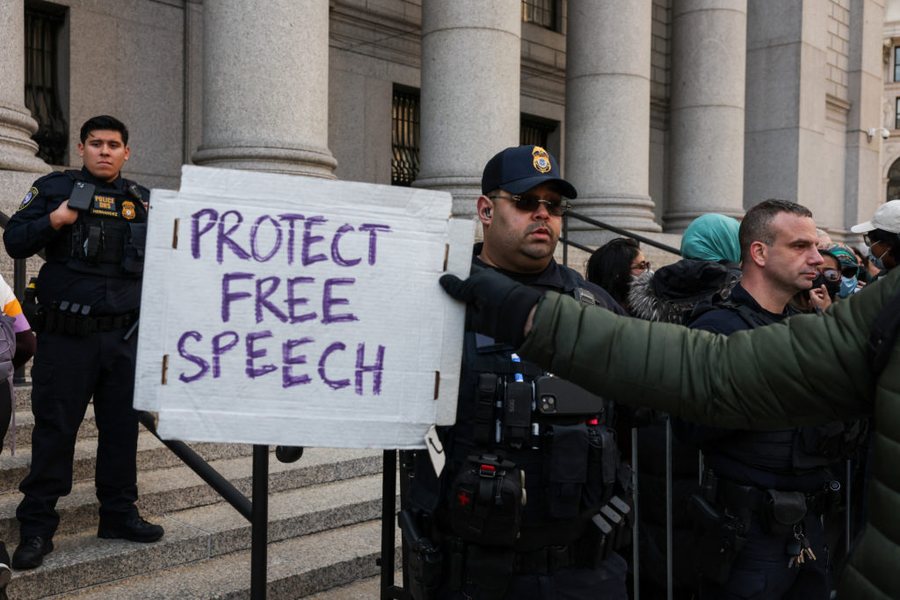
A comedy writer, Graham Linehan, was arrested by armed police officers at Heathrow Airport for offensive anti-trans posts on X...
Donald Trump's Republican Party has always created an unlikely defender of free speech, of political freedoms in general. His vice president, JD Vance, was right about the increasing censorship in the UK and Europe, but it was well-behaved by the team that tried to overturn the election result and promised to persecute their opponents.
So it's no surprise that their response to the deplorable killing of Charlie Kirk has been to reject this principle. Pam Bondi, Trump's attorney general, said she would "absolutely target" those who engage in "hate speech," comments that are seen as cover for further attacks on liberal groups.
Vance supported Bond's call for businesses to be pressured to fire employees who said "horrible things" about Kirk's death. Individuals certainly deserve scorn, but isn't this the cancel culture the vice president is using to criticize? Meanwhile, in the United Kingdom, former Prime Minister Liz Truss, a self-proclaimed free speech absolutist, called for Oxford University to expel a prominent student for joking about the murder.
The mercy in all this is that Vance and his friends are not wrong about the challenge. For when people cannot defend their case through legal debate, they turn to other, less acceptable methods.
At least Americans have the First Amendment. Britain, which Trump flew to this week, offers endless examples of the cold shoulder on free speech. You don’t have to approve of individuals to see the problem. A comedy writer, Graham Linehan, was arrested by armed police officers at Heathrow Airport for making anti-trans insults on X. A protester was prosecuted for holding a banner that described Rishi Sunak as a “coconut.” A professor was chased from her university by transgender rights activists and indifference from colleagues, a pattern across Western campuses where intolerance is disguised as progressive values. Police regularly show up at doorsteps after complaints about offensive social media posts. The response to the Linehan case has finally prompted discussion of a review, with ministers urging the police to focus “on the streets, not the tweets.”
But that's only one aspect of the battle. Many on the right fear that a new definition of Islamophobia will create a secret blasphemy law. In London, a man was prosecuted for burning a Quran, silly and unpleasant, but a crime?
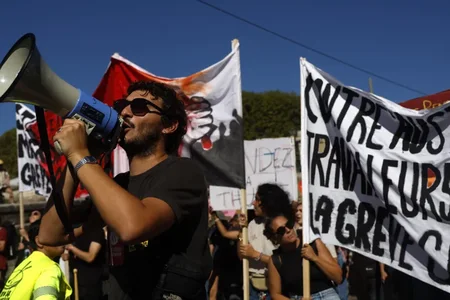
Of particular note are the 850 people arrested for protesting against the banning of Action for Palestine as a terrorist group. Their crime: waving banners that said "I support Action for Palestine."
Two factors have changed the landscape. The first is the expansion of hate crime laws. Measures originally designed to crack down on racially motivated crimes have spread to other protected groups and have morphed into broader control of speech, with public order laws also being used to treat offense as a crime. The second is the role of social media in mobilizing bigotry and misinformation at an alarming rate. Elon Musk has turned X into a channel of racial hatred. TikTok is delivering lies and untruths to thousands of people.
Not all the causes are clear. After the murders of three young girls in Southport, fake social media posts fuelled racially motivated riots and arson. In the ensuing crackdown, Lucy Connolly, whose inflammatory post on X added fuel to the fire, was among those jailed. She pleaded guilty to inciting racial hatred, but her imprisonment gave her the status of a martyr on the right.
Part of the right’s focus stems from self-interest, particularly the social media bans that were once imposed on its leading figures, including Trump. Often their causes were the ones they kept quiet about. In the UK, tech companies have also blocked an Online Safety Act designed primarily to keep harmful content away from children.
It would be nice to end with a set of clear solutions. But social media has changed the calculus, and questions come more easily than answers. How does a country protect free speech while protecting itself and its minorities? If the risks are greater, should the rules be stricter? Trump has vowed to protect American tech companies, but can governments indefinitely ignore a man like Musk who uses his platform to undermine democracy and foment revolt?
Reasonable people accept the need to protect children, to prevent fraud and defamation, and to stop incitement to violence. But the pendulum has swung too far against freedom, and a new balance is needed. There is no right not to be offended. More clarity is needed on what constitutes incitement at a time when a single post can spread fear and mobilize thousands of people.
Kirk argued that gun deaths were the cost of the right to bear arms. His views were often hateful, but he paid the ultimate price by defending his principles in the debate. Perhaps those of us who see freedom of speech as the best guarantee of other human rights should tolerate more offense as the price of our freedom.
I prefer a maximalist approach to free speech, not only because it exposes the true nature of people, but a clear choice is that any restrictions on debate should be ones that we feel comfortable seeing enforced by any shade of government.
What makes Republican and Conservative hypocrisy so depressing is that, at a time when free speech in the West needs vigilant defenders, its self-proclaimed champions have revealed themselves to be the partisans they claim to be. But perhaps the only surprise is their lack of pretensions. / Adapted from “Pamphlet” by “Financial Times”



Lini një Përgjigje